How Long Does It Take to Read the Bible in a Year?
By Dom · · 10 min read
Every January, a lot of people commit to reading the Bible in a year. By March, most have stopped. The reason is almost never a loss of faith. It is that nobody told them what the commitment actually costs, so they guessed, guessed high, and quit the first week the guess turned out to be wrong.
So here is the real number, with the arithmetic shown. Reading the Bible in a year takes about nine minutes a day if you read the Protestant canon at an ordinary pace. If you read the Catholic or Orthodox canon, it is a little more. Below is exactly where those figures come from, why most published estimates run high, and what actually makes people finish.
Key takeaways
- About nine minutes a day covers the Protestant canon in a year: 724,811 words over 365 days is 1,986 words a day, roughly nine minutes at 220 words per minute.
- The Catholic canon takes about 10.3 minutes a day and the Orthodox canon about 10.9, because both include books the Protestant canon does not.
- Most published estimates say 12 to 20 minutes. They are usually rounding up, or quietly including study and reflection time on top of the reading.
- A 90-day plan is roughly 36 minutes a day. Faster is not automatically better, and the pace you finish beats the pace you admire.
- The number that matters is not your daily minutes. It is how many days you skip, and how you handle the first one.
The arithmetic, shown
The totals underneath this pacing are worth seeing on their own: how many words are in the Bible, canon by canon, and why no two published figures agree.
Two numbers give you everything: how many words are in the Bible, and how fast you read.
The Protestant canon runs 724,811 words. Divide that by 365 and you get 1,986 words a day. Adult reading speed for ordinary prose sits around 200 to 250 words per minute, and 220 is a fair middle. Divide 1,986 by 220 and you land on 9.0 minutes a day.
That is the whole calculation. No rounding for comfort, no padding for a devotional you might or might not read.
Where it changes is the canon. Catholic and Orthodox Bibles include books the Protestant canon does not, so the same year covers more text.
| Canon | Total words | Words per day | Minutes per day |
|---|---|---|---|
| Protestant | 724,811 | 1,986 | 9.0 |
| Catholic | 828,590 | 2,270 | 10.3 |
| Orthodox | 879,155 | 2,409 | 10.9 |
The spread between the shortest and longest plan is under two minutes a day. If you have been putting off a Bible-in-a-year plan because you were not sure which tradition's canon you should use, that decision costs you less time than deciding about it has.
Why most estimates say 12 to 20 minutes
Search this question and you will mostly find answers between 12 and 20 minutes a day. Those are not wrong so much as measuring something else. Three things inflate them.
- Rounding up on purpose. Twelve is a friendlier number to promise than 9.0, and it builds in a buffer so nobody feels cheated on a slow day.
- Audio, not reading. A full audio Bible runs around 75 hours, which is about 12 minutes a day. Listening is genuinely slower than reading, because narration is paced for comprehension rather than speed.
- Study time folded in. Plans that quote 15 or 20 minutes usually assume you will also read a devotional, answer a question, or journal. That is a fine way to read. It is just not the same measurement.
Crossway made a version of this point well in an infographic on how much of the Bible you can actually get through: the gap between what people assume the commitment costs and what it costs is usually the thing standing in the way.
What other paces cost
A year is the common plan, but it is not the only one. The same 724,811 words simply compress.
| Plan length | Words per day | Minutes per day | Who it suits |
|---|---|---|---|
| 365 days | 1,986 | 9.0 | Almost everyone, and the only pace most people sustain on a bad week |
| 180 days | 4,027 | 18.3 | A second pass, or a reader who already has a daily slot |
| 90 days | 8,053 | 36.6 | An immersive sprint, usually done once for the big picture |
Published 90-day schedules bear this out. The CSB Bible in 90 Days reading schedule assigns roughly twelve chapters a day, which is a genuinely different kind of commitment from one.
The 90-day plan is worth understanding rather than dismissing. Reading that fast changes what you notice: you feel the shape of the whole story, the long arc from Genesis to Revelation, in a way that nine minutes a day cannot give you. It is also 36 minutes every single day for three months, which is a real commitment and the reason most people who attempt it do not finish.
If you are choosing, choose the pace you will still be keeping in week eleven. Almost nobody regrets going slower. Plenty of people quit going faster.
Nine minutes is not the hard part
Here is the uncomfortable thing about all of this arithmetic: it solves a problem most people do not actually have.
Lifeway Research found in its February 2026 study that fewer than 1 in 3 churchgoers read the Bible daily, a figure that has barely moved since 2019. These are people already attending services. Time is clearly not the binding constraint.
Nine minutes is not a scheduling problem. You spend more than nine minutes deciding what to watch. The reason a Bible-in-a-year plan fails is almost never that the daily reading was too long. It is that a day got missed, then a second, and by the fourth the plan felt like a debt rather than a practice, so it got quietly abandoned.
This is not a niche problem. The American Bible Society tracks exactly this gap in its annual State of the Bible research, which consistently finds a large group of people who own a Bible, believe it matters, and rarely open it. The obstacle is not conviction.
That means the useful question is not how long does it take. It is what happens on the day I miss. A plan that punishes the miss loses you. A plan that absorbs it keeps you. We wrote about the mechanics of that in why streaks make people quit and what grace days do differently.
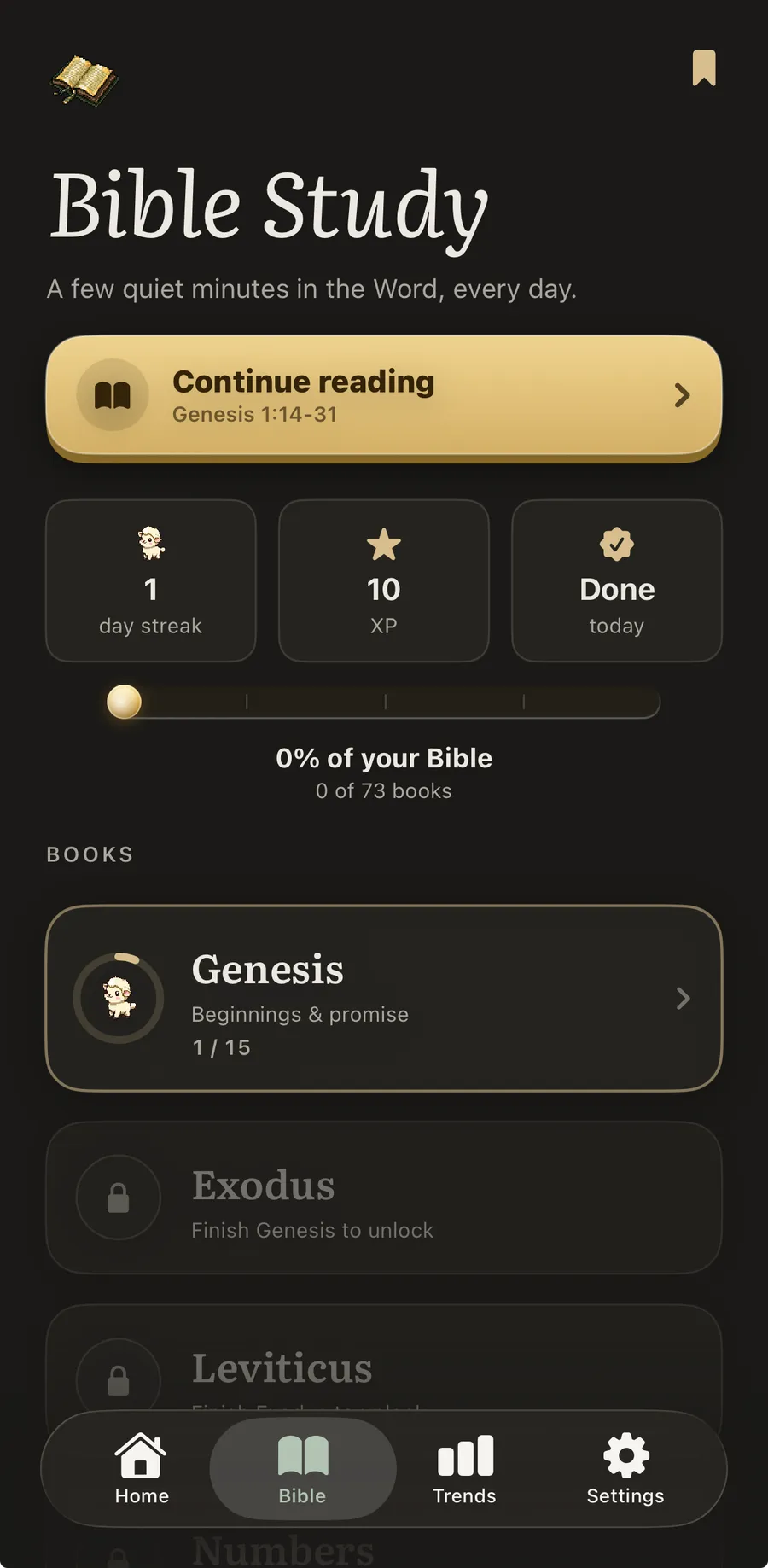
Nine minutes only works if the reading is already there when you sit down. BlessUp puts the day's chapter in front of you, computes the pace for your tradition's canon, and holds your place across the days you miss. Reading it is also what opens Instagram, which turns out to be the part that makes it stick. Day one is Genesis 1 to 3. See how the reading gate works.
How to make the nine minutes actually happen
Four things separate the people who finish from the people who mean to.
- Attach it to something you already do. Not a time of day, an existing action. "After I start the coffee" survives a schedule change. "At 7am" does not.
- Decide in advance what a missed day means. Before you start, settle it: one missed day is covered, you pick up where you left off, you do not double up. Making that call in advance keeps a bad Tuesday from ending the year.
- Do not catch up. The instinct after missing three days is to read four portions at once. It almost always fails and it teaches you that the plan is a burden. Skip ahead to today and keep going.
- Remove the decision. The reading should be waiting for you. Any morning that begins with "where was I" is a morning you might not read.
Reading with other people helps more than any plan does. If you are not currently part of a congregation, the BlessUp church finder lists churches by US city.
If you are not sure a full year is the right starting point, where to start reading the Bible walks through the smaller entry points first.
If the reason you have not started is that the phone keeps winning the morning, that is a different problem from the arithmetic, and screen time as a spiritual problem is the more useful place to take it. The mechanics of a gate that reads a chapter first are covered in how the BlessUp app lock works.
What Scripture says about the daily part
The instinct to make Scripture a daily rhythm rather than an occasional event is not a modern productivity idea. It runs through the text itself.
Of the law, Joshua was told: "Keep this Book of the Law always on your lips; meditate on it day and night" (Joshua 1:8, NIV). Day and night is a rhythm, not a marathon.
The Bereans in Acts are commended for the same habit: they "examined the Scriptures every day" (Acts 17:11, NIV). And the first Psalm describes the blessed person as one who meditates on the law "day and night" (Psalm 1:2, NIV), using the image of a tree planted by streams of water. Trees do not grow in sprints.
The honest summary
Nine minutes a day, ten and a half if your canon is larger. That is what a year through the Bible costs, and it is less than nearly every published estimate because most estimates are measuring reading plus something else.
The number is small enough that it stops being a useful excuse, which is the real point of doing the arithmetic. What is left is the harder and more interesting question: not whether you have nine minutes, but whether the nine minutes will still be there in March. That is a question about what happens when you miss, not about how fast you read.
If this is your first time through, the practical question is less about total minutes and more about which plan shape survives a normal week. A beginner's plan has its own considerations, and the 2027 plan comparison lays the four common shapes side by side.
Frequently asked questions
How many words are in the Bible?
The Protestant canon is 724,811 words. The Catholic canon runs 828,590 words and the Orthodox canon 879,155, because both include books the Protestant canon does not. Word counts vary slightly by translation, since some render the same passage more concisely than others.
Is nine minutes a day really enough to read the whole Bible in a year?
Yes, for the Protestant canon. It is straightforward arithmetic: 724,811 words divided by 365 days is 1,986 words a day, and at 220 words per minute that is about nine minutes. Larger canons take a little longer, around 10.3 minutes for Catholic and 10.9 for Orthodox.
Why do other Bible reading plans say 12 to 20 minutes a day?
Usually because they are measuring something slightly different. Some round up to build in a buffer, some quote the length of an audio Bible, which runs about 75 hours or roughly 12 minutes a day, and many include devotional reading, journaling, or study questions on top of the Scripture itself.
How long does it take to read the Bible in 90 days?
About 36 minutes a day for the Protestant canon: 8,053 words daily at a normal reading pace. It is an immersive way to see the whole arc of the story at once, but it is a substantial daily commitment and most people who attempt it do not finish.
What happens if I miss a day of my Bible reading plan?
Nothing, as long as you decide in advance not to treat it as a failure. The most reliable approach is to skip ahead to the current day rather than trying to catch up on what you missed. Doubling up turns the plan into a debt, and debts get abandoned.
Genesis to Revelation, about nine minutes at a time. Start tomorrow morning.
No guilt. Ever. Grace is built in. Funded by readers, never by ads.