Why Streaks Make People Quit, and What Grace Days Do Instead
By Dom · · 11 min read
You read every day for forty-one days. Then a Tuesday goes sideways, you go to bed without opening the app, and the number resets to zero.
What happens next is the part worth understanding. Most people do not start again at one. They stop entirely. Not because forty-one days of reading suddenly stopped counting, but because the streak had quietly become the point, and the streak is gone. This is a design problem, it is a well-documented one, and it has a fix.
Key takeaways
- Breaking a streak costs you two things at once: the day you missed, and the meta-goal of the unbroken run. That double loss is why it stings out of proportion.
- The common pattern designers report is that people who break a strict streak do not rebuild, they leave. The break is not a dip, it is an exit.
- The fix is a recovery mechanism: a grace day, streak freeze, or flexible rule that absorbs one miss without a reset.
- A grace day must refill slowly or it stops meaning anything. In BlessUp it returns after three kept days.
Why one missed day hits so hard
On paper, missing one day out of forty-two is a rounding error. It should feel like nothing. It does not, and there is a structural reason.
A streak has you pursuing two goals at once. The first is the behavior: read today. The second is the meta-goal: keep the run alive. Miss a day and you fail both at once. The behavior loss is small. The meta-goal loss is total, because a streak is the one kind of goal that cannot be partially kept.
Then a second thing happens, and it is the more damaging one. The reset does not just cost you a number, it offers you a story about yourself. A counter reading zero is easy to read as evidence that you are not the kind of person who keeps this up, which is a far heavier conclusion than one skipped evening can support.
The all-or-nothing spiral
Once the streak is broken, a familiar thought shows up: I already broke it, so today does not matter either.
This is the mechanism that turns one missed day into a finished habit, and anyone who has built a streak-based product will recognize the shape of it: the people who lapse mostly do not come back and start again at one, they stop opening the app. The value of today's reading has not changed at all. But the framing has. Before the break, today was day forty-two of something. After the break, today is day one of a thing you have already failed at once, and that is a much less appealing offer.
What the research actually shows
Streaks are not a con. They genuinely work, and it is worth being fair about that before criticizing them.
Researchers have looked at this directly. A qualitative study of streaking as a behavior change technique interviewed 21 recreational runners whose streaks ran from 100 days to more than 4,500. The commitment structure clearly did real work for them: it removed the daily negotiation about whether to go, and it created an identity worth protecting.
It also surfaced the cost. Participants described running through injuries and skipping recovery rather than break the run, and reported real stress when ordinary life disrupted the routine. One put the fear plainly: breaking the streak "might be the start of the beginning of the end or falling apart."
That sentence is the whole problem in one line. The streak had become load-bearing, so its loss threatened something much larger than a day of running. Notably, the study's authors flag the consequences of a streak actually breaking as understudied and worth future research, which is worth saying plainly: the upside of streaks is better evidenced than the downside. What follows is an argument from design and from experience, not from a settled literature.
Which points at the actual design question. Not whether to use streaks, but what your product does on the day someone misses.
What one missed day actually costs
There is a direct answer to this, and it is not the one streak counters imply.
In a study published in the European Journal of Social Psychology, Phillippa Lally and colleagues at University College London had 96 volunteers each adopt a new daily behavior and rate how automatic it felt every day for twelve weeks. Two findings matter here. First, the time to reach 95 percent of a person's own ceiling of automaticity ranged from 18 to 254 days, so there is no universal number and anyone quoting you one is rounding off enormous individual variation.
Second, and more to the point: missing one opportunity to perform the behaviour did not materially affect the habit formation process. That is the researchers' own wording.
Read that against a counter resetting to zero. The habit was not harmed. The number says it was. A strict streak is therefore not measuring your habit, it is measuring something else and then reporting it to you as though it were your habit, which is the precise reason the reset does damage the habit: not through the missed day, but through the story the reset tells you about it.
Self-compassion is not the soft option
The instinct after a broken streak is to get stricter. Set an alarm, promise not to let it happen again, treat the miss as a discipline failure.
That instinct performs worse than its opposite. In a set of four experiments published in Personality and Social Psychology Bulletin, Juliana Breines and Serena Chen found that self-compassion after a failure increased motivation to improve, including more time spent studying after a failed test, compared with self-criticism. The finding is counterintuitive and it is robust: being hard on yourself after a lapse tends to reduce the effort you put in next, not increase it.
Treating a missed day as information rather than a verdict keeps you in problem-solving mode. Tuesday went badly because you had an evening event and no plan for it. That is a solvable fact. "I am not disciplined enough" is not solvable, and it is not even true.
For Christians there is a second reason this matters, and it is not a metaphor. A habit built on guilt about missing time with God has the relationship backwards from the start. Grace is not a lenient setting on an otherwise strict system. It is the actual terms.
What a grace day is
A grace day is a stored allowance that absorbs one missed day automatically. You wake up, you did not read yesterday, and the streak is intact. Nothing was lost, nothing needs catching up, and there is no negotiation to have with yourself.
The design has one hard requirement: it has to refill slowly. A grace day that regenerates every day is not a grace day, it is an every-other-day habit with a nicer number attached, and it will not build anything.
BlessUp's rule is that grace refills after three kept days in a row. That single constraint does the necessary work.
| Approach | On a missed day | Effect on the reader |
|---|---|---|
| Strict streak | Counter resets to zero | Sharp loss, high chance of abandoning entirely |
| Unlimited grace | Always covered | No signal at all, so the streak stops meaning anything |
| Grace that refills slowly | Covered once, then earned back over three kept days | The miss is absorbed, but consistency still has to be real |
Work through the third row and you see why it holds. Alternating one day on, one day off cannot sustain a streak, because grace never gets the three consecutive days it needs to return. The allowance covers a bad week. It cannot become the plan.
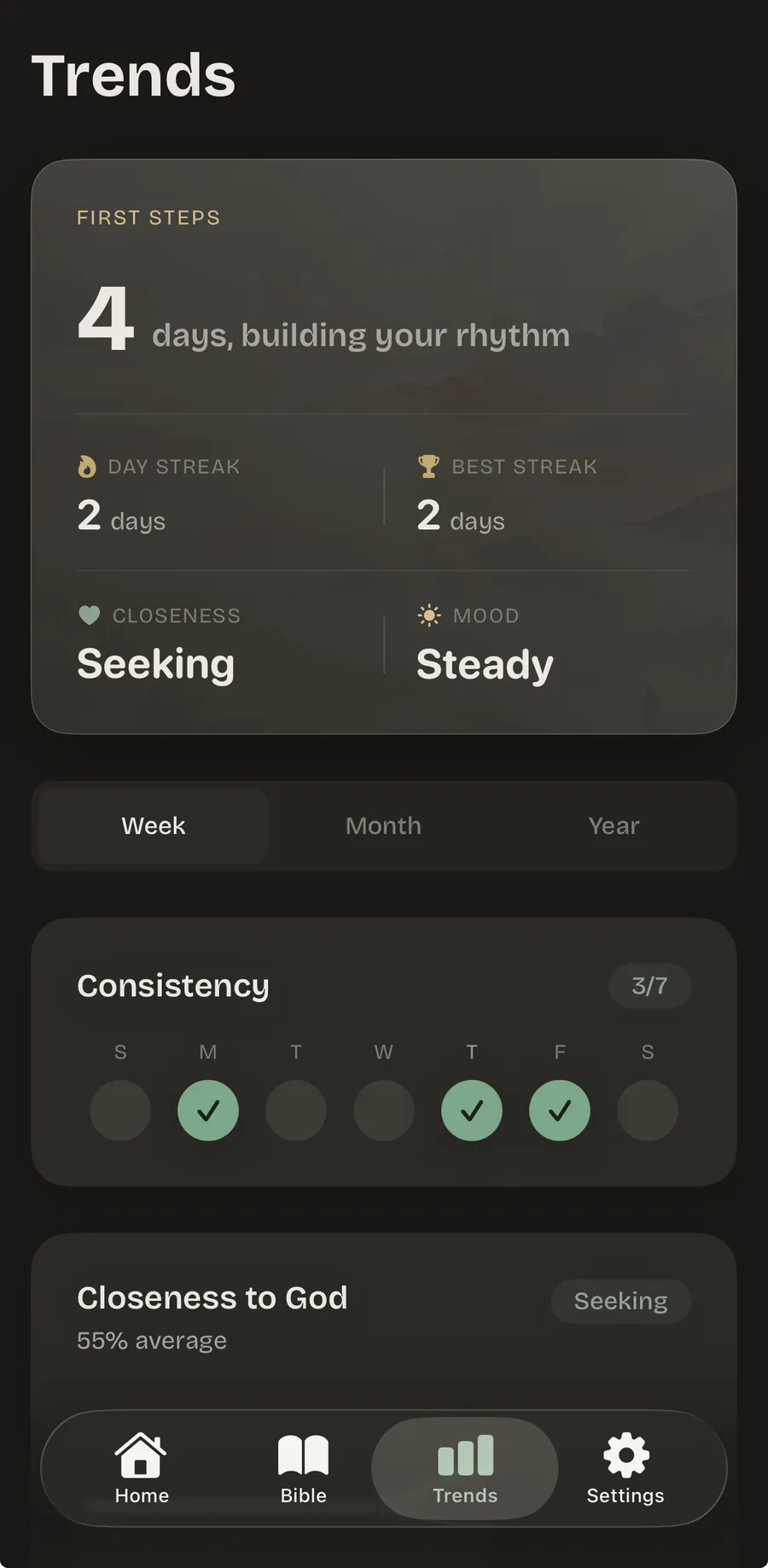
This is why the streak in BlessUp is built the way it is. Reading or prayer both keep it alive, one missed day is covered automatically, and grace refills after three kept days so it never becomes a loophole. The morning after a miss, the app says: your place is held, yesterday was a grace day, nothing was lost. See how grace days work.

What to do if you just broke one
If you are reading this the morning after a reset, four things are worth doing in order.
- Do not catch up. Reading four chapters today to make up for three missed days converts your habit into a debt. Skip to today's reading and continue.
- Name the actual cause. Not "I lost discipline." What specifically happened on Tuesday, and what would need to be different for that Tuesday to work?
- Do today's smallest version. One chapter. Not a recommitment, not a new plan, not a fresh start on Monday. Today, small.
- Count total days, not consecutive ones. Forty-one days of reading happened. They are still true. A counter is not a ledger of your relationship with God.
It also helps to know what normal actually looks like. Lifeway Research found in February 2026 that fewer than 1 in 3 churchgoers read the Bible daily, a share that has barely moved since 2019. A broken streak does not move you from exceptional to failing. It moves you from one good week to the next one.
And it helps enormously to have someone who knows what you are doing. If you are not currently part of a church community, the BlessUp church finder lists churches by US city.
If the deeper problem is that mornings keep getting away from you, building a morning routine that survives a bad week is the more useful place to start than any streak mechanic.
The same logic applies to a reading plan. A year through the Bible is about nine minutes a day, which is easy. Staying with it through a bad March is the part that needs a design, not a resolution. And if you have not started yet, where to start reading the Bible comes first.
What Scripture has to say about the missed day
The idea that faithfulness is a clean unbroken line is not something the Bible teaches. It is much more honest than that.
Lamentations puts it plainly: "Because of the LORD's great love we are not consumed, for his compassions never fail. They are new every morning; great is your faithfulness" (Lamentations 3:22-23, NIV). New every morning is a reset that works in your favor rather than against you.
Proverbs is realistic about how this goes: "for though the righteous fall seven times, they rise again" (Proverbs 24:16, NIV). Seven times. Not once, with an apology.
And Paul's description of his own progress is not a streak either: "forgetting what is behind and straining toward what is ahead, I press on" (Philippians 3:13-14, NIV).
The design principle underneath all of this
A habit tool has one job on the day you succeed and a much harder job on the day you fail. Most tools are built entirely for the first day.
The measure of a streak system is not how good it feels on day forty-one. It is whether you are still reading on day forty-three. That depends almost entirely on what the product said to you on day forty-two, and whether it treated one hard Tuesday as information or as a verdict.
The other half of finishing is choosing a plan with slack in it to begin with. The 2027 plan comparison is honest about which shapes leave room for a bad week and which do not.
Frequently asked questions
Why does breaking a streak feel so demotivating?
Because you lose two things at once. You miss the behavior itself, which is small, and you fail the meta-goal of the unbroken run, which is total, since a streak cannot be partially kept. The reset also invites you to read one missed day as evidence about your character rather than about that day.
What is a grace day?
A grace day is a stored allowance that automatically covers one missed day so your streak stays intact. You do not have to catch up or make anything up. In BlessUp, grace refills after three kept days in a row, so it can absorb a bad week without becoming the plan.
Are habit streaks bad?
No. Research on streaking as a behavior change technique finds it genuinely helps, largely by removing the daily negotiation about whether to act. The problem is not the streak, it is what a product does on the day you miss. A streak with no recovery mechanism turns its own strength into a cliff.
Should I catch up on missed days in a Bible reading plan?
Usually not. Doubling up turns the plan into a debt, and debts get abandoned. Skip ahead to the current day and keep going. The goal is a habit that survives, not a ledger that balances.
Does prayer count toward a BlessUp streak, or only reading?
Both. The streak in BlessUp is unified, so a day with reading or a day with prayer keeps it alive. That is deliberate, because a system that only counts one kind of faithfulness will eventually punish you for the other.
Grace is built in. A missed day never sets you back.
No guilt. Ever. Grace is built in. Funded by readers, never by ads.