The Best Bible Reading Plan for 2027
By Dom · · 8 min read
Every December, a wave of Bible reading plans arrives promising that next year will be different. Most of them are the same plan with a new cover. The useful question is not which plan is best in the abstract, it is which shape of plan matches how you actually read, and what each one costs you per day in real minutes.
Key takeaways
- There is no single best plan. There are four common shapes, and the right one depends on why you stalled last time.
- A one-year canonical plan runs about nine minutes a day for the Protestant canon, 10.3 for Catholic and 10.9 for Orthodox.
- Chronological plans fix confusion, not motivation. If you quit from boredom, they help. If you quit from busyness, they do not.
- January 1 is a convenient start date, not a required one. A plan begun in March that finishes beats a January plan that dies in February.
Start with why the last one stopped
Choosing a plan is a diagnosis problem, not a shopping problem. People abandon reading plans for four fairly distinct reasons, and each has a different fix.
- It got boring or confusing. You hit genealogies, or you could not tell where a prophet fitted in the story. A chronological plan is the fix.
- It took too long. Your plan wanted twenty-five minutes and your morning had eight. A slower pace is the fix, not more discipline.
- You fell behind and could not face catching up. The plan's design was the problem. A plan without a debt model is the fix.
- You forgot. Not a plan problem at all. A trigger problem.
Almost every "best plan" list skips this step and jumps to recommendations, which is why the recommendations so rarely stick.
The four shapes, compared honestly
| Plan shape | Minutes a day | Fixes | Does not fix |
|---|---|---|---|
| Canonical, 365 days | About 9 | Wanting the whole thing, in order | Leviticus in February |
| Chronological, 365 days | About 9 | Confusion about the history | A schedule that is genuinely too full |
| Old and New paired | About 9 | Boredom, by alternating registers | The sense of finishing a book |
| New Testament only | About 4 | Needing a real finish line | Two-thirds of the Bible |
| Whole Bible, 90 days | About 37 | Seeing the sweep at once | Any week that goes wrong |
The 90-day plan deserves a word. It is genuinely valuable for people who have already read the Bible and want the big picture in one pass. As a first plan it has a poor record, because 37 minutes a day has no slack in it at all.
Chronological is not automatically better
Chronological plans get recommended reflexively, and they do solve a real problem: reading events in the order they happened makes the history legible, especially the prophets, who otherwise arrive with no context.
What they cost is the shape of the books themselves. A chronological plan cuts across Psalms and drops individual psalms into the reigns they were written in. That is illuminating once and disorienting the first time. If you have never read the Bible through, canonical order gives you the books as books; chronological gives you the story as story. Neither is more faithful.
Your tradition changes the arithmetic
Most plan comparisons quietly assume a Protestant canon. If you are Catholic or Orthodox, your Bible has more books in it, and a one-year plan is correspondingly longer.
| Canon | Total words | Words a day | Minutes a day |
|---|---|---|---|
| Protestant | 724,811 | 1,986 | 9.0 |
| Catholic | 828,590 | 2,270 | 10.3 |
| Orthodox | 879,155 | 2,409 | 10.9 |
The spread between the shortest and longest is under two minutes a day, which is worth knowing if a longer canon has ever felt like a reason to put it off. Which books each tradition recognises is a genuinely interesting question in its own right.
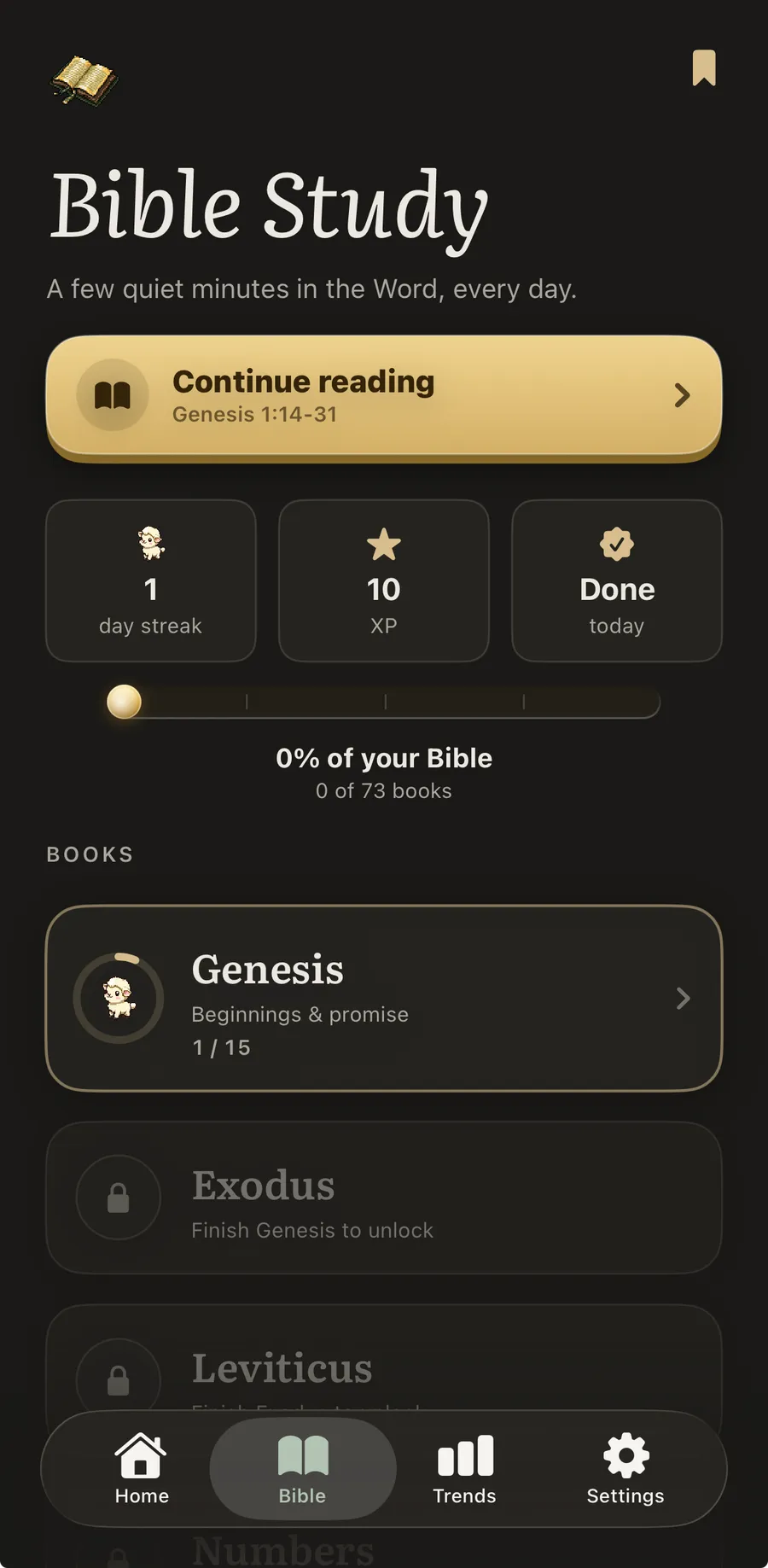
Nine minutes is the real number, not a marketing round-down. BlessUp does that arithmetic for your tradition, keeps your place, and makes the day's reading the thing that opens Instagram rather than something you have to remember. Day one is Genesis 1 to 3. Start on day one
How people engage with Scripture varies far more by circumstance than by plan design. The American Bible Society's State of the Bible research tracks that engagement year over year, and Lifeway Research has repeatedly found the same practical pattern: consistency comes from routine and community rather than from ambition.
The January problem
Plans are overwhelmingly started on January 1, and a large share of them are dead by the first week of February. The date is doing something unhelpful: it turns a reading habit into a resolution, and resolutions carry an all-or-nothing logic that reading does not survive.
Two practical adjustments help more than picking a different plan.
- Start before January. A plan begun in November has cleared its first fragile fortnight before the resolution crowd arrives, and you will not be starting alongside three other new habits.
- Decide your miss policy in advance. Write down now what you will do on the first day you skip. Most people never decide, so the first miss becomes an improvised verdict on themselves.
If falling behind is the specific thing that has ended plans for you before, the case against streak counting is worth reading before you pick anything.
So which one
If you have never read the Bible through and want a straight recommendation: a 365-day plan that pairs an Old Testament and a New Testament portion each day, at about nine minutes. It fixes boredom without the disorientation of chronological order, it has enough slack to survive a bad week, and it finishes.
If you have read it through before and want to see the architecture, take a chronological year. If you are new to Scripture entirely and need to finish something, take the New Testament in a year at four minutes a day and let that be enough. A beginner's plan has its own considerations worth reading first.
The plan is not the point
Every plan on this page covers the same words. The differences are ergonomic, not spiritual, and no arrangement of readings is holier than another. What decides the year is whether the reading becomes ordinary.
Matthew 6:34 tells us not to worry about tomorrow, which applies unexpectedly well to reading plans. You are not responsible for finishing the Bible this year. You are responsible for tomorrow's nine minutes.
Frequently asked questions
What is the best Bible reading plan for 2027?
For a first read through, a 365-day plan that pairs an Old Testament and a New Testament portion each day is the most reliable choice. It runs about nine minutes a day, avoids long stretches in a single difficult book, and has enough slack to survive a bad week. Chronological plans suit readers who have been through the Bible before and want the history in order.
How many minutes a day is a Bible in a year plan?
About nine minutes for the Protestant canon, which is 724,811 words divided across 365 days at a normal reading pace of 220 words per minute. The Catholic canon works out to about 10.3 minutes a day and the Orthodox canon to about 10.9, because both contain more books.
Is a chronological Bible reading plan better?
It is better for a specific problem. Reading events in the order they happened makes the history and the prophets much easier to follow. The tradeoff is that it breaks up books, scattering individual psalms across the reigns they were written in, which can be disorienting on a first read. Neither order is more faithful than the other.
Do I have to start a Bible reading plan on January 1?
No, and starting earlier often works better. A plan begun in November has already survived its most fragile first fortnight by the time January arrives, and you will not be competing with several other new resolutions at once. A plan begun in March that finishes beats a January plan that stops in February.
What should I do if I fall behind on my reading plan?
Pick up at the current day's reading rather than trying to read your way out of the backlog. Counting total days read rather than consecutive days keeps a single missed Tuesday from feeling like a failed year. Research on habit formation has found that missing one opportunity does not materially affect whether the habit forms.
Genesis to Revelation, about nine minutes at a time. Start whenever you are ready.
No guilt. Ever. Grace is built in. Funded by readers, never by ads.