How Many Words Are in the Bible?
By Dom · · 9 min read
It looks like a question with an answer. You search it, and you get 783,137. You search again and get 807,361. A third source says "about 750,000." None of them tell you which Bible they counted, and most of them do not say how.
The honest answer is that the number depends on three choices, and the person quoting a single figure has made all three on your behalf without telling you. Below are our own counts, the method we used, and the reason the range is as wide as it is.
Key takeaways
- There is no single number. English Bible word counts range roughly from 725,000 to 790,000 depending on canon and translation — a spread of about 65,000 words, or the length of a novel.
- We counted the text we ship. The Protestant canon runs 724,811 words, the Catholic canon 828,590, and the Orthodox canon 879,155.
- The Orthodox canon is 21% longer than the Protestant one — 154,344 extra words, which is most of the reason "the Bible" resists a single figure.
- Per day it is small. Across 365 days the Protestant canon is 1,986 words a day, about nine minutes at a normal 220-words-per-minute reading pace.
- The original languages are steadier. The traditional count for the Hebrew Bible is 306,757 words — far fewer than any English Bible, because English needs more words to say the same thing.
The short answer
An English Bible contains somewhere between about 725,000 and 790,000 words if you mean the 66-book Protestant canon. Add the deuterocanonical books and you are over 828,000. Use the fuller Orthodox canon and you are near 880,000.
If you need one number for one Bible, use ours: 724,811 words for the Protestant canon in the Berean Standard Bible. But keep reading, because knowing why the number moves is more useful than the number.
Why no two sources agree
Three separate choices sit underneath every published figure, and almost nobody states them.
1. Which canon
"The Bible" is not one book list. Protestant Bibles carry 66 books. Catholic Bibles carry 73, adding the deuterocanonical books — Tobit, Judith, Wisdom, Sirach, Baruch, 1 and 2 Maccabees, plus additions to Esther and Daniel. Orthodox Bibles carry more still, with the exact list varying between Orthodox churches.
This is the largest single source of variation, and it is worth more than 150,000 words. We wrote about what is actually different between the Protestant, Catholic and Orthodox Bibles in detail, because the difference is older and less dramatic than most people assume.
2. Which translation
Translations differ in philosophy, and philosophy shows up in the word count. A formal-equivalence translation that renders the structure of the original closely tends to run longer in English than one that aims for the sense of a phrase in natural contemporary English. Crossway's published ESV translation philosophy describes an "essentially literal" approach that seeks to reproduce the structure of the original; a thought-for-thought translation makes different trade-offs and lands on a different total.
Neither approach is cheating. They are answers to a genuine problem: Hebrew and Greek do not map one-to-one onto English. But it means the question "how many words is the Bible" cannot be answered without naming a translation. BibleGateway alone lists dozens of English versions, and they do not agree with each other.
3. What counts as a word
The least discussed and the most annoying. Does a hyphenated name count once or twice? Do you include chapter and verse numbers, section headings, footnotes, cross-references, italicised words that translators added for readability, the translators' preface? Two people counting the same file with different rules can differ by several thousand words and both be right.
This is why a figure with no method attached is close to meaningless. If a source cannot tell you which canon, which translation and which rule, the precision of "783,137" is decoration.
Our count, and how we did it
BlessUp builds a 365-day reading plan for each of three canons, and to pace those plans we had to count the text. This is the arithmetic behind the app's "about nine minutes a day," and it is the same arithmetic we are publishing here.
Method: we counted the running text of Scripture only — no verse numbers, no headings, no footnotes, no front matter. The Protestant canon was counted from the Berean Standard Bible, which is the 66-book text the app ships offline. The deuterocanonical and wider Orthodox books were counted from the World English Bible Catholic and Extended editions. Reading times use 220 words per minute, a normal adult silent reading pace for ordinary prose. Our FAQ lists which translations ship offline and how the canon is chosen.
| Canon | Total words | Words per day (365) | Minutes per day |
|---|---|---|---|
| Protestant (66 books) | 724,811 | 1,986 | 9.0 |
| Catholic (73 books) | 828,590 | 2,270 | 10.3 |
| Orthodox | 879,155 | 2,409 | 10.9 |
Two things stand out. The Catholic canon is 103,779 words longer than the Protestant one. The Orthodox canon is 154,344 words longer — 21% more text. And yet the daily difference between the shortest and longest canon is under two minutes. That gap is the whole reason a single "how long does the Bible take" figure is unsatisfying, and also the reason it barely matters in practice.
The original languages give a steadier number
English word counts wobble because English translation choices wobble. The underlying texts are more stable, and much shorter.
The traditional count for the Hebrew Bible is 306,757 Hebrew words across 22,864 verses, a figure that descends from the Masoretes, the scribes who standardised the text between roughly the fifth and tenth centuries and who counted letters and words as a preservation technique. The published statistics of the Hebrew Bible collect these traditional counts, though they should be read with the same caution as any English figure: the sources do not always agree on which edition they counted.
Either way the direction is clear and interesting. The Hebrew Old Testament is well under half the word count of its English rendering. Biblical Hebrew packs prepositions, pronouns and possessives into single inflected words that English has to unpack into three or four. "In the beginning" is one word in Hebrew.
What the number means for actually reading it
Here is the part that changes behaviour. 724,811 is an intimidating number and 1,986 is not, and they are the same number.
| Finish in | Words per day | Minutes per day | Feels like |
|---|---|---|---|
| 365 days | 1,986 | 9.0 | A coffee |
| 180 days | 4,027 | 18.3 | A commute leg |
| 90 days | 8,053 | 36.6 | A lunch break |
For comparison, 724,811 words is roughly the length of a long fantasy series. People finish those. The difference is not volume; it is that a novel supplies its own momentum and Leviticus does not, which is why the pace question and the where-to-start question matter more than the total.
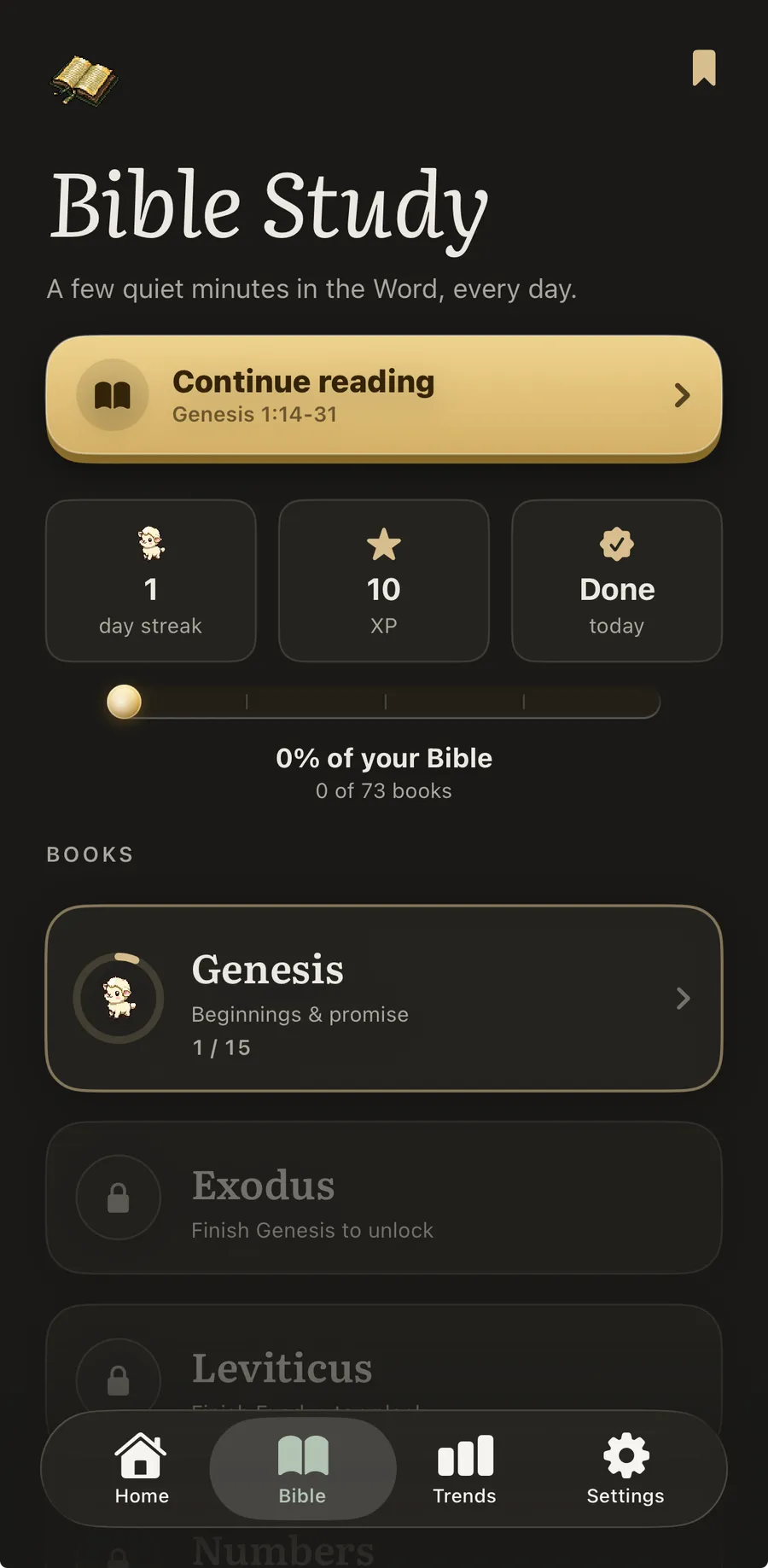
Nine minutes is a real number, not a marketing round-down: 724,811 words across 365 days is 1,986 words a day at a normal reading pace. BlessUp does that arithmetic for your tradition, picks the day's portion so there is nothing to decide, and shields the apps you choose until you have read it. Day one is Genesis 1 to 3 in all three plans. Start on day one.
Why so many published figures have no method
Word-count articles copy each other. A number gets published once with a method, the method gets dropped in the second retelling, and by the fifth the figure is floating free with a false air of precision. The tell is a number given to the exact digit with no translation named — 783,137 words of what, exactly?
We are not claiming our numbers are the only correct ones. We are claiming they are reproducible: named canon, named translation, named counting rule, named reading speed. Anyone can disagree with our rule and recount. That is the difference between a statistic and a number.
It also happens to be the more useful posture for the thing you probably came here for, which is not trivia. Psalm 119:105 calls Scripture a lamp for the feet and a light on the path — a walking metaphor, one step at a time. The total was never the point. The daily figure is. And if you want the honest version of what a day looks like, it is under ten minutes, whichever canon you hold.
Frequently asked questions
How many words are in the Bible?
It depends on the canon and translation. Counting only the running text of Scripture, BlessUp measures 724,811 words in the Protestant canon using the Berean Standard Bible, 828,590 in the Catholic canon and 879,155 in the Orthodox canon, using the World English Bible Catholic and Extended editions.
Why do different sources give different word counts for the Bible?
Three choices drive the variation: which canon is being counted (66, 73 or more books), which English translation is used, and what counts as a word — whether verse numbers, headings, footnotes and translator-supplied italics are included. A figure without those three stated cannot be checked.
How many words are in the Hebrew Bible?
The traditional count is 306,757 Hebrew words across 22,864 verses, descending from the Masoretic scribes who counted words and letters to preserve the text. That is well under half the word count of an English translation, because Hebrew packs into single inflected words what English needs several words to express.
How many words a day is reading the Bible in a year?
For the Protestant canon it is 1,986 words a day across 365 days, which is about nine minutes at a normal 220-words-per-minute reading pace. The Catholic canon works out to 2,270 words or 10.3 minutes, and the Orthodox canon to 2,409 words or 10.9 minutes.
Is the Catholic Bible longer than the Protestant Bible?
Yes. By our count the Catholic canon carries 103,779 more words than the Protestant canon, from the seven deuterocanonical books plus the additions to Esther and Daniel. The Orthodox canon carries 154,344 more words than the Protestant one, about 21% more text.
One chapter is the only key. See what your mornings look like on the other side of it.
No guilt. Ever. Grace is built in. Funded by readers, never by ads.