Bible Reading Plan for Beginners: How to Actually Start
By Dom · · 8 min read
Most people who decide to read the Bible do not fail in week one. They fail somewhere around week three, on an ordinary Tuesday, when the plan says Leviticus and the day says no. The plan was never the problem. The plan just did not survive contact with a normal week.
Key takeaways
- A one-year plan is about nine minutes a day for the Protestant canon: 724,811 words across 365 days at a normal reading pace.
- Do not start in Genesis and push straight through. Most beginners who quit, quit in Leviticus.
- Pick a pace you can keep on a bad day, not the pace you can keep on a good one.
- Missing a day is not the end of a plan. Deciding the miss meant something about you is.
Why beginner plans fail
The standard advice is to read the Bible cover to cover, starting at Genesis 1. It is good advice with one flaw: the third book is Leviticus, and Leviticus is where beginner plans go to die. You arrive at chapter after chapter of sacrificial procedure with no idea why it is there, decide you must be doing this wrong, and stop.
You were not doing it wrong. You were reading a library in the order the books were bound, not the order that makes them make sense.
The second failure is arithmetic. People choose a pace based on their most motivated day. A 90-day plan feels achievable on January 1, when you have time and enthusiasm. It feels impossible on a February Wednesday with a sick kid. The plan you finish is the one you can keep on your worst realistic day.

What the timings actually are
If the size of the book is the thing putting you off, the daily figure helps more than the total does: the Bible is 1,986 words a day across a year.
Almost nobody publishes real numbers for this, which is strange, because they are easy to compute. Take the word count of the canon and divide by the days, then divide by a normal reading pace of about 220 words per minute.
| Pace | Words a day | Minutes a day | Honest verdict |
|---|---|---|---|
| 365 days | 1,986 | About 9 | The pace most people can actually hold |
| 180 days | 4,027 | About 18 | Workable if mornings are genuinely yours |
| 90 days | 8,053 | About 37 | A sprint. Most people who try this quit |
Nine minutes is the number worth sitting with. It is less time than most people spend deciding what to watch. If you want the arithmetic for the Catholic and Orthodox canons too, it is in the full breakdown of how long the Bible takes to read.
Where to start instead of Genesis 1
There is no wrong door into Scripture, but some doors are easier to walk through first. A common and sensible beginner order is a Gospel, then a letter, then the beginning.
- Start with Mark. It is the shortest Gospel, it moves fast, and it gets you the shape of Jesus's life in about ninety minutes of total reading.
- Then John, which covers much of the same ground more slowly and says plainly why it was written: John 20:31.
- Then a letter, such as Philippians or Ephesians. Short, practical, written to real congregations with real problems.
- Then Genesis, which reads completely differently once you know where the story is going.
If you would rather start at the beginning anyway, that is fine, and there is a longer case for several starting points depending on what brought you here.
Pick the plan shape, then the pace
Plans differ by more than length. The three common shapes suit different people, and choosing wrong is a bigger cause of quitting than choosing a pace that is slightly too fast.
| Shape | How it reads | Suits you if |
|---|---|---|
| Canonical | Front to back, Genesis to Revelation | You want the whole thing and like finishing what you start |
| Chronological | Events in the order they happened | The history confuses you and you want the story straight |
| Old and New together | A portion from each, daily | Leviticus alone would sink you |
| New Testament only | About 260 chapters | You are new and want a real finish line this year |
The part nobody plans for
You will miss days. Everyone does. The question that decides whether you finish is not whether you miss, it is what happens in your head the next morning.
Most plans and most apps handle this badly. They show you a broken streak, a red mark, a number reset to zero, and the message lands as a verdict about your character rather than a fact about your Tuesday. That is why streak mechanics make people quit rather than keeping them going.
The practical fix is to stop counting consecutive days and start counting total days. If you read 300 days out of 365, you read the Bible. Nobody who finishes cares which 65 they missed.
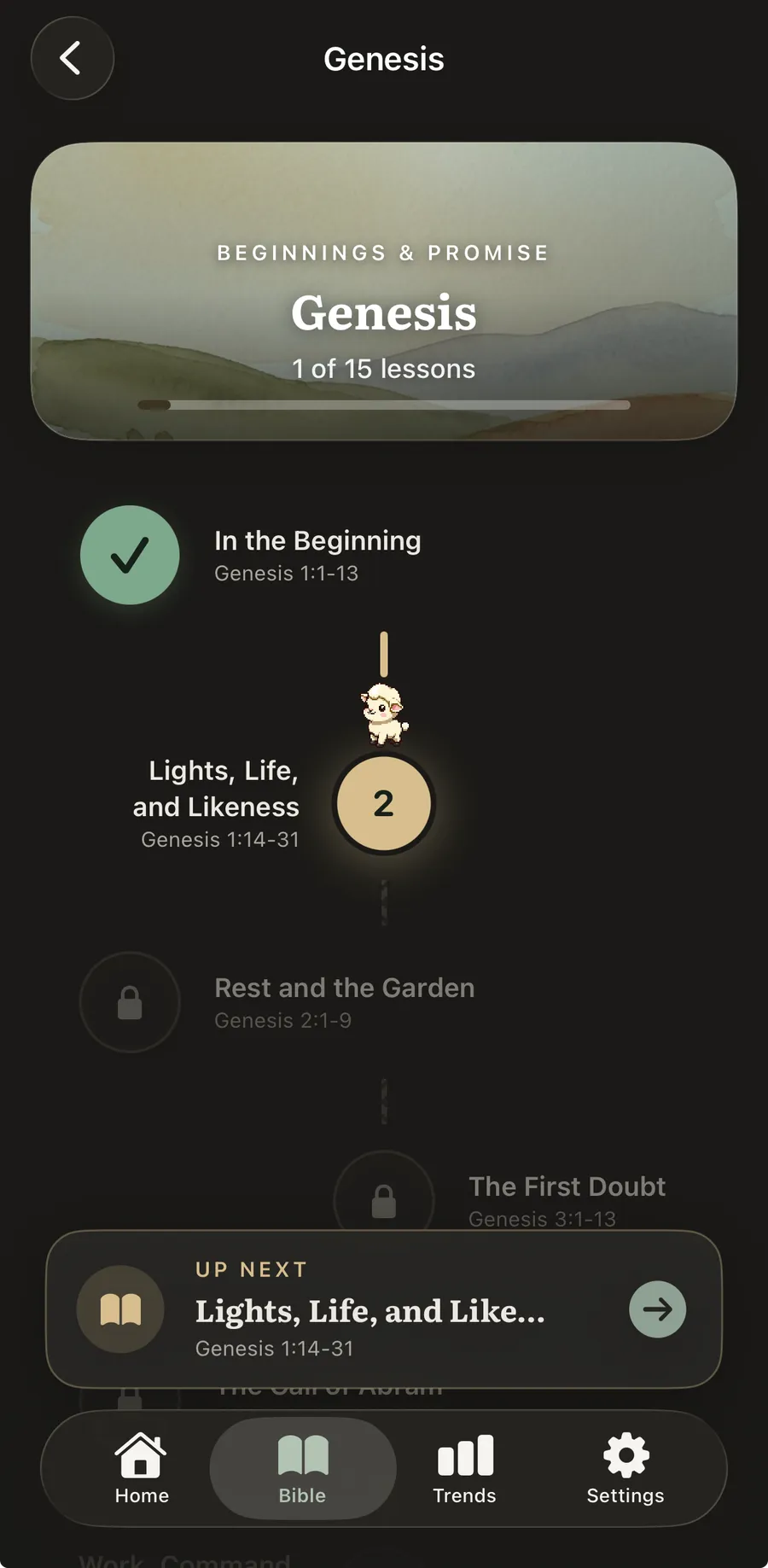
The hardest part of a reading plan has never been the reading. It is opening the app and facing sixty-six books with no idea which one is yours today. BlessUp removes that decision: every morning the day's chapter is already waiting, and reading it is what opens Instagram. Day one is Genesis 1 to 3, about nine minutes. See how the reading gate works
A first week that works
If you want something concrete to do tomorrow, this is a week that has a high chance of surviving.
- Attach it to something you already do. Not a time of day, an existing action: after you start the coffee, before you open the feed.
- Read Mark 1 through 4 over four days. One chapter each. Ten minutes at most.
- Do not take notes yet. Notes are a second habit and adding two at once halves your odds on both.
- On day five, keep going even if you skipped day three. This is the whole discipline.
- At the end of the week, pick your pace from the table above, honestly.
The research on habit formation is more forgiving than the internet suggests. In a study published in the European Journal of Social Psychology, Phillippa Lally and colleagues found that missing one opportunity to perform a behaviour did not materially affect the habit formation process. The gap does not undo the habit.
Choosing a translation
Beginners overthink this. Any mainstream modern translation will serve you. If your church uses one, use that, because hearing the same words read aloud on Sunday reinforces what you read on Wednesday. The American Bible Society's State of the Bible research tracks how differently people engage depending on how they came to Scripture, and the pattern is consistent: what matters is that reading becomes ordinary, not which edition sits on the shelf.
If your tradition matters to you, it also determines which books are in your Bible, and the Protestant, Catholic and Orthodox canons genuinely differ.
What finishing actually looks like
Not a perfect grid. A year in which reading Scripture stopped being a thing you were going to start and became a thing you did, most days, for about nine minutes, the way you brush your teeth.
Psalm 119:105 calls the word a lamp to the feet, which is a smaller claim than people usually make of it. A lamp for your feet lights the next step, not the whole road. Nine minutes tomorrow is the next step.
Frequently asked questions
How long should a beginner read the Bible each day?
About nine minutes covers a one-year plan through the Protestant canon, which works out to roughly 1,986 words a day at a normal reading pace. Ten minutes is a realistic and sustainable target for a beginner. Longer sessions are not more spiritual, and they are much harder to keep on a busy day.
Where should a beginner start reading the Bible?
A Gospel is the usual recommendation, and Mark is the shortest and fastest moving. From there, many people read John, then a short letter such as Philippians, then go back to Genesis. Starting at Genesis and pushing straight through is where most beginners stall, because Leviticus arrives before the story has hooked them.
What happens if I miss a day of my Bible reading plan?
Nothing. Research on habit formation has found that missing a single opportunity does not materially affect whether a habit forms. The practical advice is to count total days read rather than consecutive days, and to pick up at the next day's reading rather than trying to catch up on what you missed.
Is a 90 day Bible reading plan good for beginners?
Usually not. A 90-day plan runs to roughly 8,000 words a day, about 37 minutes of reading, and most people who attempt it as their first plan do not finish. A 365-day plan at about nine minutes a day has a far higher completion rate and covers exactly the same ground.
Which Bible translation should a beginner use?
Any mainstream modern translation works. If your church reads from a particular one, use that, since hearing the same wording on Sunday reinforces what you read during the week. Your tradition also determines which books your Bible contains, as the Protestant, Catholic and Orthodox canons differ.
Every morning, your reading is already waiting. You will never wonder where to start.
No guilt. Ever. Grace is built in. Funded by readers, never by ads.