Where Should I Start Reading the Bible?
By Dom · · 10 min read
Most people who want to read the Bible do not stall because they lack conviction. They stall in the first ten seconds, holding a book with sixty-six parts written across a thousand years, with no idea which page is theirs today.
So here is a direct answer rather than a list of options: start with the Gospel of John, or Mark if you want the shorter one. Then read Acts, then Genesis, then the Psalms alongside whatever else you are reading. Below is why that order works, what to do about the parts that famously lose people, and how to make the decision go away permanently.
Key takeaways
- Start with a Gospel, not Genesis. John is the most reflective, Mark the fastest at 16 chapters.
- Reading front to back is why most people stop. Leviticus is where beginner plans go to die, usually around week five.
- A workable first-year order: a Gospel, then Acts, then Genesis, then Psalms and Proverbs alongside the rest.
- Pick a readable translation and stop optimizing. NIV, NLT, or your tradition's standard are all fine first choices.
- The real fix is removing the decision. The morning you have to work out where you left off is the morning you might not read.

Why not Genesis 1
Starting at page one is the obvious move, and it works for a while. Genesis is genuinely gripping: creation, a flood, a family saga with real people behaving badly. Exodus keeps it going.
Then comes Leviticus, and this is where beginner plans reliably end. Not because Leviticus is bad, but because it is a legal and liturgical text written for a specific community in a specific moment, and reading it cold with no context is like opening a legal code for a country you have never visited. Most people slow down, feel guilty about slowing down, and then quietly stop.
There is a deeper reason too. The Bible is not a novel with a chronological plot you would spoil by starting elsewhere. It is a library, and the New Testament is where the story it has been building toward actually arrives. Starting with Jesus and reading backward into the history that anticipated Him is a perfectly coherent way through, and it is how a great many Christians actually did it.
Start with a Gospel: which one
All four tell the same story with different emphases. Any of them works. Two are best for a first read.
| Gospel | Chapters | Roughly | Best if you want |
|---|---|---|---|
| Mark | 16 | 1.5 hours | The fastest, most urgent account. Good if you want momentum. |
| John | 21 | 2 hours | The most reflective. Focused on who Jesus is rather than a full chronology. |
| Luke | 24 | 2.5 hours | The most orderly and detailed, written to a specific reader. |
| Matthew | 28 | 2.5 hours | The heaviest on Jewish context and fulfilled prophecy. |
Pick John if you want to sit with the question of who Jesus is. Pick Mark if you have started things before and not finished them, because sixteen short chapters is a finishable goal and finishing one book of the Bible changes how the rest feels.
Do not read all four back to back on a first pass. Three of them overlap heavily and the repetition is discouraging before you have context for why it is there.
A first-year order that works
Once you have a Gospel behind you, this sequence holds up well.
- 1. A Gospel (John or Mark). The center of the story.
- 2. Acts. Picks up directly where the Gospels end and shows what the first Christians actually did. It reads like history because it is.
- 3. Genesis. Now go back to the beginning. It lands differently once you know where the story is going.
- 4. Psalms and Proverbs, alongside everything else. One psalm a day is a good companion to whatever you are reading. Psalms is the prayer book of the Bible, and it is unafraid of anger, grief, and confusion.
- 5. A letter. Philippians or Ephesians. Short, practical, written to real churches with real problems.
- 6. Then a full plan. By this point you have enough footing that a year through the whole Bible is a reasonable next step.
That progression takes most people a few months at a relaxed pace, and it does the thing that matters most: it gets you finishing books rather than abandoning them.
Which translation
That you get to make this choice at all is a fairly recent inheritance. It is most of what the Reformation was arguing about: whether ordinary readers should hold Scripture in their own language.
This question absorbs far more energy than it deserves. A translation you read is better than a more precise one you do not.
- NIV is the most common middle ground, and a safe default.
- NLT is the easiest to read, and a good choice if older English has put you off before.
- ESV or NKJV stay closer to the sentence structure of the original languages, at some cost in readability.
- NABRE is the standard for Catholic readers in the United States. Orthodox readers often use the NKJV.
If you want to compare before choosing, BibleGateway lists the full range of available translations and lets you read the same passage side by side, which is a faster way to decide than reading about translation philosophy.
If your tradition has a standard, use it, because study notes and the way passages are referenced at church will match. If it does not, take the NIV and stop thinking about it. Whether the differences between traditions matter for what you are reading is covered in what is actually different between Protestant, Catholic, and Orthodox Bibles.
What to do with the parts that lose people
Four honest answers to four things nobody tells beginners.
The genealogies. Skim them. They matter, they establish lineage and fulfilled promises, and you do not need to absorb them on a first pass. Nobody is grading you.
Leviticus and Numbers. Read them later, ideally with notes. They make far more sense once you know what the sacrificial system is pointing toward.
The hard passages. You will hit violence, judgment, and things that genuinely trouble you. Do not skip past them and do not pretend the discomfort is not there. Mark them and bring them to someone. This is exactly what pastors are for, and it is a much better use of a conversation than a search engine.
Revelation. Not a first-year book. It assumes deep familiarity with Old Testament imagery, and reading it early tends to produce more confusion than light.
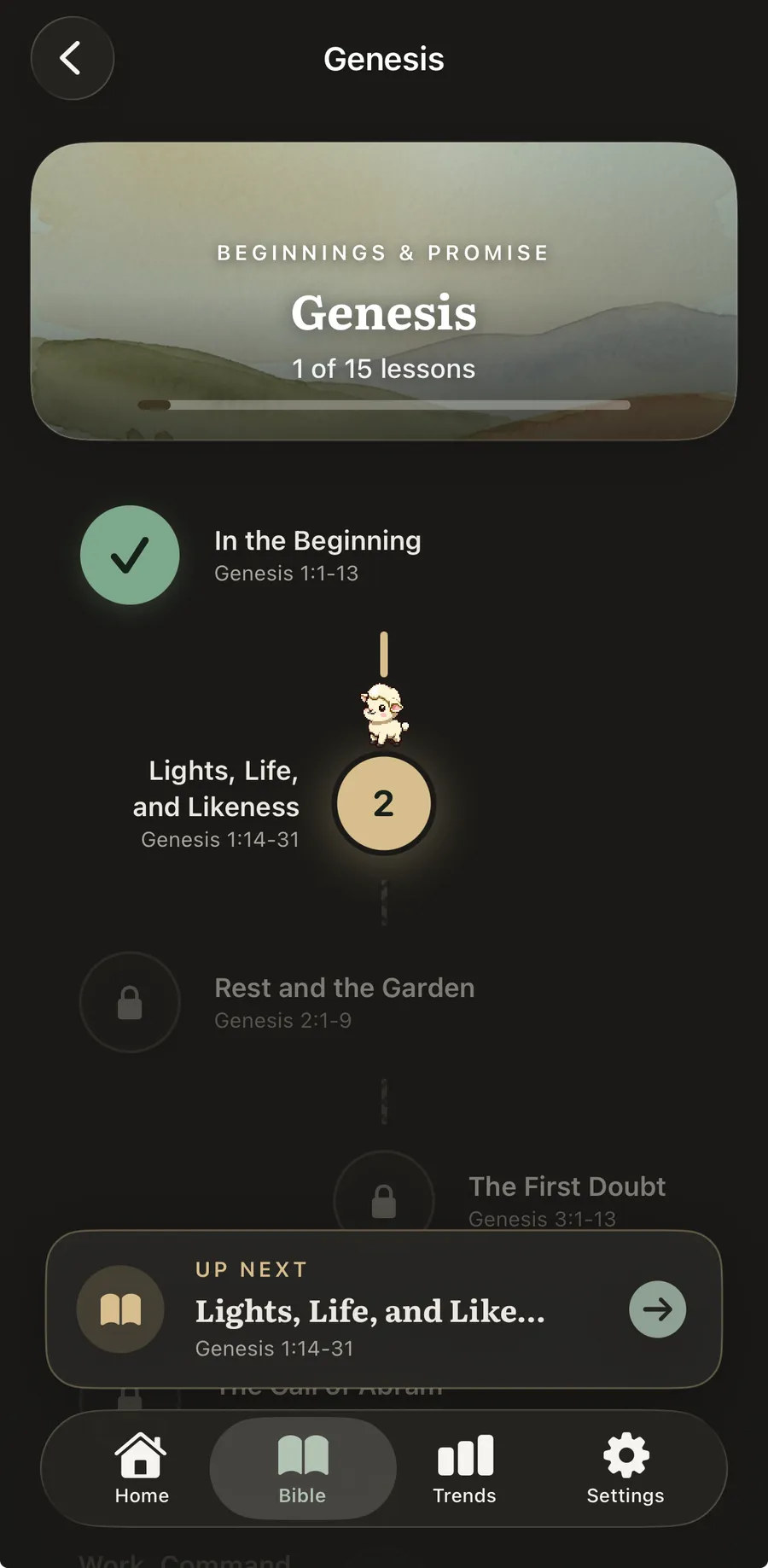
Every one of these decisions is friction, and friction is what actually stops people. BlessUp removes all of it: the day's reading is already waiting when you open the app, it takes about nine minutes, and it holds your place across the days you miss. Day one is Genesis 1 to 3, and you will never again open the app and wonder where you left off. See how the daily reading works.
How much to read at a time
Less than you think, more often than you think.
One chapter a day is a genuinely good target for a first year. It is around nine minutes, which is short enough to survive a bad week, and a chapter is a natural unit that usually ends somewhere sensible.
Lifeway Research's look at who American Bible readers actually are is a useful corrective if you are worried about doing this correctly. The people who read consistently are not unusually disciplined. They mostly just have a habit that survived.
Resist the urge to open with an hour a day. Ambitious starting volumes are the single most reliable predictor of quitting, because they work fine in week one, when motivation is doing the work, and collapse in week three, when it is not. It is far better to keep one chapter for a year than to keep five for a month.
And when you miss a day, do not catch up. Skip to today. More on why that specific instinct is so damaging in why streaks make people quit.
Read with someone
The single biggest predictor of whether a Bible habit lasts is not the plan or the translation. It is whether anyone else knows you are doing it.
The American Bible Society's annual State of the Bible research has tracked Bible engagement in the United States for years, and the pattern it keeps finding is that engagement is social. People who read consistently are generally people connected to a community that reads.
Lifeway Research's February 2026 State of Discipleship study found that among Americans who attend religious services at least monthly, 31 percent read the Bible every day and another 30 percent a few times a week. Even inside the church, daily reading is a minority habit. If you are starting from zero, you are not behind anyone.
A spouse, a friend, a small group, a text thread of two people. Someone to say "what did you make of chapter four" turns a private discipline into a shared one, and shared things survive bad weeks that private ones do not. If you are not currently part of a church, the BlessUp church finder lists churches by US city.
And once a chapter a day is genuinely a habit, a Bible widget on your home screen keeps the verse in front of you between readings.
The thing worth remembering
There is no wrong door. The anxiety about starting in the right place is itself the main obstacle, and it is worth naming that plainly.
Isaiah records God saying of His word that "it will not return to me empty, but will accomplish what I desire" (Isaiah 55:11, NIV). There is no verse in there that only counts if you arrived at it in the correct order.
Open John 1 tonight. That is the whole assignment.
Once you have picked a door, the next decision is pace. A beginner's reading plan covers what a realistic week looks like, and the passages people reach for when anxious are worth knowing before you need them.
Frequently asked questions
What book of the Bible should I read first?
The Gospel of John is the most common recommendation for a first-time reader, because it focuses on who Jesus is rather than trying to be a complete chronology. Mark is the other strong choice at only 16 short chapters, which makes it easy to actually finish.
Should I read the Bible from beginning to end?
You can, but it is where most beginners stop. Genesis and Exodus read well, then Leviticus arrives, and without context it is difficult going. The Bible is a library rather than a novel, so starting with a Gospel and reading backward into the history costs you nothing.
How much of the Bible should I read each day?
One chapter a day is a good target for a first year. That is roughly nine minutes, short enough to survive a busy week, and a chapter usually ends at a natural stopping point. Starting with an ambitious hour a day is the most reliable way to quit by week three.
Which Bible translation is best for beginners?
The NIV is a safe default and the NLT is the easiest to read. If your tradition has a standard, use it: the NABRE for Catholic readers in the United States, often the NKJV for Orthodox readers. A translation you actually read beats a more precise one you do not.
What should I do when I hit a passage I do not understand?
Mark it and keep going, then bring it to someone. Genealogies can be skimmed on a first pass, and Leviticus and Revelation both make more sense later with notes. For passages that genuinely trouble you, a conversation with your pastor is worth more than a search engine.
Every morning, your reading is already waiting. You will never wonder where to start.
No guilt. Ever. Grace is built in. Funded by readers, never by ads.