What Is Reformation Day?
By Dom · · 11 min read
You are driving past a church on the last Sunday in October and the sign out front says Reformation Sunday · 10:30. Or the school calendar has "Reformation Day" printed under October 31, in smaller type than Halloween. Nobody explains it. It is one of those church words that everyone around you seems to have absorbed by osmosis.
Here is the plain version. Reformation Day marks October 31, 1517, the day Martin Luther is said to have posted a list of ninety-five debating points on a church door in Wittenberg, Germany. Almost nothing about that sentence works the way people assume, including the door.
Key takeaways
- Reformation Day is October 31, the anniversary of Luther posting his Ninety-Five Theses in Wittenberg in 1517. In 2026 that falls on a Saturday, so most congregations observe Reformation Sunday on October 25.
- The theses were not a declaration of independence. They were ninety-five Latin propositions for an academic debate, and Luther was not trying to start a new church when he wrote them.
- The date is not a coincidence with Halloween. October 31 is the eve of All Saints' Day, when crowds would come to view relics — the one day Luther could count on the right readers walking past.
- Lutherans observe it most formally, many Reformed and evangelical churches mark it more loosely, and Catholic and Orthodox churches do not observe it at all.
- The divide has narrowed. In 15 Western European countries Pew surveyed in 2017, majorities or pluralities said Catholics and Protestants today are more similar than different.
What Reformation Day commemorates
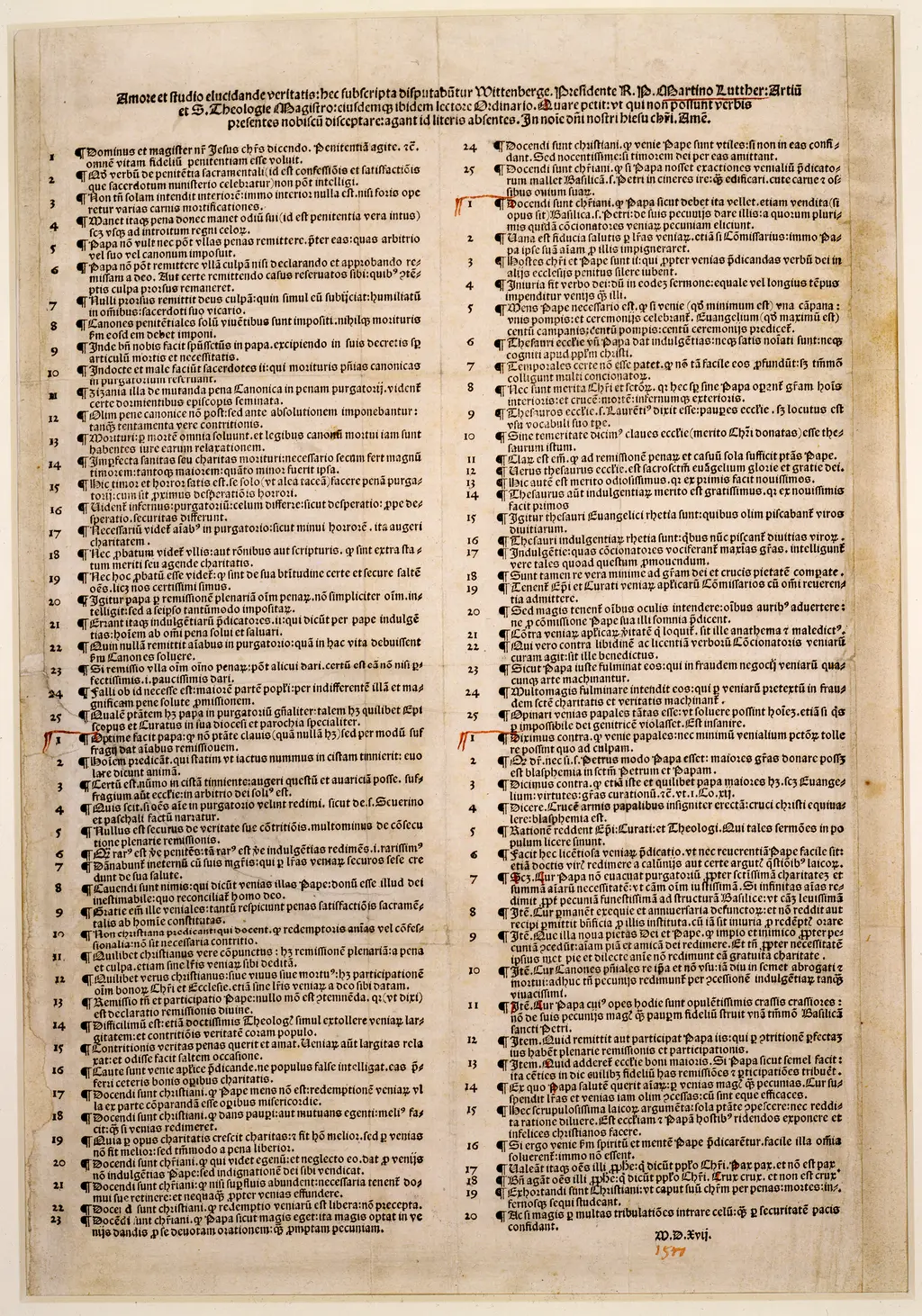
On October 31, 1517, an Augustinian friar and theology professor named Martin Luther published ninety-five propositions about indulgences — payments that were being sold with the promise of reducing punishment for sin. Tradition says he nailed them to the door of the Castle Church in Wittenberg. Whether the hammer was involved is genuinely disputed by historians; what is not disputed is that the theses circulated fast, in print, and that the argument they started did not stop.
Within four years Luther had been excommunicated. Within a generation, Western Christianity had split into branches that are still distinct today. Reformation Day is the anniversary of the first public shove.

What Luther actually wrote
The Ninety-Five Theses read nothing like a manifesto. They are numbered Latin propositions, written for a university disputation, and many of them are narrow technical points about papal authority over purgatory. Luther opens not with a demand but with a sentence about the whole shape of the Christian life. In the 1915 Jacobs and Spaeth translation, hosted in full on Wikisource, thesis 1 reads:
"Our Lord and Master Jesus Christ, when He said Poenitentiam agite, willed that the whole life of believers should be repentance."
That is the seed of everything that followed. Luther was arguing that repentance is a life, not a transaction — and if it is a life, it cannot be purchased. Thesis 62 names what he thought the Church's actual treasure was: "The true treasure of the Church is the Most Holy Gospel of the glory and the grace of God."
Two things worth holding onto. First, Luther in 1517 was not proposing to leave the Catholic Church; he was a Catholic priest asking for a debate inside it. Second, he wrote in Latin, to scholars. The mass appeal came later, and largely from other, shorter things he wrote in German. The full 1915 English edition of the theses and three of his early works is free to read at the Internet Archive if you want to see how modest the document looks.
Why October 31, and what Halloween has to do with it
The feast on the other side of that evening has its own history worth knowing — what All Saints’ Day commemorates, and why Eastern churches keep it on a completely different date.
The date is often treated as a happy accident, or worse, as a deliberate swipe at Halloween. It is neither. October 31 is All Hallows' Eve — the eve of All Saints' Day on November 1. In Wittenberg, All Saints' was the day the Castle Church displayed its enormous relic collection, and viewing the relics was itself tied to indulgences.
So Luther picked the day when the people most likely to care about indulgences would be walking past that specific door. It was the sixteenth-century equivalent of posting your argument where the crowd already is. The overlap with modern Halloween is downstream of the same calendar, not a rivalry.
This is also why some churches now hold "Reformation parties" or "Harvest festivals" on October 31 as an alternative to trick-or-treating. That is a modern pastoral choice, not something the date originally meant.
Who observes it, and how
Observance varies more than most people realize. In 2026, October 31 is a Saturday, so congregations that mark it liturgically will almost all do so on Sunday, October 25.
| Tradition | Observance | Typical marks of the day |
|---|---|---|
| Lutheran | A named festival | Red paraments, "A Mighty Fortress Is Our God", readings on justification by faith |
| Reformed / Presbyterian | Commonly observed | Reformation Sunday sermon, often on the five solas |
| Anglican / Episcopal | Rarely a set feast | All Saints' on November 1 usually takes precedence |
| Baptist and non-denominational | Varies widely | Sometimes a sermon series; often not marked at all |
| Roman Catholic | Not observed | October 31 is the vigil of All Saints' |
| Eastern Orthodox | Not observed | The Reformation is not part of Orthodox history |
If your own church does not mark it, that is not an oversight. Whether a tradition celebrates the Reformation depends on whether it understands itself as having come from it. The differences between the Protestant, Catholic and Orthodox Bibles run along the same historical seam.
What actually changed for ordinary readers
Strip away the politics and one practical thing changed more than anything else: who was expected to read the Bible.
Before the Reformation, Scripture in Western Europe was primarily encountered in Latin, mediated through clergy, in a church building. Luther's German New Testament in 1522, and Tyndale's English work in the same decade, put the text into the hands of anyone who could read their own language and afford a printed book. That combination — vernacular translation plus the printing press — is the part of the Reformation that most directly shaped how a Christian reads today.
Luther's own theological centre was Romans 1:17: "For in the gospel the righteousness of God is revealed — a righteousness that is by faith from first to last, just as it is written: 'The righteous will live by faith.'" (NIV). Reformation Sunday sermons return to that verse and to Ephesians 2:8-9 more than to any others.
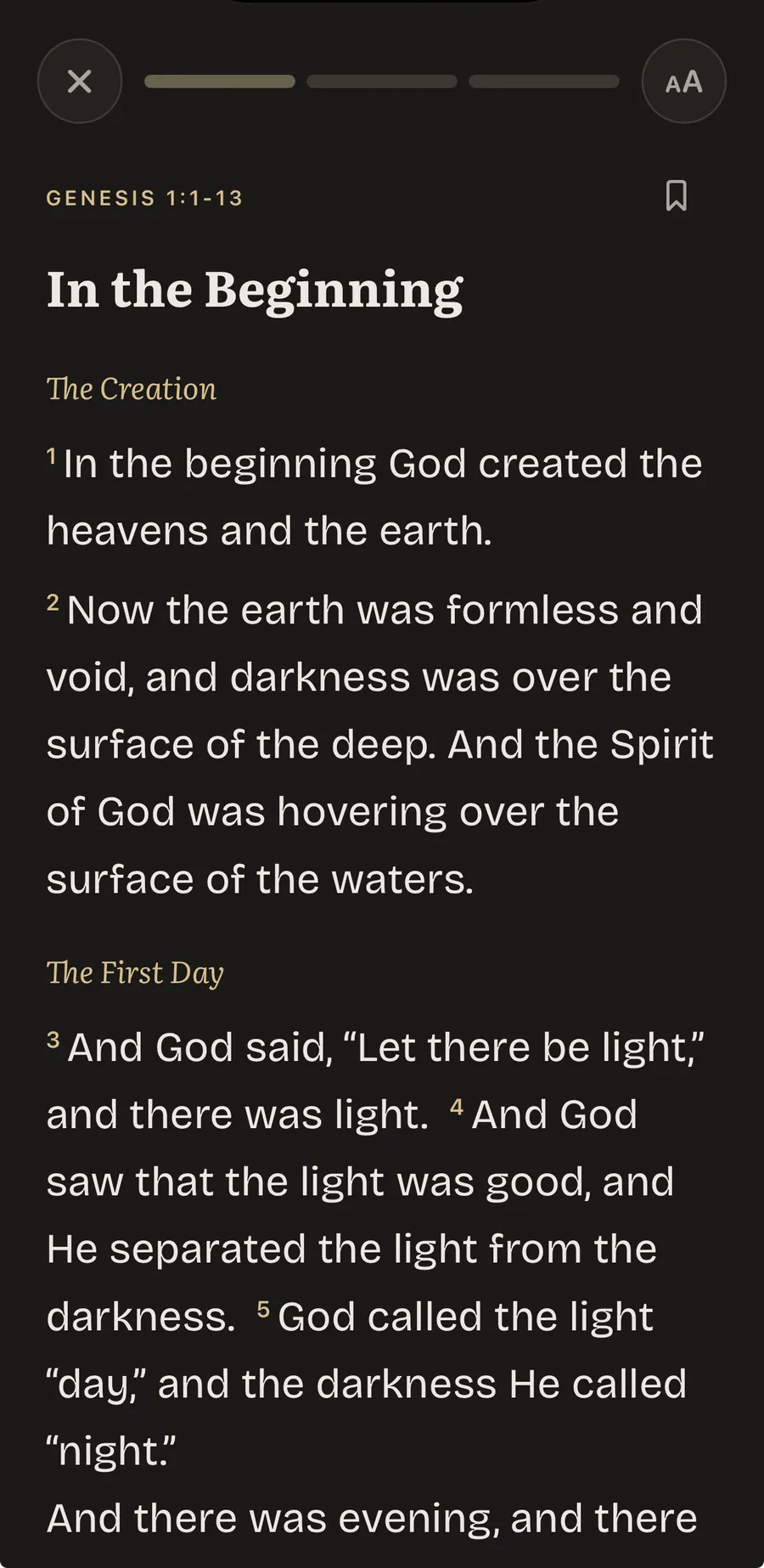
The irony is worth sitting with. The argument five hundred years ago was about whether ordinary people should have direct access to Scripture in a language they understood. That argument is over. Most of us now carry every major English translation in our pocket and read almost none of it.
If the Reformation put the text in your hands and your phone quietly took it back, the fix is not more willpower — it is changing which thing is easy. BlessUp shields the apps you pick until you read the day's chapter, and the day's chapter is already chosen, so there is nothing to decide at 7am. Day one is Genesis 1 to 3, about nine minutes. See how the reading gate works.
Five centuries later: how wide is the divide now?
This is the part of the story that rarely makes it into a Reformation Day sermon, and it is the most interesting.
In 2017, the Reformation's 500th anniversary, Pew Research Center surveyed 24,599 adults across 15 Western European countries between April and August of that year. On the doctrine the whole split turned on — whether salvation comes by faith alone or by faith and good works together — a median of 47% of Protestants said both good deeds and faith are necessary. Among Catholics the equivalent figure was 59%. In Germany, Luther's own country, nearly three times as many Protestants said faith and good works are needed (61%) as said faith alone (21%).
Pew also found that majorities or pluralities in all 15 countries said Catholics and Protestants today are "religiously more similar than they are different," and that in every country surveyed, roughly nine in ten or more of each group said they would accept the other as neighbours. This is survey data about what people report believing in Western Europe, not a statement about official teaching, and it does not transfer neatly to the United States or to the global south.
Officially, something moved too. On October 31, 1999 — Reformation Day itself — the Lutheran World Federation and the Catholic Church signed the Joint Declaration on the Doctrine of Justification in Augsburg. It states a shared conviction that "by grace alone, in faith in Christ's saving work and not because of any merit on our part, we are accepted by God," and concludes that the sixteenth-century condemnations each side issued do not apply to the other's teaching as presented in the Declaration. It has since been affirmed by Methodist, Anglican and Reformed bodies as well.
Real differences remain, and neither the survey nor the Declaration erases them. We are app builders, not theologians — for what your own tradition holds and why, ask your pastor or priest. But "the divide is exactly where Luther left it" is not an accurate thing to say in 2026.
How to mark the day, if you want to
None of this requires a program. Four ideas, in ascending order of effort:
- Read the theses. Twenty minutes, free, and shorter than you expect. Most people have opinions about a document they have never opened.
- Read Romans 1–5. This is the stretch of Scripture the Reformation argued over. Reading it without a commentary first is a genuinely different experience from reading about it.
- Go to a Reformation Sunday service. If you have never been to a Lutheran service, October 25 is a good week to visit — the day is explained from the front. Here is what to expect the first time you visit a church, and the BlessUp church finder covers 54 US cities.
- Start the reading habit the Reformation was arguing for. If you have never read the Bible end to end, the question of where to start has a real answer, and the whole thing takes about nine minutes a day.
That last one is the point of the anniversary, if it has one. The argument was never really about a door. It was about whether the text belongs to the people in the pews.
Frequently asked questions
What day is Reformation Day 2026?
Reformation Day is always October 31. In 2026 that falls on a Saturday, so most churches that observe it liturgically will do so on Reformation Sunday, October 25, 2026.
Did Martin Luther really nail the Ninety-Five Theses to the door?
The door story is traditional and disputed by historians; the earliest account comes from after Luther’s death. What is well documented is that he published the ninety-five propositions on October 31, 1517, and sent them to his archbishop, and that they circulated rapidly in print.
Is Reformation Day the same as Halloween?
No, but they share a date for a reason. October 31 is All Hallows’ Eve, the day before All Saints’ Day. Luther chose it because crowds came to Wittenberg to view relics on All Saints’, and relic viewing was tied to the indulgences he was challenging.
Do Catholics celebrate Reformation Day?
No. For Roman Catholics October 31 is the vigil of All Saints’ Day. Eastern Orthodox churches do not observe it either. That said, on October 31, 1999 the Catholic Church and the Lutheran World Federation jointly signed the Joint Declaration on the Doctrine of Justification, which found consensus on basic truths about justification.
What are the five solas?
They are five Latin phrases later used to summarise Reformation theology: sola scriptura (Scripture alone), sola fide (faith alone), sola gratia (grace alone), solus Christus (Christ alone) and soli Deo gloria (glory to God alone). Luther did not write them as a list; they are a summary that came afterward.
Every morning, your reading is already waiting. You will never wonder where to start.
No guilt. Ever. Grace is built in. Funded by readers, never by ads.