What Is All Saints’ Day?
By Dom · · 11 min read
You see it in the bulletin, or on the parish sign, or as a small line in your phone’s calendar app: All Saints’ Day. If you did not grow up with it, the name raises more questions than it answers. Which saints? Are you supposed to be somewhere? And why does it sit one day after Halloween?
Here is the short version. All Saints’ Day is the church’s once-a-year commemoration of every Christian who has died in the faith — the famous ones and, far more importantly, the ones nobody wrote down. Almost every major tradition keeps it. They simply do not all keep it on the same day, or ask the same thing of you when it arrives.
Key takeaways
- November 1 in Western churches — Catholic, Lutheran, Anglican, Methodist and many others. Eastern Orthodox churches keep the Sunday of All Saints on the first Sunday after Pentecost instead, a movable date in late spring or early summer.
- It commemorates all the faithful departed, canonized and uncanonized alike. The point of the feast is the crowd, not the celebrities.
- For US Catholics it is a holy day of obligation, but the obligation is lifted whenever November 1 falls on a Saturday or a Monday. In 2026 it falls on a Sunday, so it is kept at Sunday Mass.
- All Saints’ Day and All Souls’ Day are different days. November 1 remembers the saints in heaven; November 2 prays for all the faithful departed.
- Halloween is the eve of this feast. “All Hallows’ Eve” is simply the night before All Hallows — the older English name for All Saints.
What All Saints’ Day actually commemorates
The feast has one idea in it, and it is a generous one. Across two thousand years, most Christians who lived faithfully and died were never written about. No feast day carries their name. No church was built over their grave. All Saints’ Day exists so that once a year the church remembers them anyway, together, by name-lessness rather than by name.
That is why the traditional artwork for the day is always a crowd. Fra Angelico’s fifteenth-century panel does not put one saint in the middle and the rest in shadow. It fills the frame edge to edge with rows of people, and the ones in the back are as much the subject as the ones in front.
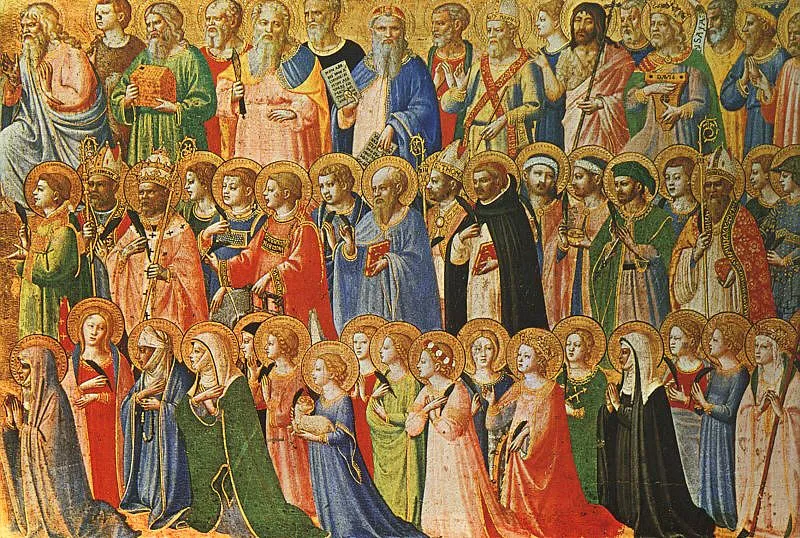

The scriptural image behind it is Revelation 7:9, which describes “a great multitude that no one could count, from every nation, tribe, people and language, standing before the throne” (NIV). A multitude no one could count is not a list. It is the opposite of a list, and the feast is built on that.
When is All Saints’ Day?
This is where most confusion starts, because the answer depends on which half of the church you are asking. Western churches fixed the date to November 1. Eastern Orthodox churches never did, and keep the commemoration on a movable date tied to Pentecost.
| Tradition | Name and date | What it asks of you |
|---|---|---|
| Roman Catholic | Solemnity of All Saints, November 1 | A holy day of obligation in the US, except when it falls on a Saturday or a Monday |
| Eastern Orthodox | Sunday of All Saints, the first Sunday after Pentecost | Kept as a Sunday liturgy; no separate weekday obligation |
| Anglican / Episcopal | All Saints’ Day, November 1 | One of seven principal feasts, and one of four days recommended for baptisms |
| Lutheran | All Saints Day, November 1 | Widely observed, often moved to the nearest Sunday |
The Orthodox placement is deliberate rather than accidental. The Orthodox Church in America explains the logic: the descent of the Holy Spirit at Pentecost is what makes holiness possible in the first place, so the commemoration of everyone who became holy belongs on the Sunday immediately after it. The feast is placed as a consequence of Pentecost, not as a date on a calendar.
Is All Saints’ Day a holy day of obligation?
For Latin Rite Catholics in the United States, yes — with a rule attached that catches people out every year. The United States Conference of Catholic Bishops lists November 1 among six holy days of obligation, and then adds that whenever January 1, August 15 or November 1 falls on a Saturday or on a Monday, the precept to attend Mass is abrogated.
So the honest answer to “do I have to go?” is: check what day of the week it lands on. In 2026, November 1 is a Sunday, which means the question resolves itself — Catholics are at Mass that morning anyway, and the parish will be keeping the solemnity.
Other traditions frame it differently. There is no obligation attached in Lutheran, Anglican or Methodist practice; the day is kept because it is worth keeping, and it is often shifted to the nearest Sunday so that more of the congregation is present for it.
All Saints’ Day and All Souls’ Day are not the same day
These two get merged constantly, and the distinction is actually simple.
- November 1, All Saints’ Day — thanksgiving for those who have died in the faith and are with God.
- November 2, All Souls’ Day — prayer for all the faithful departed, historically including those still being purified.
The second of those is where the traditions genuinely part company. Catholic and Orthodox practice includes prayer for the dead. Most Protestant churches, after the Reformation, kept the commemoration and dropped the prayers, which is why Lutheran and Anglican observance on November 1 tends to fold both ideas into one day: remembering the recently dead of the congregation alongside the saints of every century.
The Lutheran framing is worth quoting because it is not a compromise, it is a doctrine. Writing in Living Lutheran, the day is described through simul justus et peccator: in Christ every saint is a sinner and every sinner a saint, and it is God’s grace apart from works that makes anyone a saint at all. On that reading, All Saints is not a feast about spiritual high achievers. It is a feast about baptism.
If the differences between traditions interest you, the same pattern shows up in the Bible itself — what is actually different between Protestant, Catholic and Orthodox Bibles is a longer look at where the canons diverge and why.
Where the feast came from
The oldest layer of it is a commemoration of martyrs. When persecution produced more martyrs than the calendar had days, the practical solution was a single shared feast, and Eastern churches were keeping one by the fourth century. The Western date drifted: a May observance in Rome came first, and November 1 was fixed later, spreading across Western Europe through the eighth and ninth centuries until it became the general date it is now.
The English name is the useful piece of trivia here. “Hallow” is an old word for a holy person, so All Saints was All Hallows, and the night before it was All Hallows’ Eve. Contract that and you have Halloween. The costumes and the candy are much later and much more commercial, but the date is not a coincidence — October 31 is late in the day only because November 1 is the feast.
October 31 carries a second anniversary as well. Luther is said to have posted the Ninety-Five Theses on the eve of All Saints in 1517, choosing a day when crowds would come to the castle church to view its relic collection. That is a genuinely connected story rather than a coincidence, and it is covered in what Reformation Day is and why it lands on October 31.
How to actually mark the day
You do not need a program. Most of what the day asks for is attention rather than activity.
- Name your own dead. Say the names out loud — grandparents, a friend, someone from your congregation who died this year. Many churches read the year’s names aloud; you can do the same at your own table.
- Go to the service if there is one. Parishes and congregations that keep the day usually do something distinctive with it: names read, candles lit, a longer communion. If it has been a while since you were in a pew, what to expect on a first visit to a church covers the practical part, and the BlessUp church finder lists congregations by city.
- Read the two passages the day is built on. Hebrews 12:1–2 and Revelation 7:9–17. Together they take about three minutes.
- Notice who is missing from the list. The feast is deliberately about the uncounted. Someone taught you the faith without ever being thanked in public for it.
That last one is the whole feast in miniature. Hebrews calls them a cloud of witnesses, which is a strange phrase until you realise it is describing people you cannot individually identify but are surrounded by anyway.
The awkward part of a day like this is usually not willingness, it is not knowing which passage is yours or whose commentary to trust on it. BlessUp answers both before you ask: the day’s reading is already chosen when you open it, and every study lesson carries four separately written commentaries — Non-Denominational, Protestant, Catholic and Orthodox — so Hebrews 12 is explained the way your own tradition explains it. See how the reading gate works.
Why a day for the uncounted still matters
Church attendance in the United States has stopped falling but has not recovered: the Pew Research Center’s Religious Landscape Study, fielded among 36,908 US adults between July 2023 and March 2024, found 33% attending religious services at least monthly and 44% praying daily. Read next to that, a feast about ordinary unrecorded faithfulness reads less like antiquarianism and more like a correction.
Most Christian lives are not documented. They are a person who kept showing up, in a specific building, for decades, and taught someone else to. All Saints’ Day is the one day the calendar sets aside to say that this counts — and if you are wondering where your own faithfulness sits on that scale, the answer the feast gives is that the scale was never the point. If you want somewhere to begin reading again, where to start reading the Bible is a gentler entry than Genesis 1 on a cold morning.
Frequently asked questions
When is All Saints’ Day 2026?
In Western churches, All Saints’ Day is always November 1, which in 2026 falls on a Sunday. Eastern Orthodox churches instead keep the Sunday of All Saints on the first Sunday after Pentecost, so the Orthodox date moves each year and falls in late spring or early summer.
Is All Saints’ Day a holy day of obligation in 2026?
For Latin Rite Catholics in the United States, November 1 is a holy day of obligation, but the US bishops’ norm removes the obligation whenever it falls on a Saturday or a Monday. In 2026 it falls on a Sunday, so the solemnity is kept at the ordinary Sunday Mass.
What is the difference between All Saints’ Day and All Souls’ Day?
All Saints’ Day on November 1 gives thanks for all who have died in the faith and are with God. All Souls’ Day on November 2 is devoted to prayer for all the faithful departed. Catholic and Orthodox practice keeps both; most Protestant churches kept the November 1 commemoration and did not retain prayers for the dead.
Do Protestants celebrate All Saints’ Day?
Many do. Lutheran, Anglican and Methodist churches all observe November 1, often moving it to the nearest Sunday, and typically use it to remember members of the congregation who died during the past year. The Lutheran framing treats every baptized Christian as a saint by grace rather than by achievement.
Why is Halloween the day before All Saints’ Day?
Because Halloween is named after it. Saints were once called hallows in English, so All Saints’ Day was All Hallows and the evening before it was All Hallows’ Eve, which contracted to Halloween. The modern customs came much later, but the date exists because of the feast that follows it.
Every morning, your reading is already waiting. You will never wonder where to start.
No guilt. Ever. Grace is built in. Funded by readers, never by ads.