How to Stop Doomscrolling: Scripture Before Screen Time
By Dom · · Updated · 5 min read
Doomscrolling is easy to start and hard to stop. You unlock your phone for "one quick check" and lose twenty minutes to bad news and other people's highlight reels. Here's how to break the loop.
What the scroll actually costs
Before estimating that cost, it is worth checking it: how much time you actually spend on your phone is a thirty-second lookup, and most people’s guess is off in a predictable direction.
The losses are easy to shrug off one morning at a time, but they add up. The American Psychological Association notes that researchers have linked heavy technology use with worse sleep and higher stress for some users. And Pew Research Center data shows most Americans own a smartphone, with many saying they go online almost constantly — so the pull is nearly always within arm's reach.
Scripture has a word for guarding this ground: “Above all else, guard your heart, for everything you do flows from it” (Proverbs 4:23, NIV). What you pour into the first minutes of the day flows into all the rest of it.
Why doomscrolling feels so hard to quit
Before the scroll there is the pick-up, and that has its own explanation: most checks are reaches you start at a pause in the day, not answers to an alert. See why you check your phone so much.
Scripture has an unexpectedly precise word for that condition — perispao, to be dragged all around — and it uses it exactly once. We trace the pair in Bible verses about distraction and attention.
It isn't a lack of willpower. Feeds are designed to be endless, and your brain is wired to keep checking for what's new. Fighting that with sheer discipline rarely works for long. The trick is to change the environment, not just your intentions — make the good habit automatic and the bad one a little harder.
If you would rather step away for a set stretch first, fasting from your phone works best when you decide in advance what fills the time it frees.
1. Change what comes first
That first slot is worth more than the rest of the day put together, which is why it has its own rule — see the first-attention rule and the seven-day audit that goes with it.
The habit isn't the scrolling — it's the order. Put something meaningful before your feed. A short prayer or a verse gives your brain a different first move when you pick up your phone.
Paul gives the filter: “whatever is true, whatever is noble, whatever is right, whatever is pure, whatever is lovely, whatever is admirable … think about such things” (Philippians 4:8, NIV). A feed is built to show you whatever keeps you scrolling. A verse is built to show you what's true. Choose which one gets the first word of your day.
Jesus met His own temptations with words He already knew; Bible verses about temptation sorts them by the moment you are in.

2. Add a little friction
If you would rather interrupt the pattern all at once before adding friction back in, a Christian digital detox sets out the fixed-length version, including the seven-day plan for coming off it.
If you would rather attach this to a season than to a Tuesday, Lent is the obvious frame — though a phone fast is the hardest one on the usual list, because the thing being given up is also the map and the bank.
Friction is doing more work here than blocking is, and the difference is measurable: what the research says about app blockers found that a one-second pause with a visible way out beat removing the option altogether.
If your apps open instantly, you'll open them instantly. Adding a small step — like keeping them shut until you've read a chapter — is usually enough to break the autopilot. That's the whole idea behind BlessUp.
In practice it takes about nine minutes: the day's chapter is already queued up when you open the app, and finishing it opens the apps you chose. The friction isn't punishment — it's a pause just long enough for you, not the algorithm, to decide what happens next.
3. Make the good habit obvious
A weekly rest day is the other half of this, and it does not cost you the habit — a sabbath from screens works through the ladder version, from two hours up to a full day.
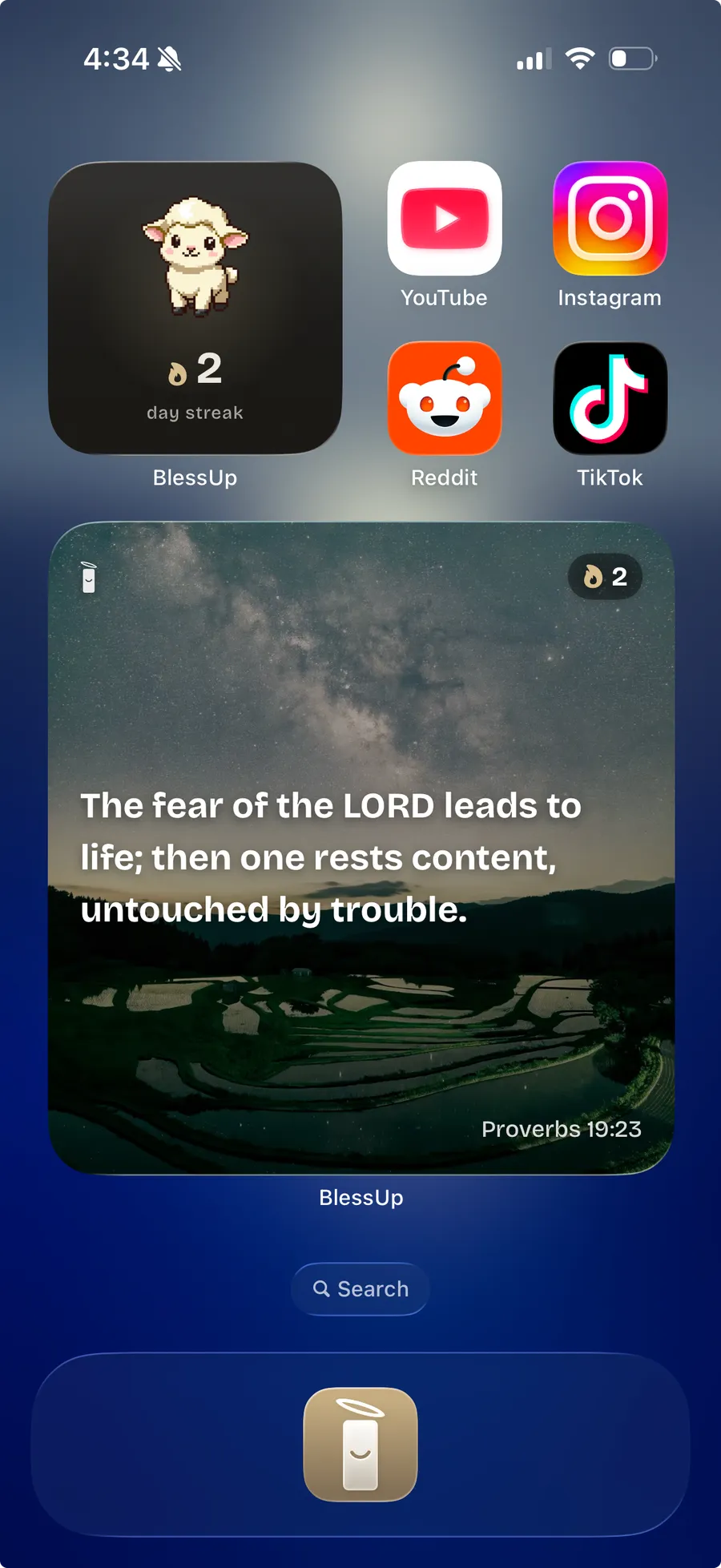
Keep a Bible verse on your home screen so faith is the thing you see, not the feed. When the better option is right in front of you, it's far easier to choose.
BlessUp's Bible verse widget does exactly this — Scripture sits on your home screen, in the spot where the feed used to catch your eye first.
A word for parents
If you're watching a teenager disappear into their phone, you're not imagining it — Common Sense Media's research tracks how large a place screens now hold in kids' and teens' daily lives. But the most convincing argument you can make isn't a lecture. It's a parent who visibly prays before scrolling. Habits like this are caught before they're taught.
Friction is the whole idea, and the trouble with adding it yourself is that you are also the person who can remove it. BlessUp puts the friction somewhere you cannot casually undo: the apps you choose stay shielded, and the day's chapter is the key that opens them. About nine minutes, and then your phone is just your phone again. See how the shield works.
Start tomorrow morning
If the morning specifically is where it goes wrong, the sequence is worth taking apart on its own: we have written about a morning routine that doesn’t start with your phone, and why leaving it in another room keeps failing.
You don't need to quit your phone. You just need to change what happens in the first five minutes. Pray before screen time, and the rest of the day starts on steadier ground.
That's exactly what a tool like BlessUp does for you. Instead of relying on willpower at your weakest moment, you lean on a small system that puts Scripture first by default. Win the morning, and the scroll loses its grip on the rest of your day. BlessUp is free to download on the App Store.
There is a larger argument underneath all of these tactics, which is that screen time is a spiritual problem rather than a productivity one. The hours are the symptom.
Frequently asked questions
What counts as doomscrolling?
It's the compulsive, autopilot scrolling that keeps going long after you got what you came for — often through bad news or content that leaves you anxious, envious, or numb. The tell is how you feel afterward: informed and done, or drained and still scrolling.
Is doomscrolling actually bad for me?
Researchers have linked heavy technology use with worse sleep and higher stress for some users, and most of us can feel the difference a scrolled-away morning makes. You don't need a study to notice it — but the research points the same direction as your gut.
Do I have to quit social media to stop doomscrolling?
No. The goal is to change what comes first, not to delete everything. When prayer and Scripture take the first few minutes, the feed loses its grip on the rest — and you can still open your apps afterward, on purpose instead of on autopilot.
How does praying first actually help?
It breaks the autopilot at the exact moment it starts: the phone pickup. With BlessUp, your chosen apps stay locked until you've finished a short prayer and read the day's verse, so the first move of your day is deliberate. Winning that one moment makes every later choice easier.
Start your day with prayer, not doomscrolling. BlessUp is free on the App Store.