A Sabbath From Screens
By Dom · · 12 min read
The idea lands well. One day a week with the screens off, the noise down, the week’s residue cleared. Then you look for how to actually do it and find two kinds of article: a productivity hack that has quietly removed everything the word means, or a twenty-four-hour purge you know you will abandon somewhere around eleven in the morning.
There is also a quieter worry underneath, and it deserves a straight answer rather than reassurance: if you have finally built a daily rhythm, does taking a day off cost you it?
Key takeaways
- A sabbath is the presence of something else, not the absence of work. Decide what the day is for before deciding what goes off, or the hours get filled by whatever is nearest.
- Gradual beats abrupt. A 2025 PRISMA review of fifteen quantitative studies recommends decreasing screen use gradually rather than stopping all at once — the opposite of the usual all-day purge.
- The evidence is real but modest. In a two-week trial of 164 adults, cutting recreational screen use improved well-being by 8.48 points on the WHO-5 — while stress biomarkers mostly did not move.
- Resting does not break the habit. Missing an occasional opportunity did not seriously impair habit formation, and automaticity resumed afterwards.
- Name what the phone may still do. A rule that forbids the map and the emergency line breaks on contact, and a rule broken on a technicality tends to be abandoned entirely.
What a sabbath is before it is a screen policy

Almost every article about a digital sabbath begins with the phone. That is the wrong end, and it is why so many of them read like productivity advice with a religious word bolted on the front.
Start where Scripture does. In Genesis the rest comes before any command about it: “on the seventh day he rested from all his work” (NIV), and the day is blessed and set apart before anyone is told to keep it. In Exodus it becomes a commandment, and the striking part is its scope: the rest covers “neither you, nor your son or daughter, nor your male or female servant, nor your animals, nor any foreigner residing in your towns” (NIV). Nobody is left working so that someone else can rest.
Then Mark records the line that governs the whole question: “The Sabbath was made for man, not man for the Sabbath” (NIV). Rest is a gift with a shape, not a compliance test.
Which reframes the practical question entirely. In both passages the day is not merely empty but set apart to God, and that is what keeps it from collapsing into a wellness technique. A sabbath is not the absence of work; it is the presence of something else. So the useful question was never how many hours can I stay off my phone. It is what is this day for. Christians differ on which day, on how strictly, and on whether the commandment binds in the same way now — those are questions for your own tradition and your pastor, and nothing here settles them. What follows is about rest, not about a sabbatarian position.
Why the all-day digital sabbath fails on the first attempt
The standard version is a cold stop: twenty-four hours, no screens, starting Saturday. It usually ends before lunch, and the failure gets read as a character verdict when it is really a design flaw.
The available evidence points the other way. A 2025 systematic review in Frontiers in Human Dynamics by Kolhe and Naik, which screened the literature under PRISMA and ran a meta-analysis across fifteen quantitative studies, reports cognitive and emotional benefits from digital detox — improved attention, reduced stress, more self-reflection. In its recommendations it describes a gradual method of decreasing screen use as usually more successful than stopping abruptly, and names “digital sabbaths” — specified intervals of complete detachment — among the practices it discusses. One honest caveat about that recommendation: it is the review citing earlier work rather than a result of the meta-analysis itself, so treat it as informed guidance rather than a measured finding.
The popular advice inverts this. It asks for the hardest possible version on day one, which is roughly like beginning a running habit with a marathon and concluding from the result that you cannot run.
What the research actually shows a break does
It is worth being careful here, because this is a topic where enthusiasm routinely outruns the evidence.
The strongest study available is a 2022 cluster-randomised trial in NPJ Mental Health Research. Pedersen and colleagues randomised 89 families, 164 adults in total, to cut recreational screen use or to carry on as usual. Over two weeks the intervention group came down to a median of 2.7 hours a week against 15.5 in the control group. They finished 8.48 points ahead on the WHO-5 well-being index and 6.83 points better on total mood disturbance, with significant improvements in tension, fatigue and vigor.
Now the parts that usually get left out. The researchers also collected saliva samples to test whether stress hormones moved, and found no significant effect on any measure of cortisol or cortisone except awakening cortisone. In their own framing, there was no consistent biomarker story to tell. How people felt improved; what their stress hormones did, mostly did not follow.
And the intervention itself was not a sabbath. It was two weeks of near-total reduction, with smartphones swapped for basic handsets. That is a far larger dose than one quiet day a week. Take the direction from it — less recreational screen time appears to make people feel better — and do not take the magnitude, because nobody has run this trial on a single day off.
A ladder: two hours, an evening, a morning, a day
If gradual beats abrupt, the sensible shape is a ladder. Start on the rung you would actually finish, and move up only when the current one is boring.
| Rung | Hand off beforehand | The phone may still | What the time is for |
|---|---|---|---|
| Two hours | Nothing. Pick hours nobody needs you. | Ring, and nothing else | Finding out what you reach for when the reaching stops |
| One evening | Tell one person you will be slow to reply | Ring, take messages you read later | The people in the room; sleep that starts on time |
| One morning | Anything time-critical, moved to the afternoon | Alarm, calls | The day’s reading, unhurried; a slow start |
| One full day | On-call duties, deliveries, anything needing a reply | Calls, maps, emergencies, camera | Worship, people, rest that is not consumption |
The middle column matters more than the ladder does. A sabbath rule that forbids the map, the emergency line and the camera is a rule that breaks the first time someone needs directions, and a rule broken on a technicality tends to be abandoned wholesale. Name what the phone may still do, in advance, and the day stops being a test you can fail on a lost turning.
Choosing the slot, and coming back
Two practical things decide whether this survives past the first attempt, and neither is theological.
Pick the slot your week actually has. Not the one a schedule says you should have. If your household’s free day is Saturday and yours is Tuesday, the honest answer is Tuesday, or the two hours on Saturday that overlap. Running sundown to sundown is the older shape and has the advantage of a clear edge; waking to bedtime is easier to hold in a house that does not already keep one. Either works. An undefined start and end does not.
Decide the re-entry before you need it. This is where the practice most often collapses: the phone comes back on and the day is spent catching up on everything that arrived, which undoes the rest and teaches you the day was expensive. Name what you will check when it ends and in what order — messages from people, then nothing else until tomorrow — and the coming back stops being a binge.
The part nobody answers: does resting break your streak?
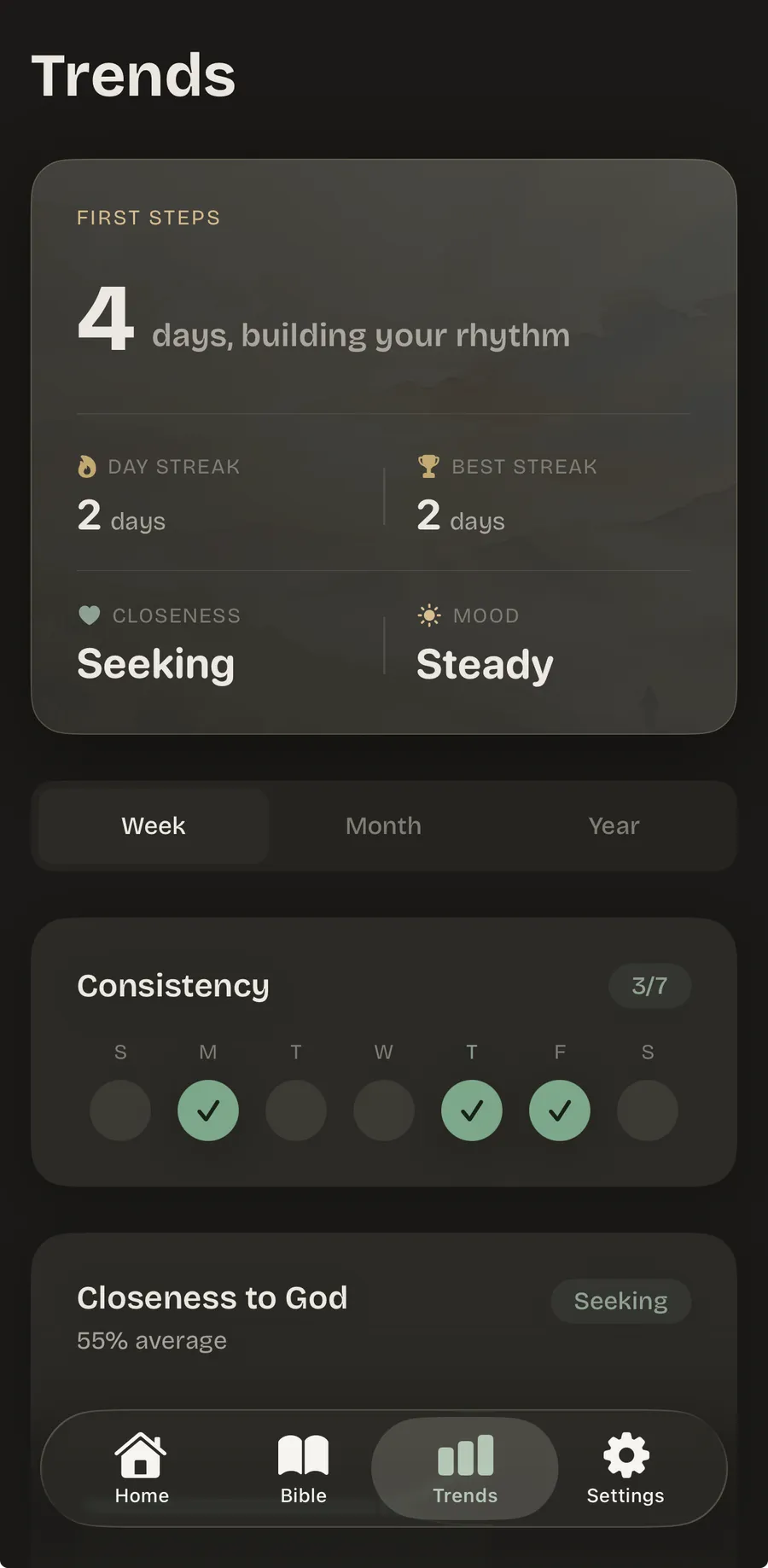
Here is the question every other article on this subject steps around, and it is the one people actually have. If you have finally built a daily rhythm — reading, exercise, language practice, anything held daily — does taking a day off undo it?
The habit research says no, and says it plainly. Reviewing habit formation in the British Journal of General Practice, Gardner, Lally and Wardle report that missing the occasional opportunity to perform a behaviour did not seriously impair the habit formation process, and that automaticity gains resumed after a missed performance. A weekly rest day is the definition of an occasional missed opportunity. It is not the thing that undoes a habit.
What actually breaks people is not the missed day but the accounting around it — the counter resetting to zero, the sense of starting again from nothing. That is a design decision made by app builders, not a fact about habits, and it is the argument we make at length in why streaks make people quit.
So if your tracker will reset on you, decide in advance what you are counting. Count kept weeks rather than kept days and a sabbath cannot break anything. Or put the rest day where the tool’s own allowance falls. Or simply agree with yourself that the number is the tool’s opinion about your week and not a verdict on it — which is true whatever app you use, and free.
There is a narrower point worth making, because it is the one thing a mechanic can settle that an argument cannot. A weekly sabbath is not just a miss that gets forgiven; it is a scheduled miss, on a seven-day cycle. In BlessUp grace refills after three kept days in a row — which means a once-a-week rest day falls inside the refill window every time, and an alternating on-off pattern never does. The rest day is the exact shape the mechanic was built to cover, and stating the limit is what makes that credible rather than promotional. See how grace days work.
A rest day genuinely costs nothing. A pattern of every-other-day is a different thing, and no mechanic should pretend otherwise. If the miss was not planned and you are wondering how to come back, what to do when you miss a day covers that separately.
When the phone is genuinely infrastructure
A last honesty, because most digital sabbath writing quietly assumes a reader with no dependants and no obligations.
The phone is the map, the bank, the two-factor code, the boarding pass, and the way a parent in another city reaches you. For some people it is also the insulin monitor, the shift roster or the only line to a person who might need help. A sabbath that requires the device to be off entirely is not available to those readers, and telling them otherwise is telling them the practice is not for them.
So the sabbath is from a named thing rather than from the device: from feeds, from the news, from work email, from whatever it is you would actually be doing. That is not a watered-down version. Setting down the specific thing that has a hold on you is closer to the point than a blanket ban you keep by luck.
And where the deeper question is what attention is doing to you rather than how many hours it takes, screen time read as a spiritual problem rather than a productivity one goes further than a day off can, as does the practical work in how to stop doomscrolling. If you want the mechanics of how a daily rhythm holds across a rest day before trying one, our frequently asked questions cover it.
Frequently asked questions
What is a digital sabbath?
A scheduled interval of complete detachment from digital devices, usually recurring weekly. The 2025 Frontiers review names the practice in exactly those terms. The useful version defines what the time is for rather than only what is switched off, since a sabbath in Scripture is the presence of something else rather than the absence of work.
How do you start a digital sabbath without quitting everything at once?
Climb rather than jump. Begin with two hours in which nobody needs you, then one evening, then a morning, then a full day, moving up only when the current rung has stopped feeling difficult. The review evidence favours gradual reduction over abrupt cessation, which is the opposite of the usual twenty-four-hour advice.
Does taking a day off screens break a reading habit?
No. Gardner, Lally and Wardle found that missing the occasional opportunity to perform a behaviour did not seriously impair habit formation, and that automaticity resumed afterwards. A weekly rest day is exactly that kind of occasional miss. What damages the habit is usually the accounting around the miss rather than the miss itself.
What do you do all day without a phone?
Decide before the day starts, or the hours will feel like a vacuum and get filled by whatever is nearest. Worship, a long meal, people you only see in a hurry, a walk, a book, work with your hands, sleep. The question is the whole practice: a sabbath is defined by what the day is for, not by what has been switched off.
The day off is not a gap in the habit. It is the shape the habit was always meant to have.
No guilt. Ever. Grace is built in. Funded by readers, never by ads.