Fasting From Your Phone
By Dom · · 12 min read
You have the date picked. Maybe it is the first of the month, maybe it is the Monday after a night that ended at 1am with a feed still open. And you have noticed that every page you read about it uses a different word. One calls it a phone fast, the next a digital detox, a third a screen sabbath, and all three describe roughly the same thing: put the phone away, feel better, come back.
They are not the same thing. Each is a real practice with its own purpose, its own length and its own way of going wrong, and the one you pick changes almost every practical decision after it. This is a guide to telling them apart, and to the part of a phone fast most plans leave out: what goes into the time you get back.
Key takeaways
- A phone fast, a digital detox and a screen sabbath are three different practices. A fast is directed toward something, a detox resets a pattern, a sabbath is a rest that comes back every week. Pick by what you want, not by the word you found first.
- The research is real but uneven. A scoping review of 14 studies found digital detox may ease depression and problematic internet use, with the most benefit for people struggling most, while effects on overall well-being stayed variable.
- Length is the wrong first question. Across 20 habit studies of adults, health habits took a median of 59 to 66 days to form, so a one- or two-week fast is not meant to rewire anything. It is for what it is directed toward.
- Plan the substitution, not only the subtraction. Name what fills each hour the phone used to take before day one.
- You do not have to announce it. Jesus’s teaching on fasting in Matthew 6:16–18 is mostly about not performing it, which is worth weighing against the usual advice to go public.
A fast, a detox and a sabbath are three different things
Fasting is a real spiritual discipline with a long history in the church, and going without a phone is an application of that idea, not an equivalent of it. Skipping Instagram is not the same as skipping food, and nobody needs to pretend it is. But the old practice has something to teach the new one. A Christian fast has never been defined by the going-without. It is defined by what it is directed toward: a fast makes room, and the point is the room.
A digital detox borrows a different idea, closer to a reset. It assumes the phone has built up a pattern you want to interrupt, sets a length, and aims to come out the other side changed. A sabbath is different again. It is not a break you take once; it is a rest that returns every week, and it works because it repeats.
All three leave the phone in a drawer, so from the outside they look identical. From the inside they ask different questions, and a plan built for one will quietly fail at the other two.
| Phone fast | Digital detox | Screen sabbath | |
|---|---|---|---|
| What it is for | Making room for something specific | Interrupting a pattern you want to break | Resting, on a rhythm that repeats |
| Typical length | An evening to a few weeks, set by its purpose | A fixed number of days or weeks, chosen in advance | One day, every week |
| Directed toward | Prayer, Scripture, a person, a decision | A different relationship with the phone afterwards | Rest itself, and the people you rest with |
| What replaces the phone | Named in advance, hour by hour | Often nothing, which is the usual weak point | Worship, a meal, a walk, sleep |
| How you know it worked | The thing it was for got the time | What you still do once it ends | It keeps coming back each week |
| How it usually goes wrong | It turns into a willpower test with no object | Everything returns on the last evening | It starts as an all-day rule on the first try |
If the detox or sabbath column is closer to what you are after, that is worth knowing before you start, and the digital wellness guides go into each of them in full. The rest of this post is about the first column: the fast.
What the research on time away from your phone actually shows
The most useful summary of the evidence is also the most honest one. A scoping review of digital detox research, following the PRISMA-ScR reporting approach, searched PubMed in December 2024, found 14 eligible studies and drew on 640 citations. Its conclusion was careful. Digital detox interventions may ease depression and problematic internet use, and people with higher symptom severity at the start appeared to benefit most. The effect on broader outcomes, such as life satisfaction and overall well-being, remained variable.
The review also notes that the studies did not test one thing. Some were short breaks from social media altogether; others were sustained, moderate limits on devices. That spread is part of why the results disagree, and it is a good reason to be wary of any page that promises a specific outcome from a specific number of days.
So a phone fast is not a guaranteed mood repair, and if you feel much the same at the end of it, nothing has gone wrong. If you were having a genuinely hard time going in, the evidence suggests you are the person most likely to notice a difference. If you were doing fine, the value of a fast may simply lie somewhere a well-being questionnaire does not measure.
How long, and why length is the wrong first question
“How long should a phone fast be?” is the question almost everyone asks first, and it is the one that matters least. The length should come from the purpose. A fast to pray through a hard decision might be one weekend. A fast so your evenings belong to your family might be two hours a night for a week. A fast to read a book of the Bible without interruption lasts as long as the book.
What length cannot do is install a new habit, and it helps to know that going in. A systematic review of how long health habits take to form pooled 20 studies and 2,601 adult participants working on behaviours like exercise, healthy eating, drinking water and flossing. None of them was about phones. Median times to form a habit ran from 59 to 66 days, and individual times ranged from 4 days to 335. In one of the included studies, only 23% of participants reached the researchers’ threshold for a formed habit at all.
Read that 23% the right way. It is not a prediction that you will struggle. It says that even motivated adults working on simple behaviours mostly had not finished forming a habit by the time the study was over, which means a fortnight away from your phone was never going to be what settles it. That takes the pressure off. A one-week fast does not have to change your life. It only has to do what it was for.

The substitution is the plan
Most phone-fast plans are lists of things to remove: delete this app, turn off that setting, move the charger to the kitchen. Removal is the easy part, because it is new and it has a start date. What decides the fast is the hour after dinner on day three, when the phone is gone and nothing has taken its place.
That is where a Christian fast parts ways with a willpower challenge. If a fast is directed toward something, the something is the plan, and it deserves to be as specific as the list of apps. Not “spend more time with God,” but “read one chapter at the table where I used to scroll.” Not “be more present,” but “walk the dog without earbuds and call my sister on the way back.”
A few pairings worth writing down before you start:
- The first minutes after waking: Scripture or a short prayer, in the chair where you would otherwise check messages.
- Waiting in a queue, a car park or an office: a paper book, or nothing at all. Boredom is allowed.
- The last hour before bed: the phone charges in another room, and whatever you read comes off a shelf.
- The reflex reach: decide in advance what your hand does instead. A notebook, a one-sentence prayer, a glass of water.
It also helps to know what you are switching off. A phone is less one habit than a steady stream of small interruptions. In Common Sense Media’s 2023 study of about 200 Android-using 11- to 17-year-olds, over half received 237 or more notifications a day. Adults are a different population and your own count may be far lower, but finding your real screen-time number first tells you how much room a fast will actually open.
Subtraction on its own is also why app blockers so often get switched off: they take something away and put nothing in its place. Pairing each removed habit with a named replacement is the same idea behind treating screen time as a spiritual problem rather than a scheduling one.
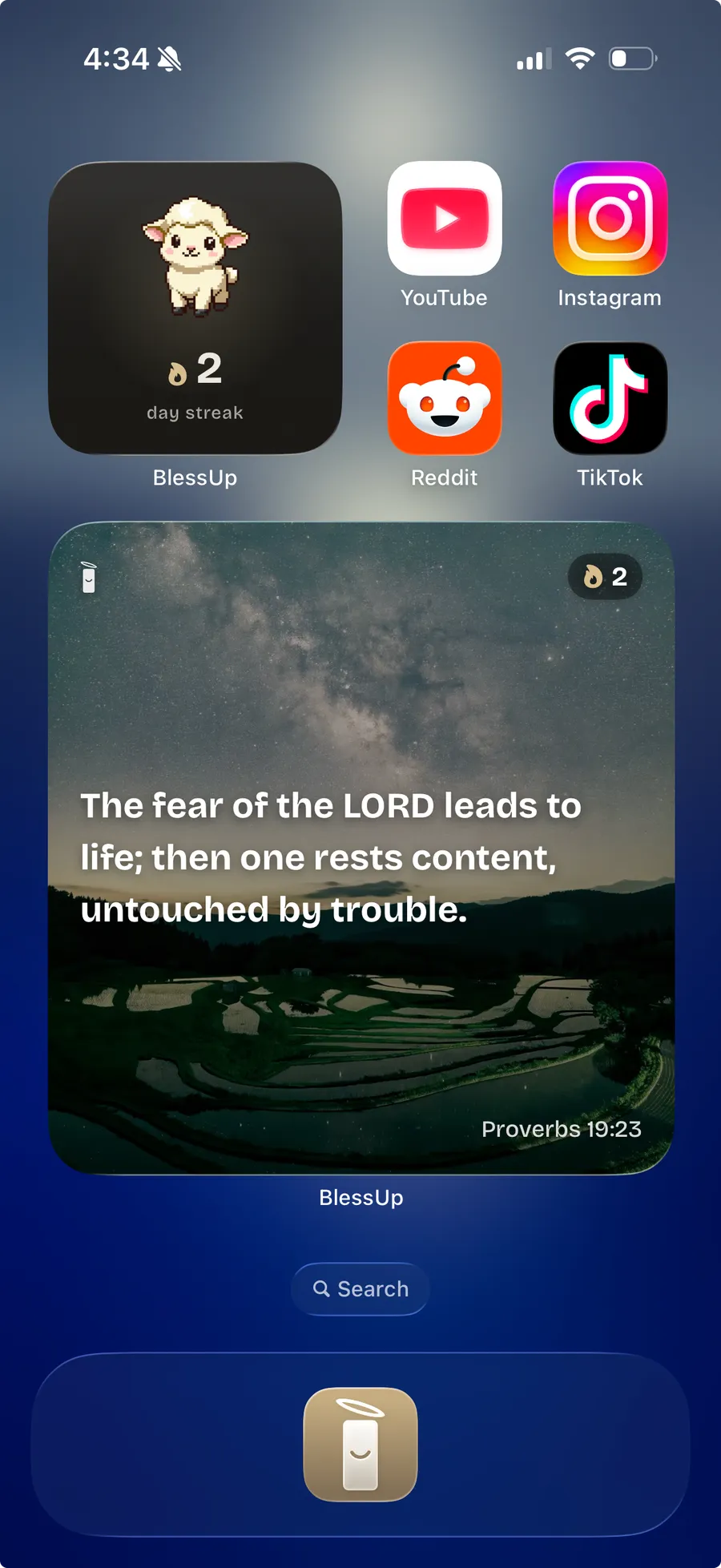
The hardest day of a fast is the one after it ends, when the apps come back and the replacement you planned has no reason to stay. BlessUp keeps the trade going once the fast is over: the apps you choose stay shielded until you have read the day’s chapter, about nine minutes, so your phone starts opening the Bible instead of closing it. It is built on Apple’s Screen Time, not a reminder you swipe away. BlessUp is free to download on the App Store.
Fast quietly
Most advice on this topic says the same thing about accountability: announce your phone fast. Post that you are going offline, tell the group chat, make it public so it is harder to quit. That genuinely helps some people, and if you have already told a friend, you have done nothing wrong.
But it is worth setting beside what Jesus taught about fasting, which is mostly about not performing it. In Matthew 6:16–18, He warns against putting on a somber face to show others you are fasting, and tells His listeners to wash their faces instead, “so that it will not be obvious to others that you are fasting” (NIV), but only to the Father, who is unseen.
That passage is about fasting, not phones, and Jesus was not talking about screen time. The application here is an inference for you to weigh, not a ruling: if a phone fast is directed toward God, it does not need an audience, and a public announcement can quietly shift what it is directed toward. A fast that opens with a post about going offline has already given the phone a part in it. We are a small team who build an app, not pastors, so for what fasting should look like in your own life, your pastor or church is the better guide.
Quiet does not mean unreachable. If people depend on getting hold of you, tell them how, plainly and privately. Just skip the announcement.
When a phone fast is the wrong tool
A fast is short and bounded, and some problems are not. If the reach for the phone happens dozens of times a day and a fortnight away mostly postpones it, the thing to look at may be a daily rhythm rather than another break. How to stop doomscrolling covers that everyday version.
A fast is also the wrong tool when the phone is doing work that cannot stop: a job that needs you reachable, a parent who relies on a call, a map, a bank, a medical app. Fast from the feeds, not from the infrastructure. And if what you are carrying is closer to persistent low mood than distraction, the scoping review cuts both ways. Time away may help, but it is not a substitute for talking to a doctor or someone you trust.
Frequently asked questions
What is a phone fast?
A phone fast is a set period of going without your phone, or without certain apps, directed toward something specific such as prayer, Scripture or the people around you. It borrows the idea of Christian fasting, where what the time is for matters more than what you give up.
How long should a phone fast be?
As long as its purpose needs: an evening, a weekend or a few weeks. A review of 20 habit studies in adults found health habits took a median of 59 to 66 days to form, so a short fast will not rewire a habit on its own, and it does not need to.
Is a phone fast the same as a digital detox?
No. A digital detox is a fixed-length reset meant to interrupt a pattern, while a phone fast is directed toward something specific. A screen sabbath is a third practice again: a rest that repeats every week.
Does fasting from your phone actually work?
Partly. A scoping review of 14 studies found digital detox may ease depression and problematic internet use, with the most benefit for people whose symptoms were most severe at the start, while effects on life satisfaction and overall well-being were variable.
What should you do instead of using your phone during a fast?
Decide before you start. Pair each habit you remove with a named replacement: Scripture or a short prayer in the first minutes after waking, a paper book while waiting, and the phone charging in another room before bed.
A fast is not time away from something. It is time toward something, and the toward is the part worth planning.
No guilt. Ever. Grace is built in. Funded by readers, never by ads.