How to Protect Your Attention as a Christian
By Dom · · 12 min read
You meant to pray this morning and instead you read a headline, then three replies to the headline. At lunch you meant to call your mother and you watched four minutes of something you cannot now name. By nine at night the good attention is spent and what is left over goes to the people you love most.
The sermons on this are right that it matters. They tend to stop at “be more disciplined,” which is where most of us have already been trying. The more useful finding is that attention is shaped far more by what surrounds you than by how hard you resolve — which means it can be designed rather than merely willed.
Key takeaways
- Attention is formative. What you attend to daily shapes what you become, which is why this is a spiritual question and not a productivity one.
- The pressure is industrial. Gloria Mark's team measured average time on a screen before switching at about two and a half minutes in 2003 and about 47 seconds in recent years.
- Willpower is the wrong lever. Environment decides most of it. Change what is within reach before you try to change how hard you concentrate.
- The first-attention rule: whatever gets your attention first sets the terms for the day. Decide that one thing and let the rest follow.
- Reclaimed attention does not stay empty. Name what fills the protected hour before you protect it, or the feed will fill it back.
Why attention is a spiritual matter
That attention is formative rather than merely spent — that what you look at repeatedly shapes what you want and what you find normal — is the argument of screen time as a spiritual problem, and it is worth reading there rather than repeated here. Paul's version is Philippians 4:8 (NIV), where the instruction is to think about whatever is true, noble, right, pure, lovely and admirable — a direction for attention rather than a point of doctrine. This post takes that as given and goes after the method.
What is worth adding is that the researchers who measured mind-wandering noticed the same tradition from the outside. Matthew Killingsworth and Daniel Gilbert wrote in Science that “many philosophical and religious traditions teach that happiness is to be found by living in the moment, and practitioners are trained to resist mind wandering and to ‘be here now.’” Their own data found minds wandering 46.9% of waking hours, and that the wandering typically made people less happy. Their sample was 2,250 volunteers who downloaded an app, so it is not representative of anyone in particular, and prayer and worship were a vanishingly small share of the moments it captured. But the direction is suggestive: an unanchored mind is not a happy one, and the traditions were onto something.
None of which is a reason to feel behind. The point is the opposite — if attention is mostly environmental, then a distracted year says something about your surroundings rather than about the state of your soul.
What you are up against, in numbers
It helps to see the scale, because most people privately assume their distraction is a personal defect.
Gloria Mark's team at UC Irvine has been measuring how long people stay on one screen before switching to another. In 2003 the average was about two and a half minutes. By 2012 it was 75 seconds. In recent years it has been about 47 seconds, a result others have replicated at 44 and 50 seconds. Read that carefully: it is a measure of screen-switching during computer work, not a measurement of the human attention span, and it does not mean people cannot concentrate for longer than 47 seconds. What it does show is how the environment has changed underneath everybody in twenty years.
The inputs arriving have changed too. Common Sense Media's 2023 Constant Companion report, which collected data from young people's own phones, found that over half of the 11- to 17-year-olds in the study received 237 or more notifications a day. That is a teenage sample rather than an adult one, but if you have wondered why your own children look like they are being paged by something, that is roughly the answer.
And the device is not optional for most people: Pew Research Center found 91% of US adults own a smartphone in its 2025 survey of 5,022 adults. This is the water. You are not weak for finding it hard to swim in.

Why trying harder does not last
Resolve works, briefly, and then it does not. There is nothing mysterious about why.
Concentrating in the presence of something you have told yourself not to look at is a second task running alongside the first one, and it draws on the same limited supply. You get through Monday on determination. By Thursday, determination is what you used to get through Monday, Tuesday and Wednesday, and there is less of it. Anything that depends on your being at your best on your worst day is not a plan.
This is the same reason app blockers stop working for most people: a tool that asks for a decision in the moment of temptation has put the decision in exactly the wrong place. And it is why treating it as a discipline problem tends to produce guilt rather than change.
The alternative is to move the decision earlier, to a moment when you are calm, and to make it once. That is what designing an environment means.
Design the environment: fewer inputs, protected hours
Two moves, in this order. The first is subtraction from the inputs; the second is protection of specific hours.
Fewer inputs. Go through notifications once, properly, and allow only the ones from a human being who is expecting a reply. Everything else — every app announcing its own activity, every badge, every marketing message — is off. This takes about fifteen minutes and is the highest-return quarter hour available to most people. Do it sitting down, in one pass, rather than one dismissal at a time over six months.
Protected hours. Pick one hour a day that is genuinely yours and defend it with something structural rather than with intention: a door, a location, a device left elsewhere, a setting that does not ask you again. One protected hour that actually holds is worth more than an all-day ambition that collapses by ten.
Before you change anything, though, it is worth knowing what is actually happening. Most advice on this skips the measuring step, which is how people end up solving a problem they do not have. Spend a week on this audit first.
| Day | The question | Where the answer is |
|---|---|---|
| 1 | What got my first attention today? | Your own memory, written down within a minute of waking |
| 2 | How many notifications did I allow yesterday? | Settings, notification list; count the apps permitted, not the alerts |
| 3 | Which hour of yesterday was genuinely protected? | Your calendar next to your Screen Time hourly graph |
| 4 | What are my top two apps, and did I choose them? | Screen Time, most-used |
| 5 | How many times did I pick the phone up? | Screen Time, pickups — compare it with your guess before you look |
| 6 | What did I fill my protected hour with? | Honest recall; if the answer is nothing, that is the finding |
| 7 | Which single change would I keep? | Days 1 to 6. Choose one. Not four. |
One change kept for two months beats six changes kept for a week, and the timeline here is longer than most people expect — how long a habit takes puts it in months rather than weeks.
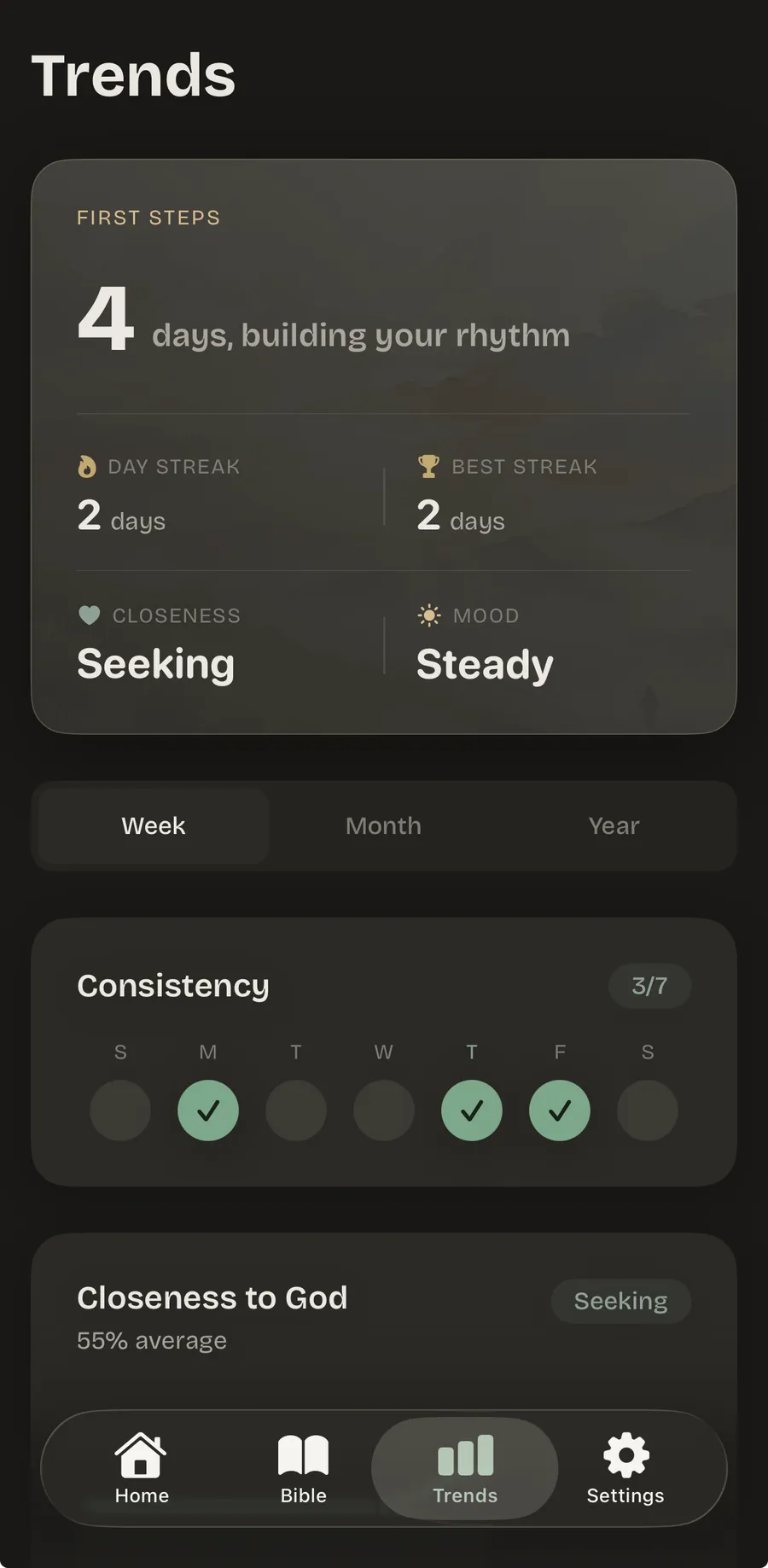
If the audit says your first attention goes to a feed most mornings, that is the one worth changing, and it is a setting rather than a character trait. BlessUp keeps the apps you pick closed until the day's chapter is read, so the feed stops being what your attention lands on first, by setting rather than by effort — about nine minutes on a year-long plan, with the window afterwards set to fifteen minutes, an hour, or until a reset hour you choose. See how the reading gate works
The first-attention rule
Of all the hours, one matters more than the rest, and it is the first.
Be careful about why, though, because the usual version of this claim does not survive checking. We have checked the morning-phone claims, and the popular one — that checking your phone sets the chemical tone of your whole day — is not supported by the evidence. Some of it points the other way, with mood predicting phone use rather than the reverse.
What survives the checking is simpler, and the case for it is made in full over there: your first attention is the only stretch of the day nobody else has claimed yet. That is what makes it the one slot worth deciding in advance rather than discovering after the fact.
So make one decision and make it in advance: the first thing that gets my attention is ___. Fill the blank with something concrete enough to start half-awake, which rules out most ambitious answers. Then arrange the room so that thing is easier to reach than the phone: put it where the phone was, and charge the phone somewhere else.
It will not work every day, and it does not need to. A rule kept most mornings is a rule. If you want the argument for why a partly-kept rule is still worth having, grace days rather than streak-shaming is the longer version.
What to fill it with
Here is the part people skip, and skipping it is why reclaimed attention leaks back.
Attention does not stay empty. Take the phone out of the first twenty minutes of the day and something will move into that space within a week, and if you have not chosen what, the thing that moves in will be whatever is nearest — which is usually the phone again, arriving through a side door.
So name it in advance. Paul's list is a reasonable filter, and it is broader than people expect: true, noble, right, pure, lovely, admirable, excellent, praiseworthy. That is not only Scripture and prayer. It is a real book, a walk, a conversation with the person in your house, music with something in it, work you can lose yourself in properly. A rough test we use, which is ours rather than Paul's: does it give back more than it takes?
Start with one slot and one filler, and let the rest wait. We are app builders rather than pastors, so for the spiritual direction side of this — what to make of a distracted season, what your own attention is telling you — your pastor is the right person to ask. You can read more about why we built this if you are curious where the advice is coming from.
Frequently asked questions
What does the Bible say about distraction?
It does not address distraction as we experience it, since nothing like a smartphone existed when it was written. What it speaks to repeatedly is where the mind rests. Philippians 4:8 lists what to think about - whatever is true, noble, right, pure, lovely and admirable - which is an instruction about the direction of attention rather than about concentration as a skill. Applying it to notifications is inference on our part rather than something the text addresses directly.
How can Christians guard their minds from distraction?
Mostly by changing what surrounds them rather than by trying to concentrate harder. In practice that means three things: cutting notifications back to messages from actual people, protecting one hour a day with something structural like a closed door or a phone in another room, and deciding in advance what gets your attention first in the morning. Resolve alone tends to hold for a few days and then run out, which is a design problem rather than a spiritual failure.
Why is it so hard to pay attention to God?
Partly because a wandering mind is the human default - one study that sampled 2,250 volunteers at random moments found minds wandering 46.9% of waking hours - and partly because the modern environment is unusually good at fragmenting attention. Research from UC Irvine measured average time on a screen before switching at about 47 seconds in recent years, down from about two and a half minutes in 2003. Difficulty here is ordinary rather than diagnostic of your faith.
How do I stop living distracted?
Measure before you change anything. Spend a week finding out what actually gets your first attention each morning, how many apps you have allowed to interrupt you, and which hour of your day is genuinely protected. Then make one change and keep it for two months rather than six changes for a week. The single highest-return change for most people is turning off every notification that is not a human being expecting a reply.
Is being distracted a sin?
Scripture speaks about what we set our minds on rather than about how long we can concentrate, and a wandering mind is something every person has. Framing ordinary distraction as sin tends to produce guilt without producing change, which helps nobody. If the question behind this one is troubling you, it is worth taking to your pastor, who knows you and can answer it properly. We build apps rather than give spiritual counsel.
Read a chapter. Your apps open. BlessUp is free to download on the App Store.
No guilt. Ever. Grace is built in. Funded by readers, never by ads.