How Long Does It Really Take to Build a Habit?
By Dom · · 9 min read
Twenty-one days is the number everybody knows, and it is the one number in this whole subject that has no study behind it at all. It comes from a 1960 self-help book by a plastic surgeon who noticed his patients took about three weeks to get used to their own faces.
The real answer is less tidy and much more useful, because it comes with the variables attached. Here is what the research says, and what it implies for a habit you are trying to start this month.
Key takeaways
- The best current estimate is a median of 59 to 66 days, from a 2024 meta-analysis of 20 studies covering 2,601 people.
- The individual range was 4 to 335 days. An average is not a deadline, and the spread is the actual finding.
- 21 days is not a research figure. It traces to Psycho-Cybernetics (1960), an observation about surgical patients that was never tested.
- Missing one day does not undo the work. The 2010 study that produced the famous 66-day average found a single missed opportunity did not materially affect habit formation.
- Morning beats evening, and chosen beats assigned. The meta-analysis found habits practised in the morning and habits people picked themselves formed faster and stronger.
What the research actually says
The most complete answer available comes from a 2024 systematic review and meta-analysis by Singh, Murphy, Maher and Smith at the University of South Australia, published in Healthcare. It pooled 20 studies covering 2,601 participants, with mean ages ranging from 21.5 to 73.5 across the samples, and looked at behaviours including physical activity, drinking water, flossing and dietary change.
Four of those studies reported a time to habit formation. The medians clustered at 59 to 66 days. The means ran considerably higher, 106 to 154 days. And individual participants ranged from 4 days to 335.
| The number | Where it comes from | What it actually is |
|---|---|---|
| 21 days | Psycho-Cybernetics, 1960 | A surgeon’s observation that patients took about three weeks to adjust to their appearance. Never tested as a habit claim. |
| 66 days | Lally et al., 2010, n=96 | The average time to reach 95% of an individual’s automaticity ceiling. The range behind it was 18 to 254 days. |
| 59–66 days | Singh et al., 2024, 20 studies, n=2,601 | The pooled median. Means ran 106 to 154 days; individuals ranged from 4 to 335. |
Two months is a fair working expectation. But the honest headline is the width of the distribution, not its centre.
The researcher’s own objection
Phillippa Lally, whose 2010 study produced the 66-day figure, is now a Senior Lecturer in Psychology at the University of Surrey, and she has been asked about it enough times to have a short answer. Does it take 66 days to form a habit? In her words: “for most people most of the time, no.”
Her point is that the study’s real result was the variability. Her 2010 paper followed 96 volunteers who each adopted one daily behaviour and rated how automatic it felt over twelve weeks. Time to reach 95% of an individual’s automaticity ceiling ranged from 18 to 254 days — a fourteen-fold spread, on behaviours as small as drinking a glass of water with lunch.
What she does point to as practical is planning: deciding in advance when and where the thing will happen, rather than intending to do it generally. That is a much better lever than counting days.

What actually shortens the number
This is the part worth acting on, and the 2024 meta-analysis is unusually specific about it. Habits formed faster or held more strongly when:
- The behaviour happened in the morning. Morning practice showed enhanced formation compared with evening practice. This is the single most actionable finding in the paper.
- The person chose the habit themselves. Self-selected habits were stronger than assigned ones — which is a real limit on any habit somebody else has set for you.
- The context stayed the same. Stable, consistent surroundings made the behaviour automatic sooner. Same chair, same hour, same trigger.
- There was a specific plan. Implementation intentions — a named when and where — predicted success, matching Lally’s own advice.
- The person enjoyed it. Affective enjoyment promoted habit strength. Grim endurance is not the efficient route.
Read as a recipe: pick it yourself, do it in the morning, in the same place, at a size you do not dread. That combination is doing more for you than any particular day count.
What happens when you miss a day
This is the question underneath the question, and it has a clean answer from the 2010 study. Reading directly from the published abstract: missing one opportunity to perform the behaviour did not materially affect the habit formation process.
One day is not a reset. The automaticity curve is not a streak counter, and it does not have a zero to go back to. What does damage the process is what people do after a missed day — abandoning the attempt, or trying to repay it with a double portion that is harder than the original commitment and therefore also gets missed.
It is worth being careful about how far this evidence stretches. A qualitative study of 21 recreational runners with streaks from 100 to more than 4,500 days, published in Health Psychology and Behavioral Medicine, found genuine benefits from the commitment structure alongside genuine costs: running through injuries, skipping recovery, and stress when routines were disrupted. The authors explicitly note that what happens when a streak breaks is understudied. Anyone telling you exactly what a broken streak costs is going beyond the evidence, ourselves included. Why streaks make people quit goes into that gap in more detail.
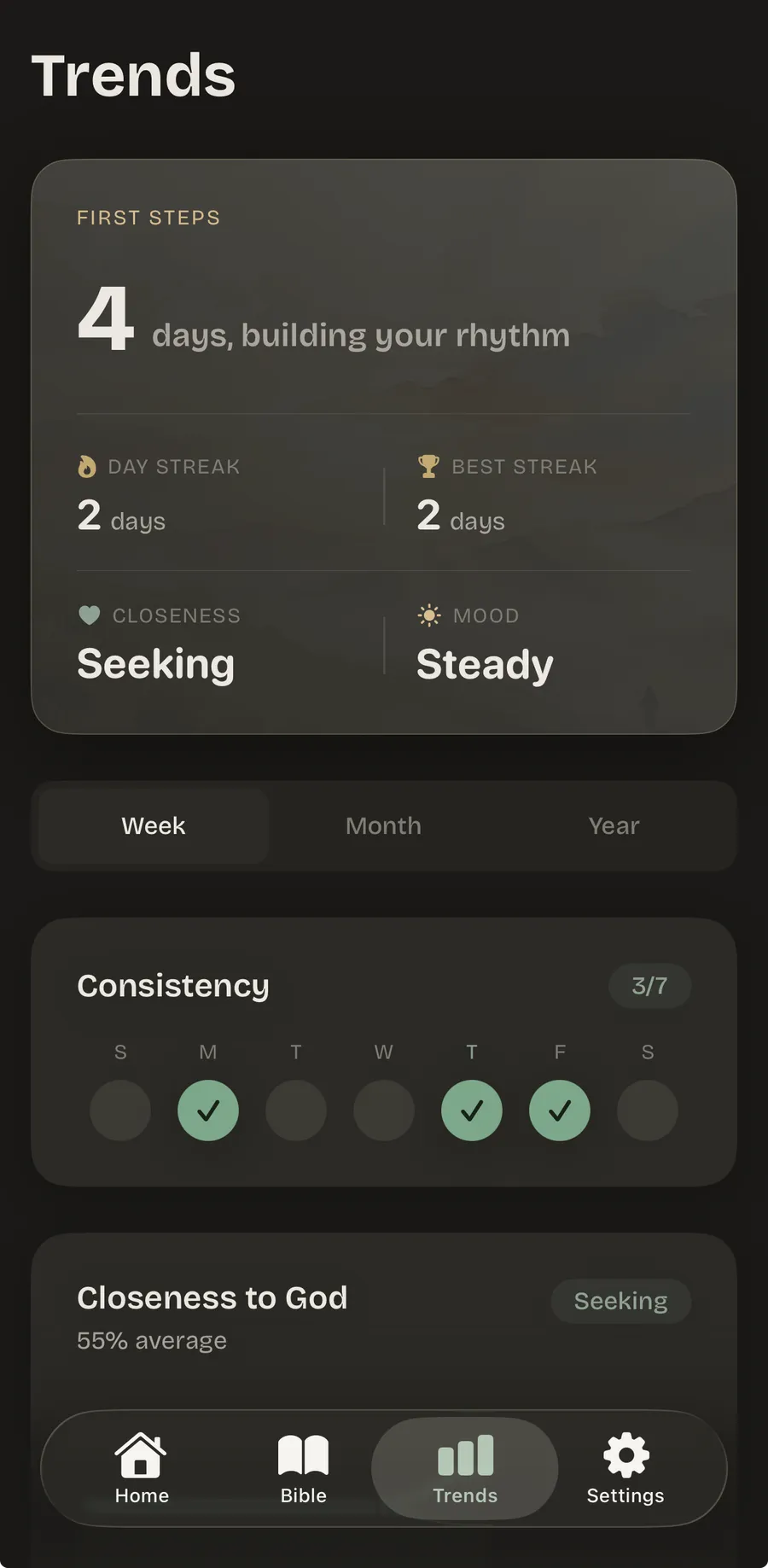
If two months is the realistic window, the design question is what happens on day nineteen when you forget. BlessUp answers it by covering the miss instead of resetting: a grace day absorbs one missed day automatically, and grace only refills after three kept days in a row, so it cannot be gamed into a permanent alternate-day habit. The app’s own words for the morning after are “your place is held, nothing was lost.” See how grace days work.
What this means for a reading habit
Daily Scripture reading fits the profile of a habit that should form near the faster end, for reasons that are structural rather than spiritual.
It is self-selected, which the meta-analysis found matters. It suits the morning, which the meta-analysis found matters more. It happens in a stable context — the same chair, before the day starts. And the size is fixed and known in advance: about nine minutes a day covers the Protestant canon in a year, which the arithmetic on reading the Bible in a year works out from real word counts.
The variable most people get wrong is size. A habit set at the level of a good day will be missed on an ordinary one, and each miss is a decision point you did not need to create. If you are starting from nothing, a reading plan for beginners is built around that principle, and how to build a morning prayer routine that sticks covers the same problem on the prayer side.
How to set it up so the odds are with you
- Name the when and the where. Not “more Bible this year.” “After the kettle boils, in the kitchen chair.” This is the single best-supported technique in the literature.
- Put it in the morning if you can. The meta-analysis found morning practice formed habits better than evening. If mornings are impossible for you, the second-best option is the most repeatable hour you have, not the ideal one.
- Pick a size for your worst day. Whatever you can do when you are tired, late and irritable. The good days will take care of themselves.
- Plan the missed day now. Decide, today, that a miss means you do the normal amount tomorrow. Not double. This decision is much easier to make well before you need it.
- Give it sixty days before judging it. Not twenty-one. If it still feels effortful at week four, that is inside the normal range and not a verdict.
And do not measure yourself against the average. The whole point of a 4-to-335-day range is that the average describes nobody in particular. If you want to know where the app’s design decisions on this come from, the story behind BlessUp covers why grace was built in before streaks were.
Zechariah 4:10 asks who dares despise “the day of small things” (NIV). It is a fair question to put to anyone counting down to day twenty-one.
Frequently asked questions
How long does it really take to form a habit?
The best current estimate is a median of 59 to 66 days, from a 2024 meta-analysis of 20 studies covering 2,601 participants. But the same analysis found individual times ranging from 4 to 335 days, and mean times of 106 to 154 days. Two months is a reasonable expectation; it is not a deadline.
Is the 21-day rule true?
No. It originated in the 1960 self-help book Psycho-Cybernetics, where the plastic surgeon Maxwell Maltz observed that his patients took about 21 days to adjust to their new appearance after surgery. It was an observation about adaptation, not a study of habit formation, and it was never tested as one.
Does missing one day break a habit?
No. The 2010 study by Lally and colleagues, which followed 96 people forming daily habits over twelve weeks, found that missing one opportunity to perform the behaviour did not materially affect the habit formation process. What causes damage is abandoning the attempt after the miss, or trying to make it up with a double portion.
What makes a habit form faster?
The 2024 meta-analysis found habits formed faster or held more strongly when they were practised in the morning rather than the evening, when the person chose the habit themselves rather than being assigned it, when the context stayed consistent, when there was a specific plan for when and where, and when the person actually enjoyed the behaviour.
Why does the research give such a wide range?
Because habits differ enormously in complexity and so do people. Drinking a glass of water with lunch and running for fifteen minutes before dinner are not the same task, and the original study found an eighteen-to-254-day spread even across simple daily behaviours. The width of the range is the finding, not a flaw in it.
One chapter is the only key. See what your mornings look like on the other side of it.
No guilt. Ever. Grace is built in. Funded by readers, never by ads.