An Advent Bible Reading Plan for 2026
By Dom · · 11 min read
The wreath gets lit on the first Sunday and everything is fine. By the second week the plan is four days behind, because December is the one month whose calendar was already full before anyone added a devotional to it. This is not a discipline problem. It is a design problem: most Advent plans are built for a month that does not exist.
So here is the version that fits the month you actually have. Twenty-six readings for the twenty-six days of Advent 2026, the real lectionary readings if you would rather follow your church, and an honest answer to the question that decides whether any of it lasts — what happens on December 26.
Key takeaways
- Advent 2026 runs Sunday, November 29 to Thursday, December 24 — 26 days, near the long end of the possible range.
- There are always four Sundays: November 29, December 6, December 13 and December 20.
- Advent 2026 begins lectionary Year B, so the Sunday Gospels come from Mark, and the fourth Sunday is Luke’s annunciation.
- The last week is its own tradition. From December 17 to 23 the Church has sung the seven O Antiphons, one a day, since at least the eighth century.
- The plan below is one passage a day, most of them a single chapter or less, moving from the promise in Genesis to the stable in Luke 2.
When Advent starts in 2026, and why the date moves
Advent begins on the fourth Sunday before Christmas, which is why it never falls on the same date twice in a row. In 2026 that Sunday is November 29, and the season runs to Thursday, December 24. Twenty-six days.
That length is not fixed either. Because Advent always ends on Christmas Eve but always starts on a Sunday, the season is between three and four weeks long, with the first Sunday landing somewhere between November 27 and December 3. Do the arithmetic on that window and Advent can be as short as 22 days or as long as 28. In 2026 Christmas falls on a Friday, which pushes the fourth Sunday all the way out to December 20 and gives the season a full 26 days — four unhurried weeks rather than the compressed version you get when Christmas lands on a Monday.
The number matters more than it sounds. A 22-day Advent and a 28-day Advent are not the same commitment, and a plan written for one will not fit the other. Every plan and every date on this page is checked against 2026 specifically.
The four Sundays, and what each candle is for
Four Sundays, four candles. In many Protestant churches the four are named hope, peace, joy and love, lit one more each week so the wreath gets brighter as the season goes. The third Sunday is traditionally called Gaudete Sunday, from the Latin for rejoice, and its candle is often rose rather than purple — which makes more sense once you notice that the epistle appointed for that Sunday opens “Rejoice always”.
The naming is a widely-kept custom rather than a rule, and different traditions order it differently. If your church names them differently, follow your church.

A 26-day Advent Bible reading plan
This is our own plan, not a lectionary. It runs the shape of the story rather than the shape of a service: the promise, the prophets who carried it, the man who announced it, and the week it arrived. One passage a day, most of them a chapter or less, so a bad December evening still fits it. Sundays carry that week’s appointed readings so the plan and your church stay in step.
Week one — the promise (November 29 to December 5)
- Sun 29 Nov · Isaiah 64:1–9 and Mark 13:24–37 — the first Sunday, and a plea for God to tear the sky open
- Mon 30 Nov · Genesis 3:1–15 — the first promise, made on the worst day
- Tue 1 Dec · Genesis 12:1–7 — a family chosen for the sake of everyone else
- Wed 2 Dec · Genesis 22:1–18 — a son, a mountain, a substitute
- Thu 3 Dec · Exodus 3:1–15 — God gives His name
- Fri 4 Dec · 2 Samuel 7:1–17 — the promise of a throne that does not end
- Sat 5 Dec · Psalm 89:1–4, 19–29 — the same promise, sung
Week two — the prophets (December 6 to 12)
- Sun 6 Dec · Isaiah 40:1–11 and Mark 1:1–8 — comfort, and a voice in the wilderness
- Mon 7 Dec · Isaiah 7:10–17 — the sign of Immanuel
- Tue 8 Dec · Isaiah 9:2–7 — the people walking in darkness
- Wed 9 Dec · Isaiah 11:1–10 — a shoot from a stump
- Thu 10 Dec · Micah 5:2–5 — the town, named seven centuries early
- Fri 11 Dec · Jeremiah 33:14–18 — the promise repeated in exile
- Sat 12 Dec · Malachi 3:1–7 — the last word before four silent centuries
Week three — the waiting (December 13 to 19)
- Sun 13 Dec · Isaiah 61:1–11 and John 1:6–8, 19–28 — Gaudete Sunday
- Mon 14 Dec · Zephaniah 3:14–20 — God singing over His people
- Tue 15 Dec · Zechariah 9:9–12 — the king who arrives on a donkey
- Wed 16 Dec · Habakkuk 2:1–4 — waiting, as an assignment
- Thu 17 Dec · Matthew 1:1–17 — the genealogy, which is the whole plan in list form
- Fri 18 Dec · Matthew 1:18–25 — Joseph, told in a dream
- Sat 19 Dec · Luke 1:5–25 — an old priest who does not believe it either
Week four — the arrival (December 20 to 24)
- Sun 20 Dec · 2 Samuel 7:1–11, 16 and Luke 1:26–38 — the fourth Sunday, and the annunciation
- Mon 21 Dec · Luke 1:39–56 — the Magnificat
- Tue 22 Dec · Luke 1:57–80 — Zechariah gets his voice back
- Wed 23 Dec · Isaiah 52:7–10 — beautiful feet on the mountains
- Thu 24 Dec · Luke 2:1–20 — Christmas Eve
If you fall behind, do not double up to catch the date. Read the next one. The plan is a path, not a schedule, and the difference between those two is most of why people quit — something a 30-day reading challenge runs into for exactly the same reason.
The last eight days are different
From December 17 the season changes gear. Catholic weekday Masses switch to their own set of readings for December 17 to 24, and at Evening Prayer the Church sings the O Antiphons — seven short verses, one a night, each addressing Christ by a title drawn from the Old Testament. The Roman Church has sung them since at least the eighth century, and what ties them together is that every one is an imperative: Come.
| Date | Antiphon | A passage that carries it |
|---|---|---|
| December 17 | O Wisdom | Isaiah 11:2–3 |
| December 18 | O Leader of the House of Israel | Exodus 3:2 |
| December 19 | O Root of Jesse’s stem | Isaiah 11:1 |
| December 20 | O Key of David | Isaiah 22:22 |
| December 21 | O Radiant Dawn | Malachi 4:2 |
| December 22 | O King of all nations | Haggai 2:7 |
| December 23 | O Emmanuel | Isaiah 7:14 |
You do not have to be Catholic to use them. If you sing O Come, O Come, Emmanuel in December, you already know them: the hymn is a verse-by-verse translation of this list. Reading one antiphon and its passage each night from the 17th is the single easiest way to make the last week of Advent feel different from the first three, which is what the last week is for.
If you would rather follow your church
Advent 2026 opens a new lectionary year, and both the Revised Common Lectionary and the Roman Catholic lectionary move to Year B — the year built around Mark. Following the Sunday readings has one advantage no personal plan can match: you arrive at church having already read what you are about to hear.
| Sunday | Old Testament | Psalm | Epistle | Gospel |
|---|---|---|---|---|
| Nov 29 — Advent 1 | Isaiah 64:1–9 | Psalm 80:1–7, 17–19 | 1 Corinthians 1:3–9 | Mark 13:24–37 |
| Dec 6 — Advent 2 | Isaiah 40:1–11 | Psalm 85:1–2, 8–13 | 2 Peter 3:8–15a | Mark 1:1–8 |
| Dec 13 — Advent 3 | Isaiah 61:1–4, 8–11 | Psalm 126 or Luke 1:46b–55 | 1 Thessalonians 5:16–24 | John 1:6–8, 19–28 |
| Dec 20 — Advent 4 | 2 Samuel 7:1–11, 16 | Luke 1:46b–55 or Psalm 89:1–4, 19–26 | Romans 16:25–27 | Luke 1:26–38 |
Three places to get the daily version, depending on where you worship. The Vanderbilt Divinity Library publishes the full Revised Common Lectionary with weekday readings attached to each Sunday. The USCCB carries the Catholic daily readings. The Presbyterian Church (U.S.A.) posts daily readings for Advent 2026 drawn from the two-year daily lectionary in the 2018 Book of Common Worship, which is a different track again — useful if you want something that does not repeat annually. If none of that is familiar, and you do not currently have a congregation to follow, our guide to finding a church in a new city and the church finder are both built for exactly the week of the year when people start looking.
What happens on December 26
Every Advent plan has a flaw built into it, and it is the same flaw a New Year resolution has: an end date. On December 24 you finish, and on December 26 there is nothing to open. The habit does not decay slowly. It stops on a specific morning, and what replaced it in that slot is almost always a phone.
The fix is not a longer Advent plan. It is deciding, before the 24th, what the 26th looks like — a Gospel, a psalm a day, the year plan you meant to start in January anyway. Write the next thing down while you are still enjoying this one. That is the whole trick, and it is worth doing whether or not you use anything else on this page. If a day does go missing in the middle, the answer is genuinely just to read the next one.
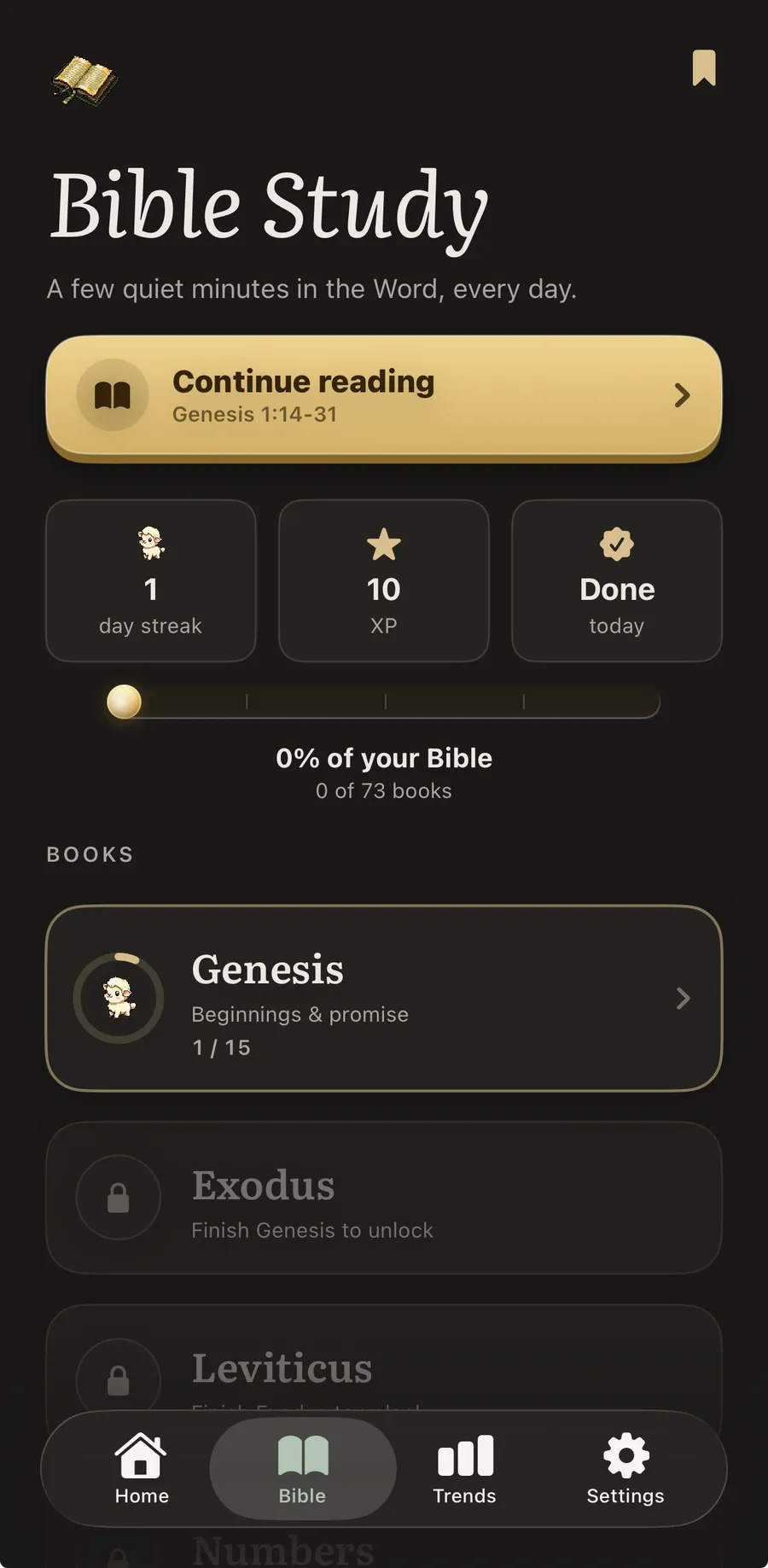
The reason December 26 is hard is that a season-shaped plan has no day 27, and nothing is holding your place when the season ends. BlessUp is built the other way round: it holds your place rather than counting down to one, so the morning after Christmas opens on the next passage rather than on nothing. Reading it is also what opens the apps you have shielded, and a missed day is absorbed by a grace day rather than resetting anything. See what it holds for you on the 26th
Advent is about waiting well, which is a skill, and skills are not seasonal. Habakkuk 2:3 puts it better than a devotional can: “Though it linger, wait for it; it will certainly come and will not delay.” That was written to people who had been waiting a long time, and it is the same instruction on December 26 as on November 29.
Frequently asked questions
When does Advent start in 2026?
Advent 2026 begins on Sunday, November 29 and ends on Thursday, December 24, Christmas Eve. That is 26 days. The four Sundays of Advent fall on November 29, December 6, December 13 and December 20.
How many days is Advent?
It changes every year, because Advent always ends on Christmas Eve but always begins on a Sunday. The first Sunday of Advent falls somewhere between November 27 and December 3, which makes the season as short as 22 days or as long as 28. Advent 2026 is 26 days.
What are the Advent readings for 2026?
Advent 2026 begins Year B of the three-year lectionary cycle, used by both the Revised Common Lectionary and the Roman Catholic lectionary. The Sunday Gospels are Mark 13:24-37, Mark 1:1-8, John 1:6-8 and 19-28, and Luke 1:26-38, the annunciation.
Do I have to follow a lectionary to read the Bible during Advent?
No. A lectionary is a shared schedule, not a requirement, and its advantage is that it lines your reading up with what your congregation will hear on Sunday. A personal plan that follows the story from promise to nativity works just as well, and either one is better than the plan you abandon in week two.
What are the O Antiphons?
Seven short verses sung at Evening Prayer from December 17 to 23, each addressing Christ by a title taken from the Old Testament, such as O Wisdom, O Key of David and O Emmanuel. The Roman Church has used them since at least the eighth century, and the hymn O Come, O Come, Emmanuel is a verse-by-verse translation of them.
Genesis to Revelation, about nine minutes at a time. Start tomorrow morning.
No guilt. Ever. Grace is built in. Funded by readers, never by ads.