How to Read the Psalms
By Dom · · 12 min read
You know Psalm 23 by heart, and maybe Psalm 51. So you decide to read the Psalms straight through. A few days in you open one that begins "How long, Lord? Will you forget me forever?" and a little later one that asks God to pay back an enemy, and somewhere around Psalm 30 the ribbon stops moving.
Nothing went wrong. Nobody told you the book has a shape, that its psalms come in a few recognisable kinds, or that the angry ones are there on purpose. This guide gives you all three, plus a pace for reading every one of the 150.
Key takeaways
- 150 psalms in five books: 1–41, 42–72, 73–89, 90–106 and 107–150. The first four end on the same blessing; the fifth ends on five hallelujah psalms, 146–150.
- Two big families, lament and praise. Laments fill much of Books One to Three; praise outnumbers them in Books Four and Five.
- Four kinds you can spot from the first line: praise (Psalm 117), lament (Psalm 13, "How long?"), royal (Psalm 72) and trust (Psalm 23).
- 73 psalms are connected to David by their headings, and 49 carry no name at all.
- One psalm a day reads all 150 in 150 days, about five months, and the day number is always the psalm number.
What the Psalms are, in one paragraph
The book of Psalms is a collection of 150 prayers, songs and poems addressed to God. Some are loud with praise. Some are quiet with trust. A great many are complaints, written by people who were frightened, grieving or angry and said so to God's face. Luther Seminary's Enter the Bible summary describes them as the prayers, hymns and meditations of Israel, and notes that believers in every generation have used them as models for their own response to God. That is the key to reading them. Most of the Bible speaks to you. The Psalms give you words to speak back.
They were not written at one time. Some come from the days of Israel's kings, and some, like Psalm 137, "by the rivers of Babylon," come from the exile centuries later. Christine Hayes, in her Open Yale lecture on biblical poetry, calls the book an anthology gathered from many centuries of Israel's history. That is why it sounds like many voices. It is.
The shape of the book: five books and a closing hallelujah
Most people read the Psalms as a pile of separate poems. They are not a pile. BibleProject's guide to Psalms points out that the book is divided into five smaller books, and many Bibles print the headings "Book One" to "Book Five" right in the text. Each of the first four books ends with almost the same line, a short blessing that closes with "Amen and Amen." The fifth ends differently, with five psalms in a row, 146 to 150, that each begin and end with "hallelujah," which means "praise the Lord."
The front door is just as deliberate. Psalm 1 opens the whole book with a picture of the person "whose delight is in the law of the LORD, and who meditates on his law day and night" (NIV). BibleProject reads Psalms 1 and 2 together as the book's introduction. The last word is Psalm 150: "Let everything that has breath praise the LORD" (NIV). The book starts with a person reading and ends with everything alive singing.
| Book | Psalms | How many | Days at a psalm a day | How it closes |
|---|---|---|---|---|
| One | 1–41 | 41 | Days 1–41 | A blessing ending "Amen and Amen" (41:13) |
| Two | 42–72 | 31 | Days 42–72 | The same blessing (72:19) |
| Three | 73–89 | 17 | Days 73–89 | The same blessing (89:52) |
| Four | 90–106 | 17 | Days 90–106 | The same blessing (106:48) |
| Five | 107–150 | 44 | Days 107–150 | Five hallelujah psalms (146–150) |
There is a movement across the five, too, and it is worth knowing before you start. BibleProject notes that laments make up much of Books One to Three, with praise woven in, while in Books Four and Five praise outnumbers lament. The book walks from complaint toward praise. It does not skip the complaint to get there.
The kinds of psalm, and how to tell them apart
Scholars sort the psalms into types by their form: how a psalm opens, what it asks for, how it ends. You do not need the full scheme. Four kinds cover most of what you will meet, and you can usually tell which one you are in from the first line or two.
| Kind | One example | How to spot it |
|---|---|---|
| Praise or thanksgiving | Psalm 117 | Opens by calling people to praise God, then gives the reason ("for…"), then calls for praise again. |
| Lament | Psalm 13 | Opens with a cry for help or a complaint. "How long?" is the giveaway. Often turns to trust near the end. |
| Royal | Psalm 72 | About the king: his crowning, his battles, or a prayer that he will rule with justice. |
| Trust | Psalm 23 | Calm from the first line. No crisis named up front, only confidence in God's care. |
Hayes uses Psalm 117 to show the praise pattern because the whole psalm is two verses long and still has every part. She describes laments as prayers voiced by one person or by the whole people, some opening with praise and some launching straight into a desperate plea. Psalm 131, with its picture of a child resting with its mother, is her second example of trust.
BibleProject offers a simpler lens that is just as useful for a first read. Every psalm, it says, falls into one of two big families: lament, which names what is wrong and asks God to act, or praise, which names what is good and thanks Him for it. If you only remember one thing from this section, remember that.
The hard psalms: laments and curses
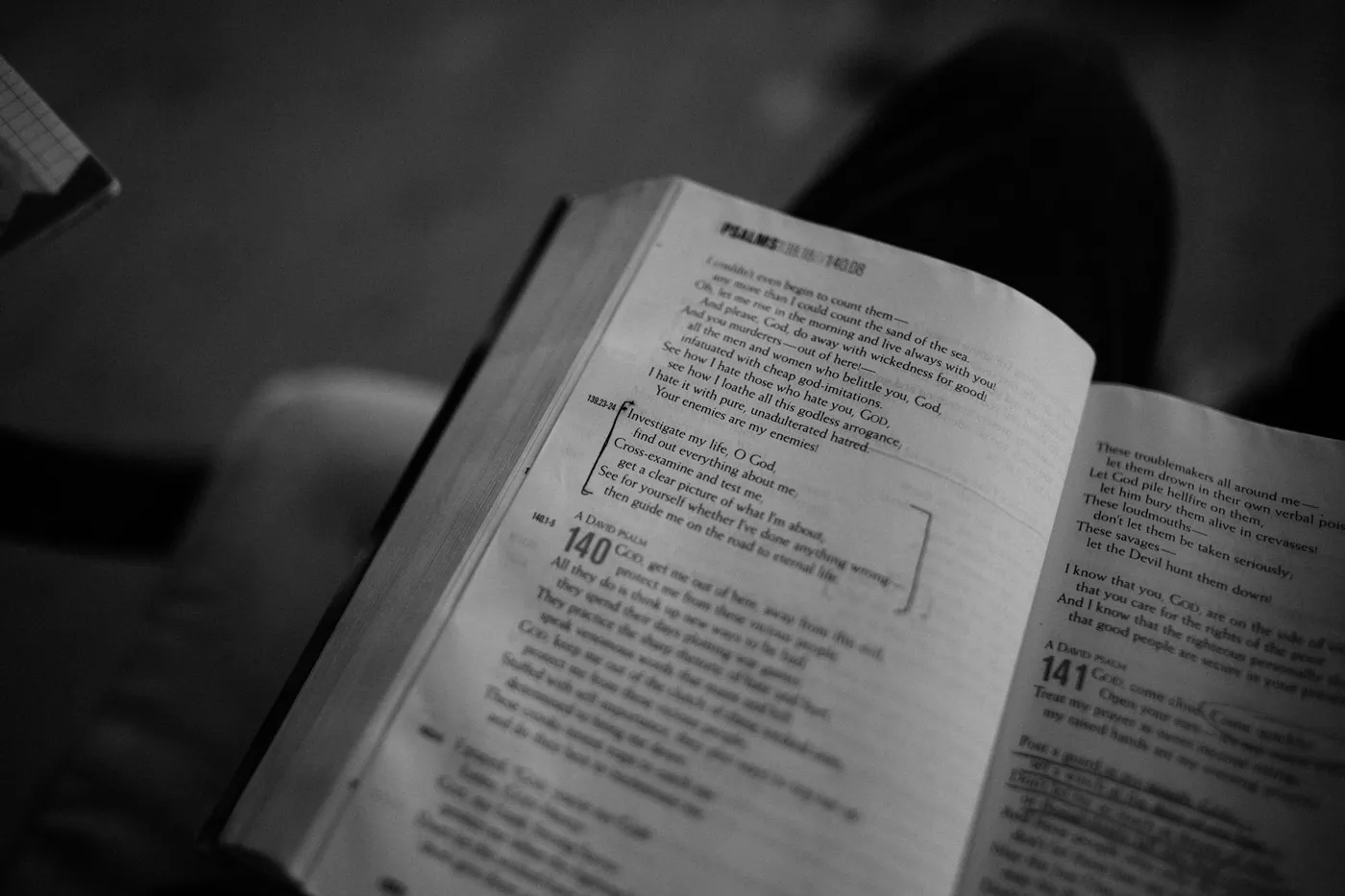
This is where most people stop. You open Psalm 13 and the first line is "How long, LORD? Will you forget me forever?" (NIV). Keep going and you find psalms that ask God to pay back enemies in ways that are hard to read aloud. Hayes notes that some laments move into a plea for vengeance on enemies. Psalm 137, the exile psalm, ends with a line many readers wish was not there.
It helps to know three things.
- The laments are not a mistake in the book. They are the largest part of its first half. BibleProject puts it plainly: the many laments show that crying out is an appropriate response to evil and tragedy, and lament plays an important role in prayer.
- Many laments turn. Psalm 13 starts with "How long?" and ends with "But I trust in your unfailing love" (NIV). Six verses, from abandonment to trust. You are allowed to be at the start of that psalm for a while.
- The curses are prayed to God, not acted out. The psalmist hands the anger over rather than carrying it out. How to read these psalms today is a question Christian traditions answer in different ways, and it is a good one to bring to your pastor or priest rather than settle alone.
If you came to the Psalms for comfort, the comfort is real. Our Bible verses about anxiety page gathers several of those psalms. But the hard ones are part of the gift. They are proof that you can bring God the prayer you actually have, not the one you think you ought to have.
How Christians have prayed the Psalms
For most of church history the Psalms have been prayed more than studied. Enter the Bible calls the book an invaluable resource for worship, and describes believers in every generation hearing God address them in these prayers as well as praying them.
The Catholic Church's daily practice is the clearest example. The U.S. Conference of Catholic Bishops' page on the Liturgy of the Hours explains that each of the five canonical Hours, the set times of prayer through the day, includes selections from the Psalms. Morning Prayer and Evening Prayer are the two hinge Hours. A person praying the Hours is praying the psalms at the start and end of every day, in the words of the Church.
That is one tradition's practice among several, and your own church may sing or pray the psalms in its own way. Ask. The shared instinct across traditions is the same one Psalm 1 opens with: read these slowly, often, and out loud if you can.
A word on authorship, since it comes up quickly. BibleProject counts 73 psalms connected to David by their headings, 12 to Asaph, 11 to the sons of Korah, a few to Solomon, Moses, Heman and Ethan, and 49 with no name at all. The headings are old traditional attributions. Who King David was, and how much weight those headings carry, is its own story.
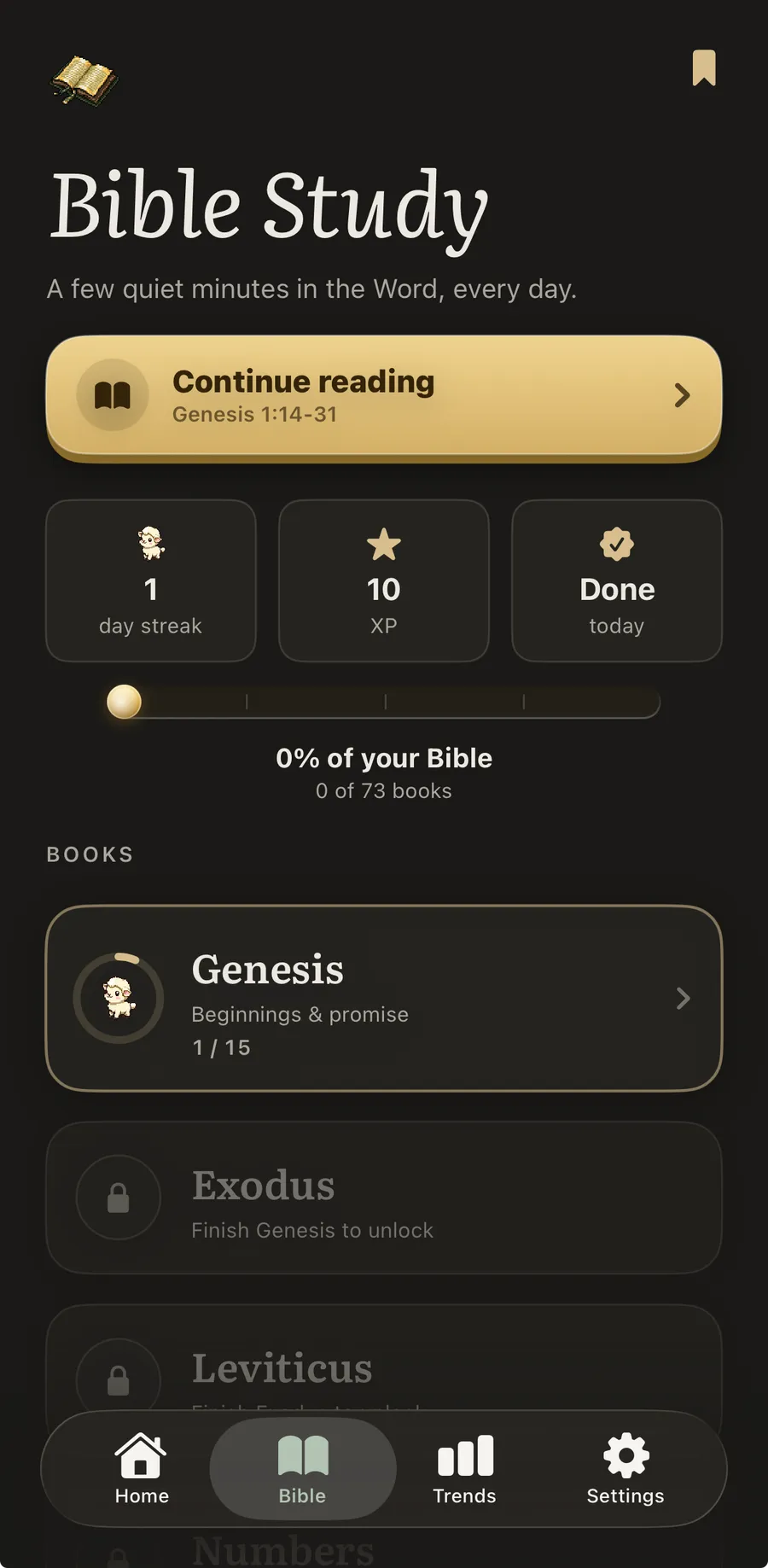
The Psalms are easy to begin and easy to lose: a few favourites, a busy week, and then no idea which number you were on. BlessUp takes that decision off your plate. Each morning the day's chapter is already set out, reading it is what opens the apps you have chosen to shield, and your place is held between days. Miss one and a grace day covers it, so you pick up where you stopped instead of back at Psalm 1. See what tomorrow's reading looks like
A pace for reading all 150
Here is the simplest plan in the Bible: one psalm a day. That reads all 150 in 150 days, about five months, and the day number is always the psalm number, so you can never lose your place. On day 23 you read Psalm 23.
The lengths are uneven, which helps more than it hurts. Psalm 117 is two verses. Psalm 119 is the longest poem in the book, an acrostic that works through the Hebrew alphabet in praise of God's word; on that day, read it in two or three sittings, or take a week over it. Most psalms fall somewhere in between and take a few minutes.
- Start at Psalm 1. It is the introduction, and the five-book shape only shows up if you read in order.
- Name the kind as you go. Praise, lament, royal or trust. It takes five seconds and it changes how you pray the psalm.
- Pray one line back. Pick a verse and say it to God in your own words. That is what the book was made for.
- Pair it with another book. The best place to start reading the Bible is a Gospel, and a psalm a day sits well alongside one.
If you would rather read the Psalms as part of the whole Bible, a year-long plan will take you through them with everything else; how long it takes to read the Bible in a year has the daily arithmetic. And if you are unsure which translation to use for poetry, the BlessUp FAQ lists the five the app offers.
Frequently asked questions
What is the main message of the book of Psalms?
The Psalms are 150 prayers, hymns and meditations addressed to God, covering praise, thanksgiving, trust and lament. BibleProject sums up the book as teaching God's people to neither ignore their pain nor let it determine their lives. Across its five books it moves from mostly lament toward mostly praise, ending with five hallelujah psalms.
How many books are in the book of Psalms?
Five. Book One is Psalms 1 to 41, Book Two is 42 to 72, Book Three is 73 to 89, Book Four is 90 to 106 and Book Five is 107 to 150. Each of the first four closes with a similar blessing ending in Amen and Amen, and the fifth closes with five psalms that begin and end with hallelujah.
Who wrote the Psalms?
Many writers over several centuries. By BibleProject's count the headings connect 73 psalms to David, 12 to Asaph and 11 to the sons of Korah, with a few linked to Solomon, Moses, Heman and Ethan, and 49 are anonymous. The headings are traditional attributions, and some psalms, such as Psalm 137, come from the exile, long after David.
How long does it take to read the Psalms?
At one psalm a day, 150 days, or about five months. The psalms vary a great deal in length: Psalm 117 is two verses and Psalm 119 is the longest poem in the book, so most mornings take a few minutes and one takes much longer. Reading several psalms a day finishes sooner.
Where should I start reading the Psalms?
Start at Psalm 1, which introduces the whole book, and read in order so the five-book shape shows. If you want a familiar way in first, Psalm 23 is a psalm of trust and Psalm 13 is a short lament that ends in trust, and both show you a kind of psalm you will meet again and again.
Every morning, your reading is already waiting. You will never wonder where to start.
No guilt. Ever. Grace is built in. Funded by readers, never by ads.