How Many Chapters Are in the Bible?
By Dom · · 9 min read
Someone decides on the last day of December that this is the year. A chapter a day, starting tomorrow, all the way through. It is a good instinct and it is a clean rule, and it is also going to take until spring of the year after next.
The Bible has 1,189 chapters. That is the number, and almost everything interesting about reading plans falls out of it once you do the division.
Key takeaways
- 1,189 chapters in the Protestant canon: 929 in the Old Testament and 260 in the New.
- One chapter a day takes 3 years and 3 months, not one year. Finishing inside 365 days needs about 3.26 chapters a day.
- Chapters are a medieval invention. Stephen Langton added them in the early 1200s; verse numbers came from Robert Estienne in 1551.
- Chapters are wildly uneven. Psalm 119 runs 176 verses; Psalm 117 runs 2. Five books have only one chapter at all.
- Words are the honest unit. The Protestant canon is 724,811 words, which is 1,986 a day across a year — about nine minutes at a normal reading pace.
The number, by testament
The standard count for the 66-book Protestant canon is 1,189 chapters, and it does not vary between the King James, the NIV, the ESV or any other mainstream English translation, because they all inherit the same division scheme.
| Section | Books | Chapters |
|---|---|---|
| Old Testament | 39 | 929 |
| New Testament | 27 | 260 |
| Whole Bible | 66 | 1,189 |
Two more figures people look for: Psalms has the most chapters of any book at 150, and in the New Testament, Matthew and Acts tie at 28 each. Five books have exactly one chapter — Obadiah, Philemon, 2 John, 3 John and Jude — which is why nobody cites a chapter number when quoting them.
Most of those one-chapter books take under five minutes to read; every book of the Bible, timed has the full list.
The Catholic and Orthodox canons include additional books, so their chapter totals are higher. How much higher depends on which edition you are holding, which is one of several reasons chapters turn out to be a poor unit of measurement. The books themselves are the clearer comparison, and what is actually different between the Protestant, Catholic and Orthodox canons lays out exactly which ones each tradition includes.
Why a chapter a day does not finish in a year
This is the single most common planning mistake, and it is pure arithmetic.
| Pace | Days to finish | In plain terms |
|---|---|---|
| 1 chapter a day | 1,189 | 3 years and about 3 months |
| 2 chapters a day | 595 | 1 year and 8 months |
| 3 chapters a day | 397 | Still misses a year by about a month |
| 3.26 chapters a day | 365 | Exactly one year |
| 4 chapters a day | 298 | Just under 10 months |
Notice the third row. Three chapters a day feels like a generous, round, achievable rule — and it still lands you in early February of the following year. The pace that actually closes the loop is an awkward fraction, which is the first hint that chapters are the wrong thing to be counting.
The exact daily figure, and a weekly pattern that makes it workable, are in how many chapters a day it takes to read the Bible in a year.
The New Testament on its own is much friendlier: 260 chapters is a chapter a day for eight and a half months, and that genuinely is a reasonable first-year goal. The Old Testament at the same pace runs two and a half years.
Chapters are not the same size, and it is not close
Genesis is a good illustration of the spread: fifty chapters and about 32,046 words, which is roughly two and a half hours at a normal pace. A reading guide to Genesis breaks that down section by section, using the headings the book uses on itself.
The Psalms show the spread inside a single book: Psalm 117 is two verses and Psalm 119 is the longest poem in the whole collection. Our Psalms reading guide turns that into a pace of one psalm a day.
A chapter is not a unit of anything. It is a place where a thirteenth-century scholar put a mark.
Psalm 119 has 176 verses. Psalm 117 has 2. They sit two pages apart. Psalm 119 alone is longer than Obadiah, Philemon, 2 John and Jude added together — those four books total 84 verses between them.
Across the whole Bible the average chapter runs around 610 words, or roughly two and three-quarter minutes of reading. But an average built on a range that wide is not describing any actual morning. A “chapter a day” plan gives you ninety seconds on one day and fifteen minutes on another, and the day it gives you fifteen minutes is usually not the day you have fifteen minutes.
That variance is the real reason chapter-count plans get abandoned. It is not a discipline failure. It is a plan that quietly changes the size of the ask without telling you.
Who divided the Bible into chapters?
Nobody who wrote any of it. The original texts have no chapters, no verses, and in many cases no spaces between words.
According to the Christian History Institute, the chapter system came from Stephen Langton, a professor at the University of Paris who later became Archbishop of Canterbury, working in the early 1200s. His divisions were carried into the Latin Vulgate and from there into essentially every Bible printed since.
Verse numbers came three centuries later. Robert Estienne — the printer usually called Stephanus — introduced numbered verses in his 1551 Greek New Testament, specifically to make cross-referencing possible. The Geneva Bible of 1560 was the first English Bible to carry both systems together, which is why the chapter-and-verse citation you use today has the shape it does.
Both men were solving a practical problem: how do you point someone else to a specific sentence in a very long book? They succeeded completely. What they were emphatically not doing was designing daily reading portions, and the divisions occasionally land in places that cut a thought in half.
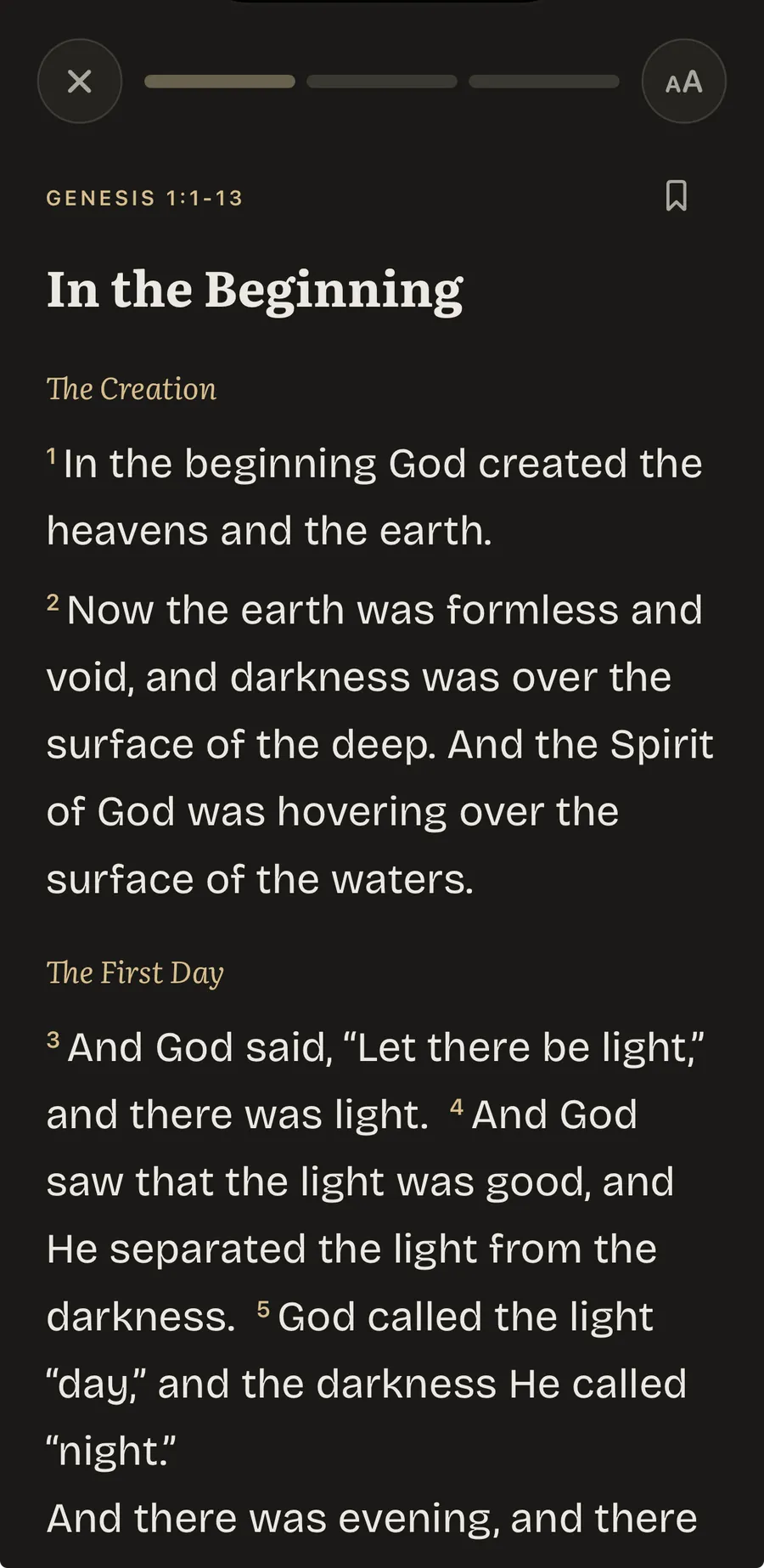
If you have ever abandoned a plan around Leviticus, the pace is a likelier culprit than your discipline — a chapter-count plan hands you a fifteen-minute day with no warning. BlessUp splits the year by word count instead: 724,811 words across 365 portions works out to 1,986 words a day, which is about nine minutes at a normal reading pace, and it computes the same arithmetic separately for the Catholic and Orthodox canons. Day one is Genesis 1 to 3. Start on day one.
What to count instead
Words. They are the only unit that maps onto the thing you actually have to spend, which is minutes.
| Canon | Total words | Words per day | Minutes per day |
|---|---|---|---|
| Protestant | 724,811 | 1,986 | 9.0 |
| Catholic | 828,590 | 2,270 | 10.3 |
| Orthodox | 879,155 | 2,409 | 10.9 |
A word-balanced plan will sometimes stop you mid-chapter, which feels wrong the first few times and then stops mattering. In exchange, every day is the same size, and the size is one you agreed to. If you want the longer version of that arithmetic, how long it takes to read the Bible in a year works through the reading-speed assumptions, and how many words are in the Bible covers where the word counts come from and why translations differ.
How much of it people actually finish
Worth knowing, because the answer is less discouraging than the internet suggests. The American Bible Society’s State of the Bible 2026 — 2,649 interviews with US adults fielded in January 2026 by NORC at the University of Chicago — found that half of Americans say they have read half the Bible or more, a third have read most or all of it, and 17% say they have read the entire thing.
Seventeen percent is not a small number for a 1,189-chapter book. It is also a reminder that finishing is normal rather than exceptional, and that the people who did it were not reading faster than you. They were reading on more days.
Picking a pace you will actually keep
Three honest options, in order of how often they survive contact with a real week:
- A fixed number of minutes. Nine or ten a day covers the whole thing in a year. Set the timer, read to the marker, stop.
- The New Testament first, a chapter a day. 260 days, finishes inside a year, and every chapter is a manageable size. A good first year.
- A chapter a day, cover to cover, and accept three years. Nothing wrong with this if you name the timescale at the start instead of discovering it in March.
What does not work is picking a pace for the version of yourself who has a free hour. Pick the pace for a bad Tuesday. Where to start reading the Bible covers which book to open first if Genesis 1 is not it, and the BlessUp FAQ answers the practical questions about pace-switching partway through.
Psalm 119:105 calls the word “a lamp for my feet, a light on my path” (NIV) — from the longest chapter in the book, which took its author 176 verses to say. Length was never the measure.
Frequently asked questions
How many chapters are in the Bible?
The Protestant Bible has 1,189 chapters across 66 books: 929 in the Old Testament and 260 in the New Testament. The count is the same in every mainstream English translation, because they all use the chapter divisions Stephen Langton created in the early 1200s. Catholic and Orthodox Bibles include additional books and therefore have more chapters.
How long does it take to read one chapter a day?
1,189 days, which is 3 years and about 3 months. To read the whole Bible in a single year you need an average of 3.26 chapters a day. Reading only the New Testament at a chapter a day takes 260 days, or roughly eight and a half months.
Which book of the Bible has the most chapters?
Psalms, with 150. In the New Testament, Matthew and Acts tie for the most at 28 chapters each. Five books have only a single chapter: Obadiah, Philemon, 2 John, 3 John and Jude.
What are the longest and shortest chapters in the Bible?
Psalm 119 is the longest at 176 verses, and Psalm 117 is the shortest at 2. They sit two pages apart. Psalm 119 on its own is longer than Obadiah, Philemon, 2 John and Jude combined, which total 84 verses between them.
Who divided the Bible into chapters and verses?
Stephen Langton, a Paris professor who later became Archbishop of Canterbury, created the chapter divisions in the early 1200s. Robert Estienne, a French printer known as Stephanus, added numbered verses in his 1551 Greek New Testament. The Geneva Bible of 1560 was the first English Bible to use both together. None of the divisions are original to the biblical text.
Genesis to Revelation, about nine minutes at a time. Start tomorrow morning.
No guilt. Ever. Grace is built in. Funded by readers, never by ads.