What to Pray About When You Don’t Know What to Say
By Dom · · 11 min read
You sit down, you close your eyes, and there is nothing. Not doubt exactly, and not distraction. Just a blank where the words are supposed to be, and a growing sense that everyone else got instructions you missed.
This is one of the most common obstacles people describe, and it is not a spiritual failure. It is a missing skill, and skills have structures. Here are the ones that work, from a four-part shape to a list you can read straight off a page on a morning when nothing comes.
Key takeaways
- The blank is normal. Pew puts daily prayer at 44% of US adults, yet prayer is the one practice almost nobody is taught mechanically — so plenty of people who pray still stall on how to start.
- ACTS gives you the next move: Adoration, Confession, Thanksgiving, Supplication. The order matters more than the completeness.
- Praying a psalm out loud removes the composition problem entirely. Psalm 23, 61 and 121 each take about a minute out loud; Psalm 139 takes about three.
- The Lord’s Prayer is about sixty words, and the shorter form in Luke 11 was given in answer to this exact question. Praying it line by line, slowly, takes about three minutes.
- Fluency comes from frequency, not effort. Attach it to something that already happens daily rather than trying harder.
The blank is normal, and it is not a spiritual problem
Worth establishing first, because the silence usually gets read as evidence of something.
Pew Research Center’s Religious Landscape Study, a survey of more than 35,000 Americans fielded in 2023–24, found that 44% of US adults pray at least daily, with another 23% praying weekly or a few times a month. So two thirds of American adults pray at least sometimes — and prayer is the one practice almost nobody is ever taught mechanically. Reading has plans. Church has an order of service. Prayer gets handed to you as a blank page and an expectation.
If the blank page is literal, a prayer journal layout that begins with the day’s passage gives you a first line to pray from.
Not knowing what to say is what happens when a skill is assumed rather than taught. It is not a measure of how much you care.
The simplest fix: a four-part shape
The most durable answer is a structure that tells you what comes next. The common one is ACTS, an acronym that has been taught in churches for generations because it works on a bad day.
| Part | What it is | A way in |
|---|---|---|
| Adoration | Who God is, not what you need | “You are…” |
| Confession | What you are carrying that you have not said | “I got this wrong…” |
| Thanksgiving | Three specific things from today | “Thank you for…” |
| Supplication | What you and other people need | “Please…” |
Two things make it usable rather than theoretical. The order does real work — starting with who God is rather than what you want changes the shape of everything after it. And it is a framework, not a rota: on a day when you have nothing but requests, spend the whole four minutes on the S. Four parts at a minute each is four minutes, which fits in front of the day’s nine-minute reading rather than competing with it.
If you want words rather than a method, here is one line for each part, usable exactly as they stand:
- A: “God, you were here before I woke up and you will be here after I forget this.”
- C: “I have been carrying something I have not said to you. It is this.”
- T: “Thank you for one thing from yesterday that I did not earn.”
- S: “Please be near the person I am most worried about today, and near me.”
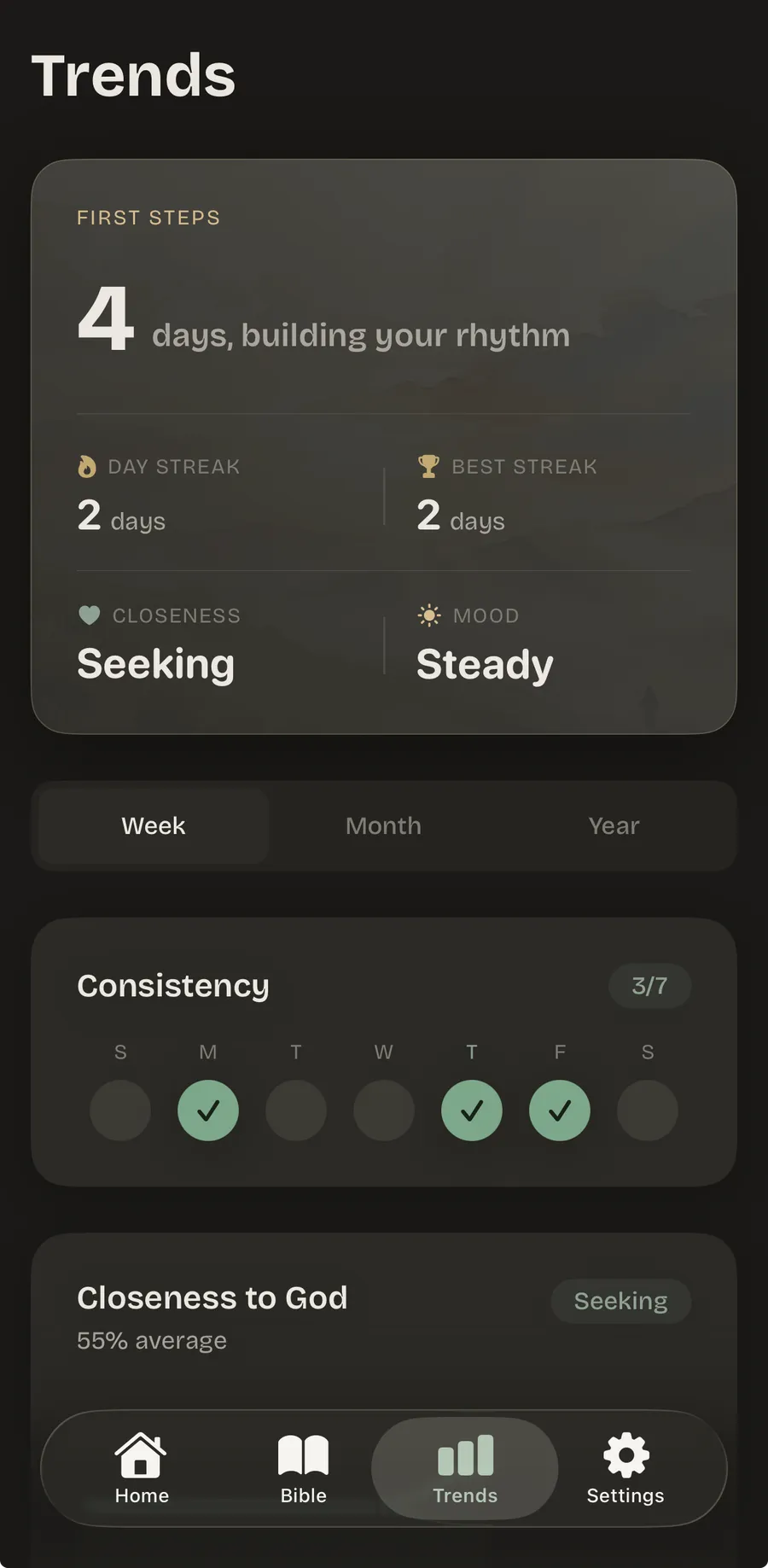
We built the app’s check-in on the same idea with two sliders instead of four letters. It asks how close to God you feel and how you are doing, and picks one of 118 written prayers, across twelve themes such as comfort in suffering, trust in uncertainty and gratitude for goodness, to match those two answers. You do not have to know which part of ACTS you need that morning. That is the whole point of a structure: it carries you to the part you need, on the days you cannot find it yourself.
When even the structure is too much
Some mornings four categories is three too many. Three smaller entry points, in ascending order of effort.
If the thing you cannot find words for is your phone, we wrote prayers for the moments the reach happens, each short enough to memorise.
- Pray the news of your own day. Not world events — your Tuesday. The conversation you are dreading, the person you keep meaning to call, the email you have reread four times. Specific beats worthy every time.
- Pray a psalm out loud. Someone else’s words, said as your own. This is what the Psalms are for and it removes the composition problem entirely. Psalm 23, 61 and 121 are each around a hundred words, about a minute out loud; Psalm 139 is nearly four hundred and takes about three.
- Say the one true sentence. If the honest content is “I do not want to be doing this,” that is a prayer. Romans 8:26 is explicit that the Spirit helps in weakness when we do not know what to pray for.
The second one is the highest-yield habit here. Praying a written prayer is not a lesser form of praying, and Christians have done it in every century. Reading someone else’s words is how most people learn what their own sound like.
For a simple way to start, praying the Psalms shows how to say one psalm as your own prayer, with a worked example on Psalm 13.
A list to pray through when nothing comes
Keep this somewhere you can see it. It is a prompt sheet, not a checklist, and one line is a complete morning.
- People: someone in your house, someone you have fallen out with, someone whose name came up and you thought “I should pray for them” and then did not.
- Work: the decision you are avoiding, the colleague you find difficult, the thing you are afraid you are not good enough for.
- Your own condition: what you are anxious about, what you are angry about, what you are pretending is fine.
- Gratitude: three things from the last 24 hours, and not the large abstract ones. The coffee. The traffic that was better than expected.
- Beyond you: your church, your street, whatever is on the news that you have no power over.
- The day ahead: the one thing you would most like to go well, said out loud.
Six lines. Nobody does all of them, which is the point of having six.
The pattern most people describe is not refusing to pray, it is never arriving at the moment — the phone gets picked up first, and then the morning is gone. BlessUp shields the apps you choose until the day’s chapter is read, and the check-in that comes with it asks two questions and matches a written prayer to your answers, so the blank page problem is handled on the days you have nothing. Prayer counts toward the same streak as reading. See how the daily check-in works.
What Jesus said when asked this exact question
The disciples asked to be taught how to pray (Luke 11:1), which is a fair indication that not knowing is the normal starting condition rather than a modern failure. The answer in Luke 11:2–4 is the shorter form of the prayer; the fuller version most people know, in Matthew 6:9–13, is given unprompted in the Sermon on the Mount and is about sixty words long.
Its structure is worth noticing, because it already has the shape the ACTS acronym codified many centuries later. It opens on who God is. It asks for bread, which is to say today’s ordinary needs and not a strategy. It handles forgiveness in both directions. It ends on protection. Nothing in it is elaborate, and the instruction immediately before it in Matthew warns against many words.
If you want to know what each line actually means, and why churches word it differently, see the Lord’s Prayer explained line by line.
Praying it slowly, one line at a time, pausing to fill each line with your own specifics, is a complete practice and takes about three minutes. On one ordinary Tuesday, “give us today our daily bread” became the meeting at ten, an invoice that had not been paid, and enough patience for the school run; “as we also have forgiven” became one name, said once. That is the whole method: the line is the prompt and your day is the content, and the prayer is finished when the lines run out rather than when you run out.
If that one name is hard to say, our guide to forgiving someone who hurt you goes through it step by step.
The part that makes it easier over time
Fluency comes from frequency, not from effort. The people who find prayer easy are almost never the ones who concentrate hardest; they are the ones who have done it most recently.
There is a second reason to tie it to reading. The American Bible Society’s State of the Bible 2026 — 2,649 interviews with US adults fielded 8–27 January 2026 by NORC at the University of Chicago — found that the group of Americans curious about and open to Scripture has grown by nine million people in two years. Curiosity is a good starting condition and a poor schedule. What turns one into the other is a slot, and a slot that already contains a reading is easier to add a prayer to than an empty one.
Which makes the practical question a scheduling one. Attach it to something that already happens every day — the kettle, the commute, the moment before the phone comes off the charger. How to pray consistently covers the whole habit, from the slot to what to do when it slips. Building a morning prayer routine that sticks covers the anchoring in detail, and how to build a prayer streak covers keeping it going once it starts.
And when it goes quiet for a week, nothing is lost and nothing is owed. Why streaks make people quit is about that specific trap, which catches more returning prayers than the blank page ever did. If you want the reading side of the same rhythm, where to start reading the Bible is the companion question, and the BlessUp FAQ covers the practical bits.
Frequently asked questions
What should I pray about when my mind goes blank?
Start with the concrete details of your own day rather than large worthy subjects: the conversation you are dreading, the person you keep meaning to call, the thing you are anxious about. If even that is too much, pray a psalm out loud, or say the one true sentence you have, which may be that you do not want to be doing this.
What is the ACTS prayer method?
A four-part structure: Adoration, Confession, Thanksgiving, Supplication. You begin with who God is, then what you have been carrying, then three specific things from the last day, then what you and other people need. It is a traditional teaching framework rather than a biblical formula, and it is meant to be adjusted rather than completed.
Is it okay to pray using someone else's written prayer?
Yes, and Christians have done it in every century. Praying a psalm or a written prayer is not a lesser form of praying. It removes the composition problem on days when there are no words, and reading other people's prayers is how most people learn what their own sound like.
How long should a prayer be?
The Lord's Prayer is about sixty words, and the instruction immediately before it in Matthew 6 warns against many words. A minute is a real prayer. Consistency matters far more than length, and a short prayer said daily builds fluency in a way an occasional long one does not.
How do I start a prayer?
With an ordinary sentence, out loud if you can. “God, I am here and I do not know what to say” is a complete opening, and so is reading the first line of a psalm. You do not need a form of address, a posture or a warm-up; Jesus' own example in Matthew 6 begins with two words, Our Father, and warns against many more.
What did Jesus say to pray about?
The disciples asked to be taught how to pray in Luke 11:1, and the answer, given in Luke 11:2 to 4 and in its fuller form in Matthew 6:9 to 13, opens with who God is, asks for today's ordinary needs, handles forgiveness in both directions, and closes on protection. It is a complete template, and praying it slowly one line at a time while filling each line with your own specifics takes about three minutes.
Your day starts in the Word, not the feed. BlessUp is free to download.
No guilt. Ever. Grace is built in. Funded by readers, never by ads.