Who Was King David?
By Dom · · 13 min read
Most people meet David twice and never again: once as a boy with a sling, once as the name in a genealogy at the front of Matthew. In between sits about sixty chapters of one of the least sanitised biographies anyone has ever written down.
He is the subject of more consecutive narrative than any other person in the Old Testament, the founder of a dynasty named by name in a ninth-century inscription set up by a hostile neighbour, and the reason a phrase like “a man after God’s own heart” is complicated rather than flattering.
Key takeaways
- David was Israel’s second king, traditionally around 1000 B.C.: a shepherd from Bethlehem who reigned forty years and took Jerusalem as his capital.
- His story runs about sixty chapters across 1 Samuel 16–31, all of 2 Samuel, 1 Kings 1–2, and a friendlier retelling in 1 Chronicles.
- The Tel Dan inscription, found in 1993, names the “House of David” — the earliest reference to his dynasty outside the Bible, dated to the ninth century B.C.
- Seventy-three psalms carry his name in Hebrew, 85 in Greek, and at least eleven of their headings tie them to an episode in Samuel you can read alongside.
- The text keeps the worst chapter in. A king takes another man’s wife and has her husband killed, and the record says so. Ancient royal records were propaganda; this one is not.
The short version
David was the second king of Israel, traditionally placed around 1000 B.C., and the Bible’s most thoroughly documented failure, and both of those are told in the same books. He was the youngest son of a Bethlehem farmer, worked as a shepherd, was anointed king while the previous king was still on the throne, spent years as a fugitive, united the tribes, took Jerusalem and made it his capital, and founded the dynasty the Gospels trace Jesus back to. He also took another man’s wife, had the man killed to cover it, and watched his own family come apart afterwards. The text softens neither half, which is the most unusual thing about how it is told.
The dates the text gives are plain. 2 Samuel 5:4–5 has him thirty when he became king, reigning seven and a half years over Judah from Hebron and thirty-three over all Israel from Jerusalem, forty in all; that puts his death at about seventy, and 1 Kings 2 hands the throne to his son Solomon.
Where to actually read about him
David’s story is spread across four books, and knowing which does what saves a lot of flicking back and forth.
| Book | Chapters | What is there |
|---|---|---|
| 1 Samuel | 16–31 | Anointing, Goliath, Saul’s jealousy, the years on the run |
| 2 Samuel | 1–24 | The whole reign: Jerusalem, Bathsheba, Absalom’s revolt |
| 1 Kings | 1–2 | His last days and the succession |
| 1 Chronicles | 11–29 | A second, much more favourable retelling, written later |
The two accounts are worth reading against each other. Chronicles leaves out the Bathsheba episode entirely, naming her only as Solomon’s mother. Samuel does not leave out anything, and the difference between them is a lesson in how the same life gets told for different purposes.
Is there evidence outside the Bible?
Yes, and this was a genuinely open question until 1993.
That year, an excavation at Tel Dan in northern Israel directed by the archaeologist Avraham Biran turned up a fragment of an inscribed stone slab. According to the Biblical Archaeology Society, the Aramaic inscription has a king boasting of defeating both the king of Israel and the king of the “House of David.” Most scholars date it to the ninth century B.C.
The Museum of the Bible, which displayed the stele in 2025, describes it as the earliest known reference to the House of David outside Scripture. A hostile neighbour, roughly a century after David is said to have lived, casually naming the southern kingdom after its founder — that is exactly the kind of incidental evidence historians find persuasive, because nobody writing a taunt has a reason to invent a dynasty.
Be careful what it does and does not settle. It establishes a dynasty called the House of David; it says nothing about the size of his kingdom or any specific event in his life. A minority of scholars, notably Philip Davies, argued the phrase referred to a place rather than a dynasty, though most accepted the dynastic reading. Claims about the scale of David’s rule remain contested — the identification of a “Large Stone Structure” in the City of David as David’s palace is described even by its supporters as intriguing but tentative.
Six moments that carry the story
- The anointing (1 Samuel 16). Samuel works through the seven older sons of Jesse of Bethlehem before anyone thinks to fetch the youngest from the sheep. The line the chapter turns on is that people look at outward appearance and God looks at the heart — stated before any of David’s heart has been shown.
- Goliath (1 Samuel 17). Famous as an underdog story, which undersells it. David’s own stated reasoning is not that he is brave, and not that a sling outranges armour: he points to the lion and the bear he has already fought (17:37), and tells Goliath the battle belongs to God rather than to weapons (17:45–47).
- Sparing Saul (1 Samuel 24 and 26). Twice he has the man hunting him at knife-point and twice he lets him go. This is the strongest evidence in the book about his character, and it is not the story anyone tells. Running through the same years is his friendship with Saul’s son Jonathan (1 Samuel 18–20), who gives up his own claim to the throne for him: the one relationship in the story with nothing sordid in it.
- The promise (2 Samuel 7). David wants to build God a house. God answers that He will build David one: “Your house and your kingdom will endure forever before me; your throne will be established forever” (2 Samuel 7:16, NIV). This is the Davidic covenant, and it is why the Gospels open by calling Jesus the son of David: the line is the promise, not merely the ancestry. Christine Hayes, in her Open Yale lecture on 1 and 2 Samuel, points out how unlike Saul’s position this is: David’s heirs can be punished for what they do, but the kingdom is not taken away.
- Bathsheba and Uriah (2 Samuel 11–12). He takes another man’s wife and has her husband killed to cover it. The prophet Nathan traps him into passing sentence on himself, and the consequences run through the rest of the book.
- Absalom’s revolt (2 Samuel 15–18). His son takes the throne and David flees his own city. When Absalom is killed against his orders, the king’s response is not relief.
David’s story runs about sixty chapters across four books, which is exactly the length that gets started and abandoned. A plan that hands you the next portion each morning solves that: BlessUp shields the apps you pick until the day’s reading is done and holds your place between days, so 1 and 2 Samuel arrive in order rather than in bursts. Genesis to Revelation, about nine minutes a day. Start on day one.
Did David write the Psalms?
Some of them, on the traditional reading, and the number is smaller than most people assume.
Seventy-three psalms in the Hebrew text carry the superscription le-David, and the Greek Septuagint attributes 85; Yale Divinity School’s Yale Bible Study gives both counts and notes that some psalms bearing the heading mention the Temple, which was not built until Solomon’s reign. The heading itself is a preposition and a name, and the preposition can mark an author, a dedication or a collection, which is exactly why the question stays open.
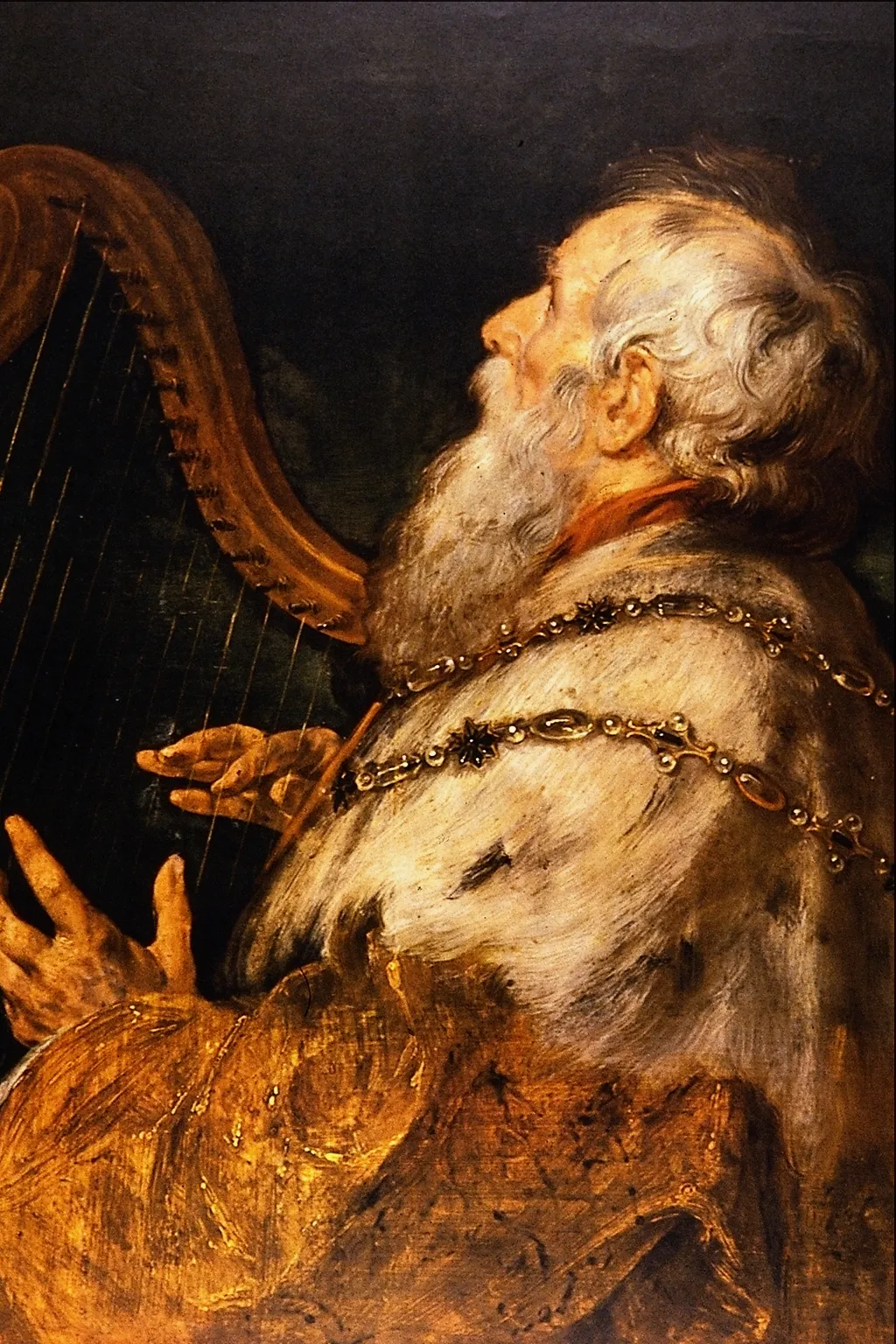
The Psalter also names other authors outright — Asaph, the sons of Korah, Solomon, Moses — and around fifty psalms carry no attribution at all. How much weight the superscriptions carry is a question traditions answer differently, and it is one for your pastor or parish rather than for us. What is not in dispute is that David is portrayed throughout as a musician: he is playing the harp when he first arrives at Saul’s court, and his laments over Saul and Jonathan are preserved as poems.
If you want to read the psalms themselves rather than the argument about who wrote them, a guide to reading the Psalms lays out the five books and the kinds of psalm you will meet.
Whatever you conclude about authorship, some of the headings are the Psalter’s own cross-references to Samuel, and a reading plan is the natural place to use them: read the psalm on the morning the plan reaches the chapter. Six of them, in the order the story happens:
| Psalm | Its heading says | Read it beside |
|---|---|---|
| Psalm 34 | “When he pretended to be insane before Abimelek, who drove him away, and he left.” | 1 Samuel 21:10–15 |
| Psalm 56 | “When the Philistines had seized him in Gath.” | 1 Samuel 21:10–15, the same episode |
| Psalm 52 | “When Doeg the Edomite had gone to Saul and told him: ‘David has gone to the house of Ahimelek.’” | 1 Samuel 22:9–19 |
| Psalm 51 | “When the prophet Nathan came to him after David had committed adultery with Bathsheba.” | 2 Samuel 12 |
| Psalm 3 | “When he fled from his son Absalom.” | 2 Samuel 15–18 |
| Psalm 18 | “When the Lord delivered him from the hand of all his enemies and from the hand of Saul.” | 2 Samuel 22, where the same song is printed |
Why the Bible keeps the worst parts in
This is the thing most worth noticing about David, and it survives whatever position you take on the history.
Ancient royal records were propaganda. Kings commissioned accounts of their victories, not their crimes. The Tel Dan inscription itself is a king boasting. Against that background, a national epic that includes its founder-king taking another man’s wife and arranging her husband’s death, and being publicly condemned for it by a prophet who lived to tell the story, is doing something very unusual.
It is also why David remains readable. 1 Samuel 13:14 calls him “a man after his own heart” (NIV), and Acts 13:22 repeats it in God’s own voice as “a man after my own heart”; the same book of Samuel records every reason to doubt the description. The two sit together without being reconciled, which is closer to how most people experience their own lives than a cleaner story would be.
If you want to read him properly, 1 and 2 Samuel together run 55 chapters, roughly two months at a chapter a day. Inside a year-long plan the arithmetic is tighter. In BlessUp’s 365-day plan, at a pace of about 1,986 words a day, 1 Samuel begins on day 89, David walks in at chapter 16 on day 94, and his story is finished by day 110: seventeen mornings and about two and a half hours of reading for the whole of it, from the sheep to the succession. A reader who opened Instagram first on those seventeen mornings would have skipped one of the best-told lives in the book without noticing. Where to start reading the Bible covers how Samuel fits into a first year, how long it takes to read the Bible in a year has the pace arithmetic, and the differences between the Protestant, Catholic and Orthodox canons explains why the Psalms are numbered differently depending on which Bible you are holding. The BlessUp FAQ covers the practical side of following a plan through a long book.
Frequently asked questions
Who was King David in the Bible?
David was the second king of Israel, traditionally dated to around 1000 B.C. He was the youngest son of a Bethlehem farmer and worked as a shepherd before being anointed king while Saul still reigned. After years as a fugitive he became king at thirty, reigned seven and a half years in Hebron and thirty-three in Jerusalem, united the tribes, captured Jerusalem and made it his capital, and founded the dynasty the Gospels trace Jesus back to. He died at about seventy and was succeeded by his son Solomon.
Is there archaeological evidence that King David existed?
Yes. An inscribed stone slab found at Tel Dan in northern Israel in 1993, in an excavation directed by Avraham Biran, carries an Aramaic inscription in which a king boasts of defeating the king of Israel and the king of the House of David. Most scholars date it to the ninth century B.C. It establishes that a dynasty was named after David; it does not settle the size of his kingdom or any particular event.
Where in the Bible is the story of King David?
It runs across four books. 1 Samuel 16 to 31 covers his anointing, Goliath, and the years running from Saul. 2 Samuel covers the whole reign, including Bathsheba and Absalom's revolt. 1 Kings 1 to 2 covers his death and the succession. 1 Chronicles 11 to 29 retells the reign much more favourably and omits the Bathsheba episode entirely.
How many Psalms did David write?
Seventy-three psalms carry the superscription le-David in the Hebrew text, and the Greek Septuagint attributes 85 to him. The Hebrew heading is a preposition and a name, and the preposition can mark an author, a dedication or a collection; some psalms carrying it refer to the Temple, which was built after his death. Other psalms name Asaph, the sons of Korah, Solomon and Moses, and around fifty have no attribution. At least eleven of the David headings name an episode in Samuel, and the six set out above can be read beside those chapters.
What is the Davidic covenant?
The promise God makes to David in 2 Samuel 7 that his house and kingdom will endure forever and his throne be established forever. Unlike Saul, whose kingship was withdrawn, David's heirs can be punished for what they do without the kingdom being taken away. The Gospels lean on it when they call Jesus the son of David: the line is the promise, not just the ancestry.
Why does the Bible include David's worst moments?
It is genuinely unusual. Ancient royal records were commissioned propaganda that recorded victories rather than crimes, and the Tel Dan inscription is itself a king boasting. A national epic that records its founder-king taking another man's wife, arranging her husband's death, and being publicly condemned by a prophet is doing something different from the surrounding literature.
One chapter is the only key. See what your mornings look like on the other side of it.
No guilt. Ever. Grace is built in. Funded by readers, never by ads.