Bible Verses for Thanksgiving
By Dom · · 11 min read
Someone hands you the job at four in the afternoon. You are saying grace, the table is being set, and you have ten minutes to find something short, true, and not embarrassing to read out loud in front of your uncle.
This page is built for those ten minutes. Here are the passages people actually open at Thanksgiving, what each one is doing, which to pick for the table you are actually sitting at, and how to read one without turning dinner into a service.
Key takeaways
- For a single line at the table, use 1 Chronicles 16:34 or Psalm 107:1. Both read “Give thanks to the LORD, for he is good; his love endures forever,” and neither needs explaining.
- The most-opened passage of Thanksgiving week is not a thanksgiving verse. It is Numbers 6:24–26, the blessing, across five years of YouVersion data reported by Lifeway Research.
- 1 Thessalonians 5:18 says give thanks “in” all circumstances, not “for” them. One preposition separates honest gratitude from pretending the year was fine.
- Keep the reading under thirty seconds — one to five verses. Psalm 100 in full is five verses and about twenty-five seconds aloud.
- Lincoln proclaimed the holiday on October 3, 1863, mid–Civil War, naming “widows, orphans, mourners” in the same text that set apart the last Thursday of November.
The verses people actually look up at Thanksgiving
Bible apps can see which passages get opened on which days, and the Thanksgiving picture is not the one the listicles suggest. Lifeway Research published the eight passages YouVersion users read most during the week of Thanksgiving across five years, 2020 through 2024. Only three of the eight are about giving thanks.
| Rank | Passage | What it is |
|---|---|---|
| 1 | Numbers 6:24–26 | The blessing Aaron spoke over Israel |
| 2 | 1 Chronicles 16:34 | A thanksgiving refrain from David’s psalm at the ark |
| 3 | Psalm 23:6 | The closing line of the shepherd psalm |
| 4 | James 1:17 | Every good gift comes down from the Father |
| 5 | Psalm 107:1 | The opening call of a psalm about being rescued |
| 6 | Psalm 9:1–2 | A vow to give thanks with the whole heart |
| 7 | Psalm 119:2 | A blessing on those who seek God wholeheartedly |
| 8 | 1 John 4:18–19 | Perfect love drives out fear |
Read that list again and notice what it is doing. The most-opened passage of Thanksgiving week is a blessing. Then comfort, then reassurance, then a line about fear. People are not mainly looking for words to perform gratitude with. They are looking for something to steady them on a day that puts a lot of family in one room.
That is a useful thing to know before you pick. The reading is not a test of how thankful everyone is. It is thirty seconds where the noise stops.
How many people will actually be listening
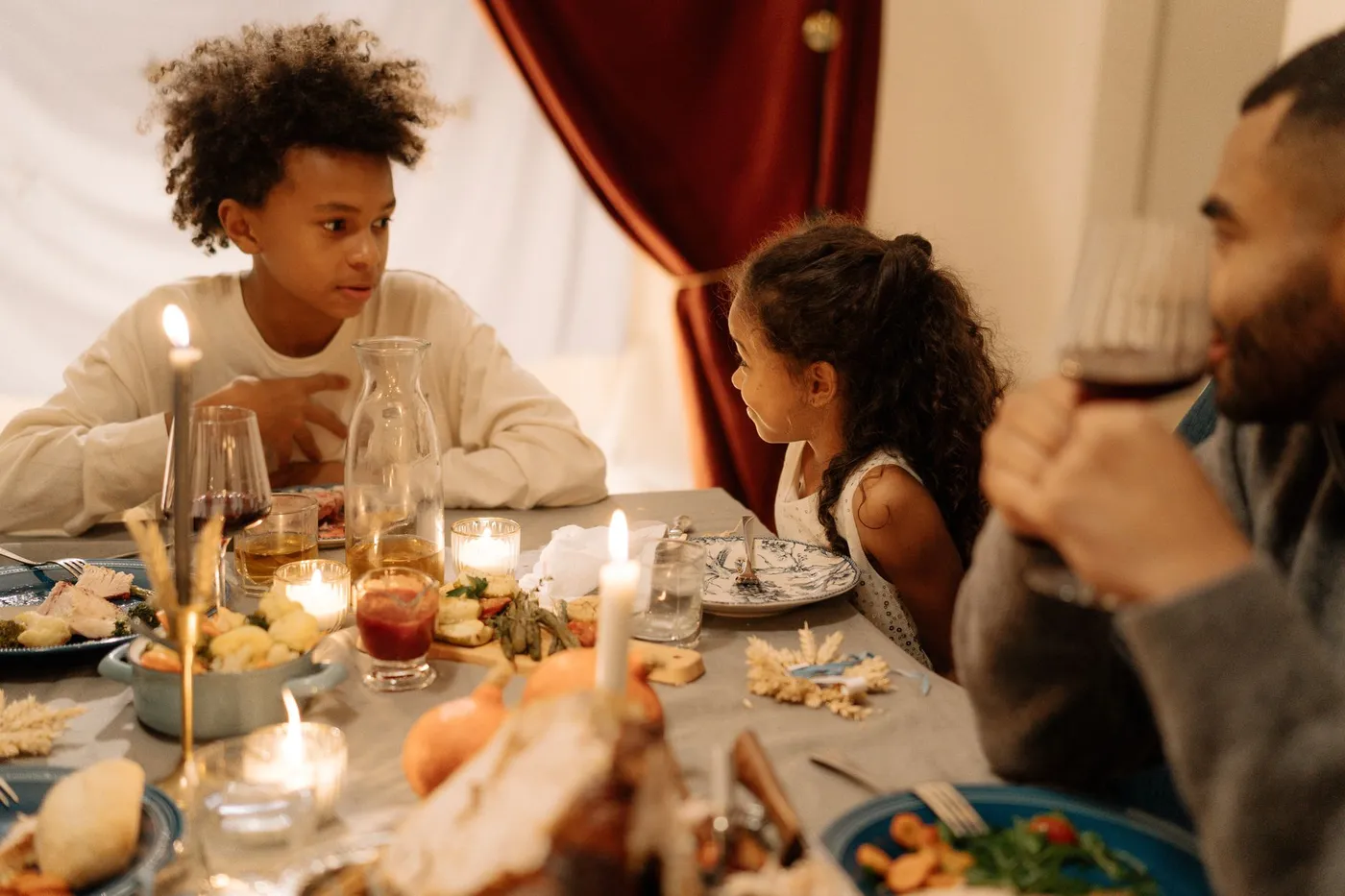
More than you think. Pew Research Center surveyed 9,609 U.S. adults in November 2024 and found that 91% celebrate Thanksgiving, that 65% say someone at their dinner typically says a prayer or blessing, and that 69% say someone names what they are thankful for. Those numbers hold well outside regular churchgoing: this is one of the few days a year when a table of people who disagree about almost everything will go quiet for a sentence.
So the bar is low and the moment is real. Say what you are reading, read it, stop.
The classic Thanksgiving passages, and what each one is doing
Five carry most of the weight, and they are not interchangeable.
Psalm 100:4 — “Enter his gates with thanksgiving and his courts with praise; give thanks to him and praise his name” (NIV). This is a processional line, written for people walking into the temple. It fits the moment everyone sits down, because it is about arriving somewhere on purpose.
1 Chronicles 16:34 and Psalm 107:1 — both say the same sentence: “Give thanks to the LORD, for he is good; his love endures forever” (NIV). It is the shortest complete thing you can say, and it gives a reason rather than an instruction. If you want one line and no discussion, use this one.
Colossians 3:15–17 — Paul writes “And be thankful,” two words tucked into a paragraph about how a household behaves. Read in full it is less a gratitude verse than a description of a room where people are not fighting. On some Thanksgivings that is the more useful text.
Philippians 4:6–7 — thanksgiving shows up here as part of how you pray when you are anxious, not as a mood you are told to have. If the day is stressful, this one meets it honestly. We work through that passage and eleven others in the verses people reach for when they are anxious.
1 Thessalonians 5:16–18 — the one everybody quotes, and the one most often quoted wrong. It deserves its own section.
“In all circumstances” is not “for all circumstances”
The NIV reads: “Rejoice always, pray continually, give thanks in all circumstances; for this is God’s will for you in Christ Jesus.”
Read the preposition. It says give thanks in all circumstances. It does not say give thanks for all circumstances. Paul is telling a church under real pressure to keep giving thanks while the pressure is still on. He is not telling them the pressure is a gift.
That distinction matters at a table where someone has had a genuinely bad year. “Give thanks for everything” asks a person who lost a job in March to call March good. The text does not ask that. It asks them to keep speaking to God from inside March. Those are different sentences, and only one of them is in the Bible.
If that difference is doing real work for someone at your table, it is worth talking through with a pastor rather than settling in a paragraph. We build reading habits here; we do not adjudicate the hard cases.
The holiday itself was proclaimed in the middle of a war
The American version of this day was not established during a good year. Abraham Lincoln issued the proclamation on October 3, 1863, in the third year of the Civil War, and the text does not pretend otherwise. It names “a civil war of unequaled magnitude and severity” and asks the country to “commend to His tender care all those who have become widows, orphans, mourners, or sufferers in the lamentable civil strife” in the same document that sets apart “the last Thursday of November next as a day of thanksgiving and praise.” The full text is at the American Presidency Project, and the original document is held at the National Archives.
So the holiday and the epistle agree. Thanks is something you say inside the year you actually had. Nobody has ever been required to have a good one first.
A verse for the table you are actually sitting at
Pick by situation, not by popularity.
| If this is your table | Read | Why it fits |
|---|---|---|
| Mixed company, some of whom do not go to church | 1 Chronicles 16:34 | One sentence, no jargon, nobody has to hold a pose |
| A chair is empty this year | Psalm 34:18 | It does not fix the absence. It says God is near it |
| A financially hard year | Habakkuk 3:17–18 | It lists the failed crops first, then gives thanks anyway |
| Small children at the table | Psalm 136:1 | It has a repeating line they can say back to you |
| You are hosting and running on four hours of sleep | Colossians 3:15 | “And be thankful” is two words and you can manage two words |
| You want to read properly, before everyone sits | Psalm 100 | Five verses, about twenty-five seconds aloud |
How to read one at the table without it being awkward
The awkwardness almost never comes from the verse. It comes from not knowing how long this is going to take. Take that worry off the table in the first sentence.
- Say what it is before you read it. “I’m going to read four lines from Psalm 100, then we eat.” Now everyone knows the shape of the next thirty seconds.
- Read it once and do not explain it. A reading that gets explained becomes a talk, and a talk at a Thanksgiving table is a different thing that you did not announce.
- Keep it under thirty seconds. That is one to five verses. Longer is not more reverent, it is just longer.
- Close with one plain sentence of your own. Not a summary of the passage. Something like “Glad you’re all here.” Then pass the potatoes.
If you want the room to say something back, Psalm 136 is built for it: every line ends “His love endures forever,” and after two lines people join in without being asked.
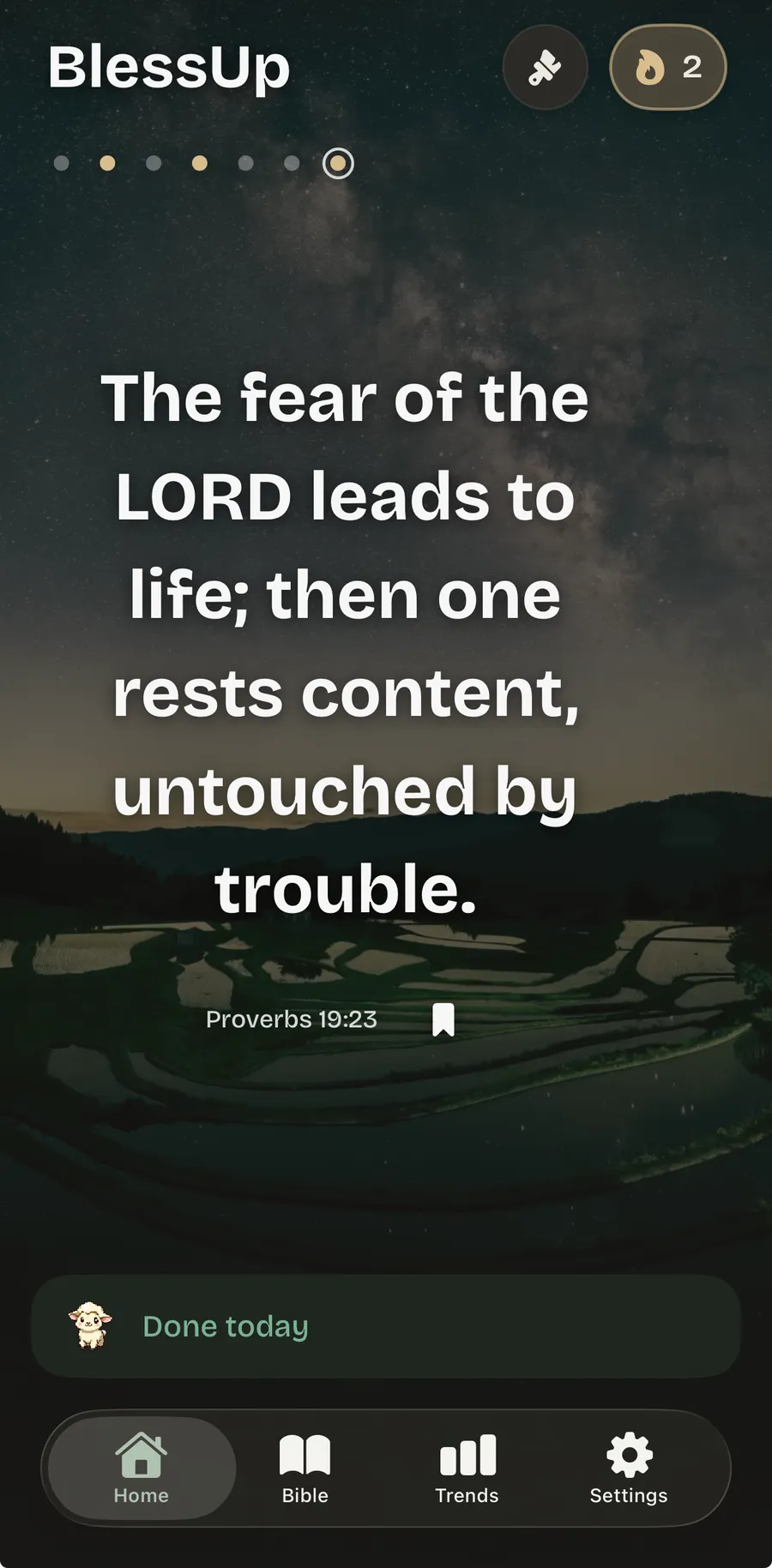
The trouble with the Thanksgiving verse is that you go looking for one twice a year, at four in the afternoon, with a kitchen behind you. It feels like homework because it is the only time you do it. BlessUp puts the day’s verse on the home screen every morning and makes reading the day’s chapter the thing that opens Instagram, so by the time November comes you are not searching for something to say, you are just somewhere around day three hundred. Day one is Genesis 1 to 3, about nine minutes. See how the day’s reading works.
What to do with it after Thursday
Thanksgiving sits in an odd spot on the calendar. November is Global Bible Month, and the Sunday after Thanksgiving is usually the first Sunday of Advent, which means the most-searched Bible week of the autumn runs straight into the season with the most reading plans attached to it. If a verse landed on Thursday, that is a good week to keep going rather than to stop.
Two easy next steps. An Advent reading plan gives you a short, dated passage every day through Christmas, which is about as low-friction as reading gets. Or if the honest answer is that you have not read much of the Bible in years and Thursday reminded you of it, start where beginners actually should rather than at Genesis 1 with a running start.
And if you are travelling for the holiday and want a service on the Sunday, the BlessUp church finder maps churches across 54 US cities, which is a faster way to solve it than asking your host.
Frequently asked questions
What is the most popular Thanksgiving Bible verse?
Among Bible app users it is Numbers 6:24–26, the blessing that begins “The LORD bless you and keep you” — the passage most read during Thanksgiving week across 2020 to 2024, according to YouVersion data reported by Lifeway Research. Among passages that are actually about giving thanks, 1 Chronicles 16:34 and Psalm 107:1 lead, and both read “Give thanks to the LORD, for he is good; his love endures forever.”
What Bible verse should I read at Thanksgiving dinner?
Psalm 100:4 or 1 Chronicles 16:34. Both are a single sentence, both are recognisable to people who have not been inside a church in years, and neither needs any setup. Say what you are about to read, read it once, and stop.
Does the Bible say to give thanks even when the year has been bad?
1 Thessalonians 5:18 says to give thanks “in all circumstances,” not for them. Paul is telling a church under pressure to keep speaking to God while the pressure is still on, which is a different instruction from being told the hard thing was good. Lincoln’s 1863 Thanksgiving proclamation takes the same posture, naming the war and its mourners in the same text that calls for a day of thanks.
How long should a Thanksgiving Scripture reading be?
Under thirty seconds once people are seated with food in front of them, which is one to five verses. Psalm 100 in full runs about twenty-five seconds aloud. Anything longer belongs before everyone sits down rather than at the table.
Do most Americans pray before Thanksgiving dinner?
About two-thirds do. Pew Research Center surveyed 9,609 U.S. adults in November 2024 and found 65% say someone at their Thanksgiving dinner typically says a prayer or blessing, and 69% say someone names what they are thankful for. Ninety-one percent celebrate the holiday at all.
Small daily readings, cover to cover. That is the whole plan.
No guilt. Ever. Grace is built in. Funded by readers, never by ads.