What Is a Breath Prayer?
By Dom · · 11 min read
The email you were dreading is open on the screen. Your chest is tight and you have maybe four seconds before you have to answer it. There is no time to kneel, no time for a quiet hour, no time to find a verse. There is time for one breath.
That is the whole idea behind a breath prayer: a prayer short enough to fit inside a single breath, said in two halves, one as you breathe in and one as you breathe out. It sounds new. It is one of the oldest ways Christians have prayed.
Key takeaways
- A breath prayer is a very short prayer in two halves: a few words to God as you breathe in, a few words of request as you breathe out.
- It grows out of the Jesus Prayer of the Eastern Orthodox tradition, which Christianity Today traces to Egyptian desert monks of the third and fourth centuries.
- The best-known form, “Lord Jesus Christ, Son of God, have mercy on me,” echoes two cries in the Gospels: Mark 10:47 and Luke 18:13.
- A 2001 BMJ study of 23 adults found that reciting the Ave Maria slowed breathing to about six breaths a minute. That is a finding about breathing rhythm, not a promise about anxiety or health.
What a breath prayer is, in one breath
A breath prayer is the smallest complete prayer there is. It fits in the gap between one notification and the next, and it still has everything a prayer needs: Someone you are speaking to, and something you are asking. Christianity Today puts it simply: breath prayers are short prayers that coincide with inhaling and exhaling. You turn your heart toward God, then split a few words across one breath. Part of the prayer goes with the breath in. The rest goes with the breath out.
The classic example is the one Christianity Today gives. Breathe in and pray, “Lord Jesus Christ, Son of God,” then breathe out and pray, “have mercy on me.” That is the whole prayer. It takes about as long as it took you to read it.
Three things make it a breath prayer and not just a short sentence:
- It is addressed to God. The first half is almost always a name for Him. This is not a phrase you say to yourself to calm down.
- It is short enough to repeat. Six to ten words, usually. You can say it once, or return to it all day.
- It rides the breath. The breathing is not the point. It is the rhythm that carries the words, the way a tune carries a hymn.
If you have read what it means to pray without ceasing, this is one of the practical forms that command has taken. The breath prayer is how a person with a full day keeps turning back to God inside it.
Where it comes from: the Jesus Prayer and the desert
The breath prayer did not start in a wellness app. According to Christianity Today’s account, breath prayers come from the Jesus Prayer, practiced in the Eastern Orthodox Church and going back as early as the third and fourth centuries, to the monks of the Egyptian desert.
The same account gives the rest of the story in three steps:
- The 13th century. A monk named Nicephorus the Hesychast connected the Jesus Prayer to breathing.
- 1782. The Philokalia, a collection of Greek Christian monastic writings, was published and carried the practice further.
- 1884. The Way of a Pilgrim, the story of a traveler who prays the Jesus Prayer as he walks, brought it to a much wider audience.
The words themselves are older still. They come from two people in the Gospels who had nothing to offer Jesus but a short, honest cry.
The first is Bartimaeus, a blind man sitting by the road outside Jericho. When he heard Jesus was passing, he shouted, “Jesus, Son of David, have mercy on me!” (Mark 10:47, NIV). The second is the tax collector in the parable Jesus told, who would not even look up, and prayed, “God, have mercy on me, a sinner” (Luke 18:13, NIV).
Neither prayer is long. Neither is polished. Both were heard. That is worth remembering on the days you feel you have nothing more to say than that.
One distinction matters here. In the Orthodox tradition there is also a specific method, called hesychasm, in which the Jesus Prayer is repeated with the breath in a particular way. The Orthodox Church in America is direct that this method “requires always and without exception the guidance of a spiritual guide”. The simple breath prayer in this article is not that method, and nothing here is meant to teach it. We cover how the Orthodox pray the Jesus Prayer in our piece on unceasing prayer.
The Jesus Prayer belongs to the Orthodox tradition, and it is best learned from that tradition’s own teachers. But Christians of every church pray short prayers like these. You will find them in the Psalms, in Catholic devotions, and in the quick “Lord, help” that nearly every believer has said under their breath.
How to write your own in two halves
You can pray the traditional words. You can also write a breath prayer of your own, and the old shape makes it easy.
The in-breath is a name for God. Pick the name that fits what you need today. The out-breath is a request. Keep it to a few words, and let it be honest rather than impressive.
Here is the pattern, built from the Scripture lines it comes from:
| Breathe in | Breathe out | Where it comes from | A moment it fits |
|---|---|---|---|
| Lord Jesus Christ, Son of God | have mercy on me | The words of the Jesus Prayer, echoing Mark 10:47 and Luke 18:13 (often prayed with “a sinner” at the end) | Said simply, once, at any point in the day |
| Jesus, Son of David | have mercy on me | Bartimaeus by the road, Mark 10:47 | When you need help and have no words |
| God | have mercy on me, a sinner | The tax collector, Luke 18:13 | Right after you snap at someone |
| Our Father in heaven | hallowed be your name | The Lord’s Prayer, Matthew 6:9 | Before you pick up the phone in the morning |
| Good Shepherd | lead me through today | “I am the good shepherd,” John 10:11 | In the car, before a hard meeting |
A few simple rules keep it from becoming a slogan:
- Say it slowly. Let the breath set the pace, not the other way round. There is no count to hit.
- Keep the same prayer for a while. A line you have prayed a hundred times is one you can reach for without thinking when a hard moment comes.
- Mean the words. If your mind wanders, and it will, come back to the words and say them again. The coming back is part of the prayer.
If your attention tends to scatter when you pray, our guide on how to focus when you pray goes further into why returning matters more than never drifting.
When to pray it: the gaps in an ordinary day
A breath prayer is the smallest complete prayer there is. It does not replace a longer time with God. It fills the gaps around it.
Most of us have more of those gaps than we think. The seconds while a page loads. The red light. The walk from the car to the office door. The moment the phone lights up and your hand is already reaching for it. Christianity Today’s writer describes praying short breath prayers for people the moment she hears their prayer requests, or hears hard news from the world. That is a good model. The prayer goes where the need is, right then.
It also helps on the days when longer prayer feels far away. When you feel distant from God, a full hour of prayer can feel like a wall. A single honest breath does not. For a reader in that season, a breath prayer is a way back that asks for almost nothing, and our piece on Bible verses about anxiety gives you passages to pray from when the worry is loud.
Breath prayers work best alongside a steady rhythm, not instead of one. If you want a longer time of prayer to anchor the day, start with our guide on how to pray consistently, then let breath prayers carry you between those times.
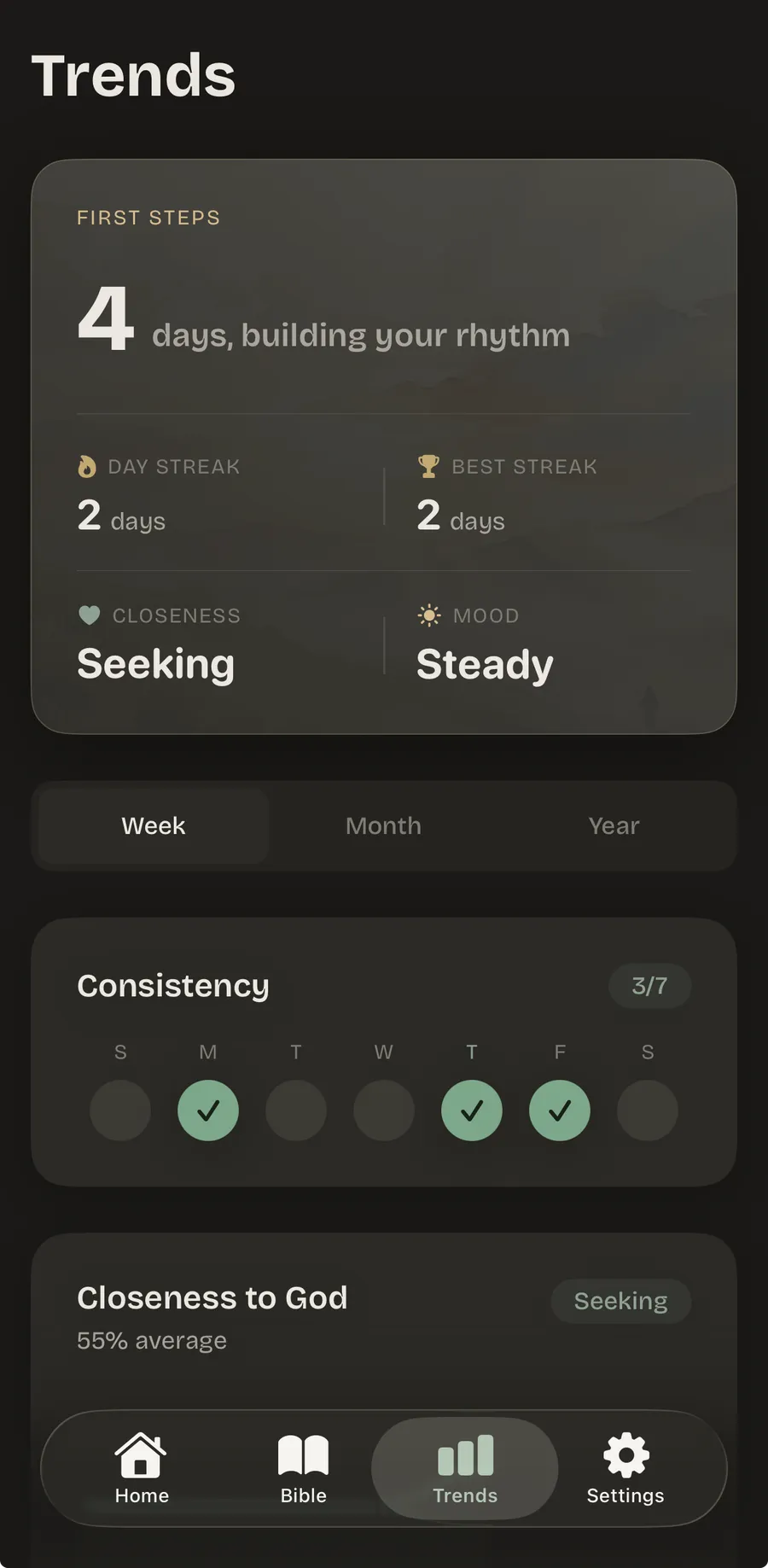
Some mornings God feels close and some mornings He does not, and a breath prayer is often all there is room for. BlessUp starts the day with two honest questions: how close do you feel to God, and how are you feeling? It offers a written prayer matched to your answers, and that prayer counts toward the same streak as your reading, with a grace day to cover a missed one. Connection grows the way anything grows: a little, daily, with grace. The apps you choose to shield still open the simple way. Read the day’s chapter, and they unlock. See how the morning check-in works
What the breathing research does and does not say
You will see breath prayer sold as a stress cure. The research is more modest than that, and more interesting.
In 2001, a team led by Luciano Bernardi published a small study in the BMJ. They measured 23 healthy adults in Florence and Pavia, Italy, as they recited the Ave Maria in Latin or a yoga mantra. Both slowed breathing to about six breaths a minute, and heart and blood-pressure rhythms lined up with the breath. Baroreflex sensitivity, a measure of how the body steadies blood pressure, rose from 9.5 to 11.5 ms/mm Hg. The researchers had noticed that one cycle of the Ave Maria took almost exactly ten seconds.
A larger picture comes from a 2018 systematic review in Frontiers in Human Neuroscience by Zaccaro and colleagues. From 2,461 abstracts, only 15 studies met their criteria. Those studies looked at slow breathing, under ten breaths a minute, in healthy people, and linked it to higher heart rate variability and to changes in brain activity and mood.
Here is what that does and does not mean:
- It does suggest that praying a short, repeated prayer slowly tends to slow the breath, and slow breathing has measurable effects on the body.
- It does not show that breath prayer treats anxiety, lowers blood pressure, or makes you healthier. The BMJ study was 23 people in a lab. The review was about breathing techniques, not prayer.
- It measured nothing spiritual. No study can weigh whether a prayer was heard. That is not what the research was for.
So hold the science lightly. The reason to pray a breath prayer is not what it does to your heart rate. It is Who you are talking to.
Is it Christian, or is it meditation?
Some Christians worry that breath prayer is Eastern meditation with a Bible verse on top. It is a fair question to ask, and the history gives part of the answer: the practice comes from Christian monks praying to Jesus by name, and the words come from the Gospels.
The research above actually sharpens the answer. In the BMJ study, a Latin Ave Maria and a yoga mantra slowed the breath in almost the same way. The body could not tell them apart. What makes a breath prayer Christian is not the breathing at all. It is Who the words are addressed to.
That is the difference most Christians point to. A breath prayer is spoken to God, in words from Scripture, not used to empty the mind. If you are unsure, talk it over with your pastor or priest. They know you, and they know your church’s teaching better than any article can. You can also find a church near you with our church finder.
Frequently asked questions
What is a breath prayer?
A breath prayer is a very short prayer said in two halves, one as you breathe in and one as you breathe out. The first half is usually a name for God and the second a simple request, such as "Lord Jesus Christ, Son of God" on the breath in and "have mercy on me" on the breath out.
Is breath prayer biblical?
The practice grew out of the Jesus Prayer of the Eastern Orthodox tradition, and its best-known words echo two short cries in the Gospels: Bartimaeus in Mark 10:47 and the tax collector in Luke 18:13. The Bible does not describe the breathing method itself, so if you have questions about it, talk them through with your pastor or priest.
What is an example of a breath prayer?
The classic example is the Jesus Prayer: breathe in and pray "Lord Jesus Christ, Son of God," then breathe out and pray "have mercy on me." Others follow the same pattern, such as "God" on the breath in and "have mercy on me, a sinner" on the breath out, from Luke 18:13.
Is breath prayer the same as meditation?
Not in the way most Christians practice it. A breath prayer is addressed to God in words drawn from Scripture, and the breathing is only the rhythm that carries them. Research on slow breathing studies the technique, not prayer, so it cannot settle the question either way; a pastor or priest can help you think it through for your own tradition.
One chapter is the only key. See what your mornings look like on the other side of it.
No guilt. Ever. Grace is built in. Funded by readers, never by ads.