What Does It Mean to Pray Without Ceasing?
By Dom · · 10 min read
Four words, and most people meet them as an accusation. You are struggling to hold ten minutes in the morning, and Paul appears to be asking for all of them, every day, for the rest of your life.
He is not, and the reason is in the sentence he wrote it in. What the command asks is real and demanding, but it is not non-stop words, and Christians have been practising it inside ordinary working lives — kitchens, workshops, school runs — for a very long time.
Key takeaways
- It is one clause in a run of three. “Rejoice always, pray continually, give thanks in all circumstances” — three habits of posture, not three tasks to complete.
- It does not mean non-stop talking. Nobody in the tradition has read it that way, and the practices built on it are short and repeatable.
- The Orthodox form is the Jesus Prayer — “Lord Jesus Christ, Son of God, have mercy on me a sinner” — which the Orthodox Church in America calls the most normal form of unceasing prayer in the tradition.
- Brother Lawrence practised it in a monastery kitchen, as a layman, for the rest of his life after a period as a soldier.
- Start with three anchors, not with every minute: a morning reading, a one-line return at midday, and a short look back at night.
What Paul was asking the Thessalonians to do
Start with the sentence, because almost every misreading comes from quoting the phrase alone.
“Rejoice always, pray continually, give thanks in all circumstances; for this is God's will for you in Christ Jesus” (1 Thessalonians 5:16–18, NIV). The King James renders the middle clause “pray without ceasing,” which is the phrasing most people search for and the reason it sounds more severe in English than its neighbours do.
Look at what it is sitting between. “Rejoice always” plainly does not mean feeling cheerful in every second, and nobody reads it that way. “Give thanks in all circumstances” does not mean speaking thanks without pause. These are three descriptions of a settled orientation, written to a young church in a short run of closing instructions. The middle one is asking for the same kind of thing as the two on either side of it: a direction you keep turning back to, rather than an activity you perform without stopping.
Christians differ on how far to press it, and those differences are real rather than decorative. Some traditions read it as a call to constant interior prayer; others as a description of a life oriented toward God throughout its ordinary business. We are not the people to settle that — if you want it worked out in your own tradition, ask your pastor or priest.
What “without ceasing” does not mean
Three things it does not ask, all of which people quietly assume it does.
It does not mean continuous words. No major tradition has taught that, and the practices actually built on this verse are short, repeatable and designed to fit around work. If the command required uninterrupted speech, every practice developed to obey it would look nothing like the ones that exist.
It does not mean prayer is the only thing you may attend to. The people most associated with unceasing prayer were, without exception, doing something else at the same time: cooking, mending shoes, copying manuscripts, farming.
It does not mean a failed day is disobedience. The verse is a direction, and a direction is something you can be facing again a moment after you noticed you were not. If the phrase has been sitting on you as a debt you cannot pay, that is worth putting down before you read any further.
The opposite of unceasing prayer, measured
Here is a modern problem the Thessalonians did not have.
Whatever else unceasing prayer is, it describes attention that holds a direction across a day. The contemporary opposite of that has been measured. Gloria Mark's group at UC Irvine has tracked how long people stay with one screen before moving to another: the average was around two and a half minutes when they began in 2003, and about 47 seconds in recent years, with other researchers landing at 44 and 50. These are measurements of screen-switching during computer work rather than a limit on what a human mind can do, so do not read them as a verdict on your capacity. But they describe the medium most of a modern day now runs through, and a day made of 47-second fragments is a hard surface on which to keep any direction at all.
Something similar shows in what people report doing. Pew Research Center's Religious Landscape Study, surveying US adults in 2023–24, found the share praying daily had fallen 14 points since 2007. That is a change in a habit, not a change in human beings, and habits are the kind of thing that can be rebuilt deliberately. The connection between fragmented attention and a thinner prayer life is one we find persuasive rather than one this data proves; we have made the longer case in screen time as a spiritual problem.
How Christians have practised it: the Jesus Prayer and Brother Lawrence
Two examples, from two traditions, both of them lived inside ordinary work.
The Jesus Prayer. The Orthodox Church in America describes it plainly: “The most normal form of unceasing prayer in the Orthodox tradition is the Jesus Prayer”. The words most usually said are “Lord Jesus Christ, Son of God, have mercy on me a sinner” — the publican's prayer from Luke 18, chosen because mercy is what is most needed. It is short enough to carry, which is the point: a line you already know can be returned to in a gap in the day without preparation.
There is also a specific method, hesychasm, in which the prayer is repeated with the breath in a particular bodily posture. It is worth being careful here, because this is the part that gets borrowed and flattened into a breathing exercise. The OCA is direct that the hesychast method “requires always and without exception the guidance of a spiritual guide,” that using it without guidance is to court spiritual disaster, and that abuses became serious enough that its use was greatly curtailed in recent centuries. The breathing is not the point, and it is not a technique to pick up from an article. The prayer itself, said in ordinary words, is available to anyone.
Brother Lawrence. The Western lay example, and the more approachable one. He spent time as a soldier before entering the Discalced Carmelite priory in Paris; being uneducated, he entered as a layman, and he worked in the kitchens and as a cobbler there for the rest of his life. What he became known for was bringing God into every part of that work rather than escaping it — the practice of the presence of God, carried out over pots.
The pattern in both is the same, and it is the opposite of intensity. Something short. Something repeatable. Something done while doing something else.
Three anchors: a first step for an ordinary day
So do not try to fill the day. Anchor it, in three places, and let the rest of the day return to those.
| When | What it is | How long | What it borrows from |
|---|---|---|---|
| Morning | Read the day's chapter, then pray one sentence out of what you read | Under ten minutes | The daily office, kept by most traditions in some form |
| Midday | One line, said once, wherever you are — in a corridor, a car, a queue | Seconds | The Jesus Prayer, as a short return rather than a method |
| Evening | Two minutes looking back: where was God in today, and what do you want to say about it | Two minutes | The examen, and Brother Lawrence's habit of finding God in the day's work |
Three anchors is not unceasing prayer. It is the beginning of a day with a direction in it, which is what the command is pointing at, and it is achievable this week. Add the midday line first if you only take one — it is the one that teaches the returning, and returning is the whole skill.
If the words themselves are the obstacle, what to pray about is the companion to this, and a morning prayer routine goes deeper on the first anchor.
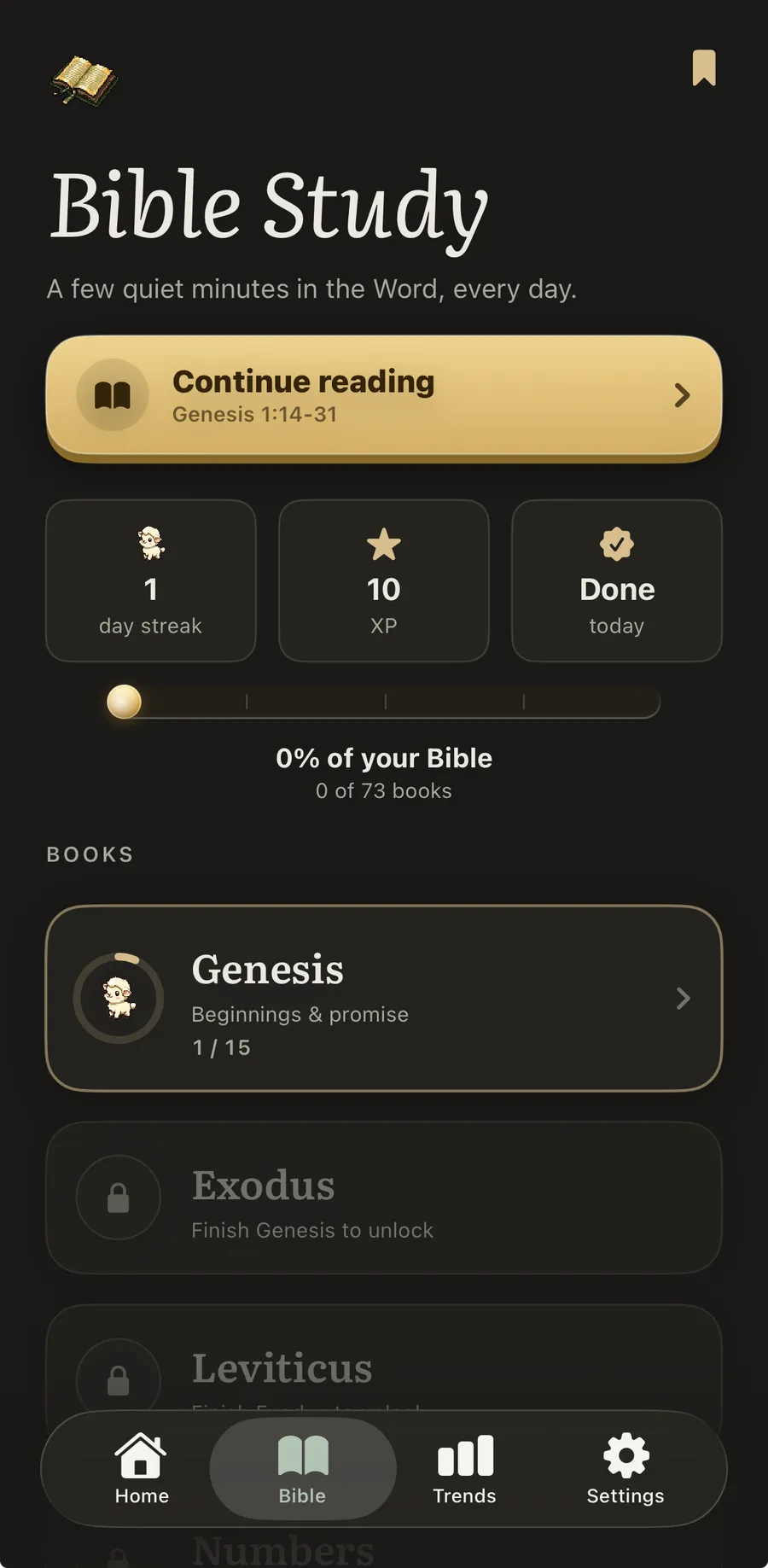
The first anchor is the one everything else hangs from, and it is also the easiest to lose to a phone that is already full of other people's mornings. BlessUp puts the day's chapter before the apps you have chosen to shield, then offers a prayer matched to a short check-in, and counts prayer toward the same streak as reading. Connection grows the way anything grows — a little, daily, with grace. It is free to download on the App Store.
None of this is a technique for producing closeness to God, and it would be dishonest to sell it as one. It is a shape. What happens inside the shape is not ours to promise, and if the deeper trouble is that prayer has gone quiet rather than that your day is busy, how to pray consistently and your own pastor are both better places to take it than a blog. More about who we are if you want to know where this is coming from.
Frequently asked questions
What does 'pray without ceasing' mean in the Bible?
It comes from 1 Thessalonians 5:17, where the NIV renders it 'pray continually' and the King James 'pray without ceasing'. It sits between 'Rejoice always' and 'Give thanks in all circumstances', and reading the three together is what makes it intelligible: none of them describes an activity performed without pause, and all three describe a settled orientation. The command is about a direction you keep returning to rather than continuous speech.
Is it possible to pray without ceasing?
If it means unbroken words, no, and no major tradition has taught that. If it means a life that keeps turning back toward God through ordinary work, Christians have been doing it for centuries - Brother Lawrence in a monastery kitchen, and those who pray the Jesus Prayer in the Orthodox tradition. What makes it possible is that the practices are short and repeatable rather than continuous.
How do you pray continually when you work all day?
By anchoring the day rather than filling it. Three anchors work for most people: a short reading and one sentence of prayer in the morning, one memorised line said once somewhere in the middle of the day, and two minutes looking back in the evening. The midday line is the one worth starting with, because it is the one that trains the habit of returning, and it takes seconds.
What is the Jesus Prayer?
A short prayer used in the Orthodox tradition, which the Orthodox Church in America describes as the most normal form of unceasing prayer in that tradition. The words most usually said are 'Lord Jesus Christ, Son of God, have mercy on me a sinner', drawn from the publican's prayer in Luke 18. There is also a specific method called hesychasm, in which it is repeated with the breath - the OCA is clear that this requires the guidance of a spiritual guide and should not be picked up on your own.
What is the difference between 'pray without ceasing' and 'pray continually'?
They translate the same phrase in 1 Thessalonians 5:17. 'Pray without ceasing' is the King James wording and the one most people search for; 'pray continually' is how the NIV renders it. The difference is in English register rather than in meaning - 'without ceasing' sounds more absolute to a modern ear, which is part of why the verse reads as heavier than the two commands surrounding it.
Your day starts in the Word, not the feed. BlessUp is free to download.
No guilt. Ever. Grace is built in. Funded by readers, never by ads.