How to Focus When You Pray
By Dom · · 13 min read
You sit down to pray. Thirty seconds in you are composing a reply to a text from yesterday. You catch yourself, come back, get another forty seconds, and then you are planning dinner. The phone is face down on the table and it has not even buzzed. By the end you are not sure the prayer counted.
Here is the first thing worth knowing: the wandering is not the problem you think it is. A mind that drifts in prayer is a mind doing what minds do all day. What can change is the setup around the prayer and what you pray from — and those two things are far more under your control than your concentration is.
Key takeaways
- Drift is the baseline, not a failure. In a study that sampled 2,250 people at random moments, minds were wandering 46.9% of waking hours, and no less than 30% during every activity measured but one.
- Sitting with nothing is genuinely hard. Across 11 studies, many people did not enjoy 6 to 15 minutes alone with their thoughts — 67% of men in one study preferred a mild electric shock to it.
- Pray from something. A passage read a minute earlier gives the mind a place to go. A blank is the hardest possible starting position.
- Park the intrusions on paper. A thought written down stops asking to be remembered.
- The return is the practice. Coming back the fifth time is the prayer, not evidence that the first four failed.
Why your mind wanders when you pray (everyone's does)
In 2010, Matthew Killingsworth and Daniel Gilbert published a study in Science that used an iPhone app to contact 2,250 volunteers at random moments and ask what they were doing and whether they were thinking about it. On average people reported their minds wandering 46.9% of the time, and no less than 30% of the time during every activity on the list but one. The volunteers ranged from 18 to 88 years old, and about three quarters were American.
Two honest caveats. These were people who chose to download an app, not a representative sample of anybody. And nobody in the study was praying — the activities were things like walking, eating and watching television. So this is not a measurement of what happens in prayer. It is something more useful than that: it is the background rate for being a person. Whatever you were expecting of your attention, roughly half of it is somewhere else at any given moment, and that was true before you sat down.
There is a second finding worth sitting with. Timothy Wilson and colleagues ran eleven studies asking people to spend 6 to 15 minutes alone in a bare room with nothing to do but think, after handing over their phones and anything to write with. Most did not enjoy it. In one study, among participants who had already said they would pay money to avoid being shocked again, 67% of the men (12 of 18) and 25% of the women (6 of 24) gave themselves at least one electric shock rather than sit there with their own thoughts. A later study recruited people aged 18 to 77 at a farmer's market and a church, and found much the same thing.
Being alone in quiet with nothing external to hold onto is, for most people, genuinely difficult. That is not the same situation as prayer — prayer has someone in it, and a purpose — but the overlap is real enough to explain something. If silent prayer feels harder than it seems like it should, that is not a defect in your faith. It is close to the most ordinary finding in the literature on attention.
This is also worth naming plainly, because the usual next move in an article like this is to make you feel behind: you are not behind. Prayer that wanders still counts. If the feeling underneath the distraction is really that nothing is happening when you pray, that is a different question, and we have written about when prayer feels dry separately.
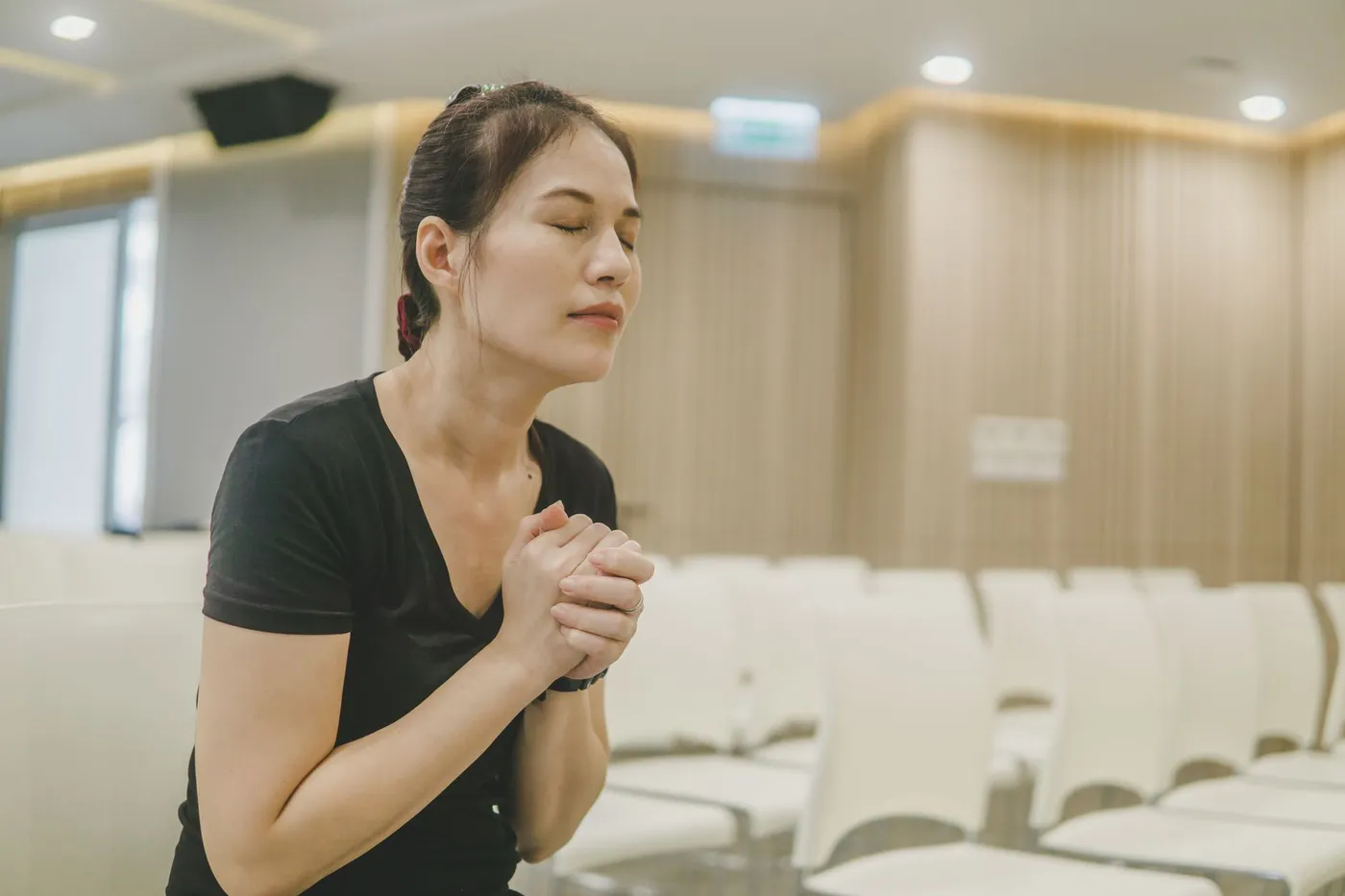
Before you start: where the phone goes
Almost everything that makes prayer easier is decided before the prayer starts, and the largest single variable is the phone.
Be precise about the scope, though, because this is where the usual advice overreaches. What is being proposed here is a rule for the ten minutes you are praying — phone in another room, or at minimum a closed drawer, for the length of the session — and not a standing nightly rule about where the phone lives. Those are different commitments with different success rates: we have written about why the permanent version tends to slip after a few days. A ten-minute rule has to survive ten minutes, which is a far easier thing to ask.
Within the session, distance beats orientation. Face down on the table is still within reach, and something within reach stays a live option your attention keeps returning to, whether or not it has done anything. If you are reading from the phone, put it in aeroplane mode and set it down when the reading is finished.
Jesus gives setup advice, as it happens, though for a different reason: “But when you pray, go into your room, close the door and pray to your Father, who is unseen” (Matthew 6:6, NIV). He is contrasting private prayer with praying to be seen praying, so the closed door there is about audience rather than about acoustics or notifications. But the practical shape of the instruction is a room, a door, and fewer inputs, and that shape holds up remarkably well for a problem He was not addressing.
If the pull of the phone is the larger story in your day and not only in your prayer, the habit itself is the thing to work on — breaking the scroll reflex does more for prayer than any amount of trying harder in the moment.
Pray from something: a passage first
Most advice about focus in prayer treats it as a concentration skill. It is more useful to treat it as a content problem. A mind with nothing to hold will find something to hold, and what it finds will be your inbox.
So do not start from a blank. Read something first — a psalm, the chapter you are on, four verses. Then pray from it. The passage gives you a first sentence, which is the part people stall on, and it gives you somewhere to return to when you drift, which is the part people quit on. If you are not sure what to say once you have read, what to pray about is the companion to this.
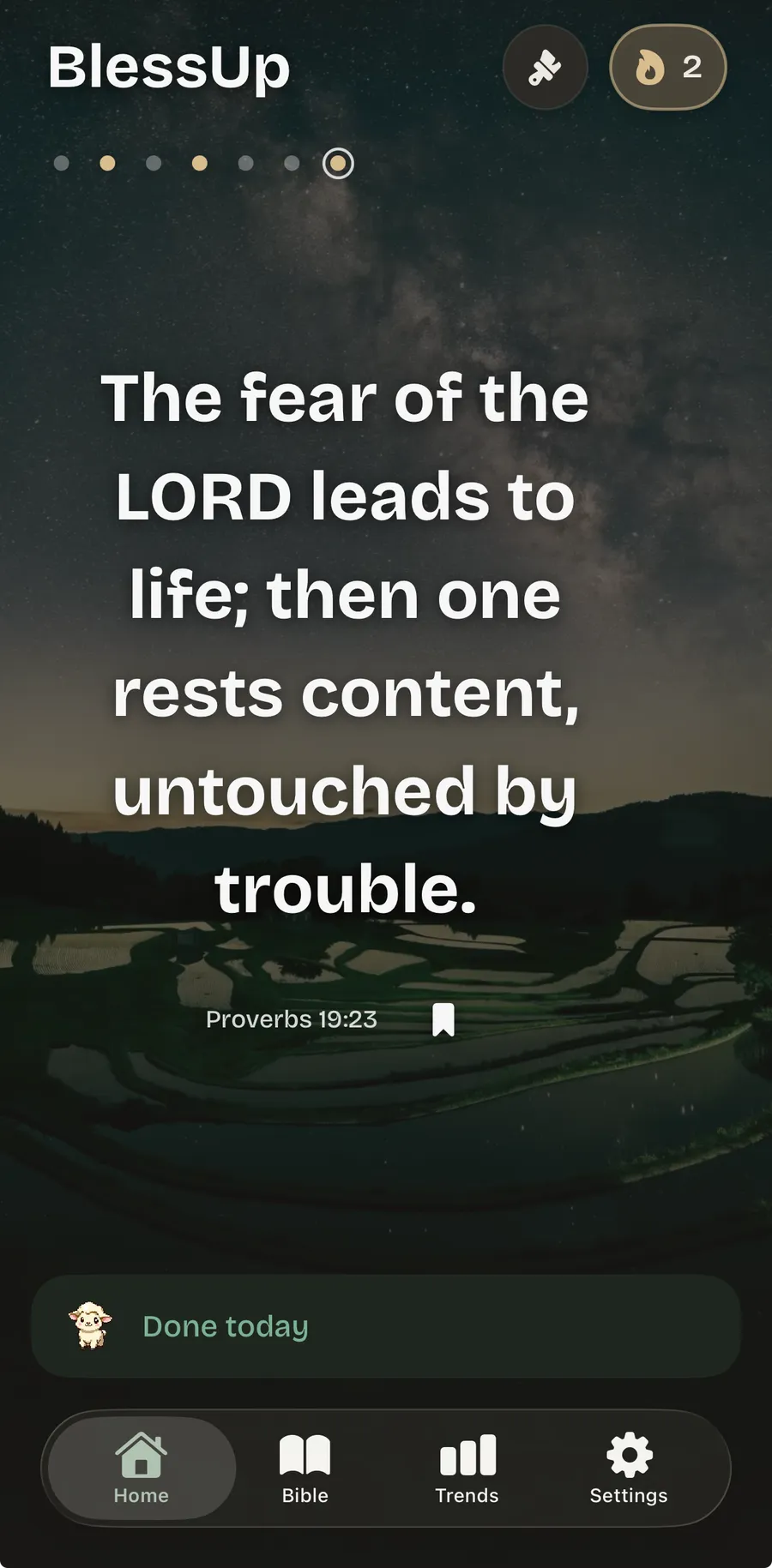
BlessUp is built around a version of this. The first unlock of the day runs a short check-in, then the day's chapter, and the prayer it offers is chosen to match the two check-in answers, so the reading and the prayer sit next to each other rather than the prayer having to start from nothing. Reading first is not a rule the app invented — it is the oldest available fix for a wandering mind.
A paper list for the thoughts that will not leave
Some intrusions are not distractions at all. They are your brain correctly reminding you about the dentist, because you have given it no other way to be sure you will remember.
Keep a scrap of paper and a pen beside you. When a task arrives mid-prayer, write it down in three words and go back. That is the whole technique. It works because the thought was doing a job — holding the reminder — and paper does that job better, so the thought stops applying for it. Paper rather than a note on your phone, for the reason in the last section.
The same trick handles the other four common intruders, each with a setup change that pre-empts it and a short line to say when it arrives anyway.
| What interrupts | The setup that pre-empts it | The return, when it happens anyway |
|---|---|---|
| The phone buzzing | Phone in another room, not face down beside you | “That can wait. Where was I?” |
| The to-do list | Paper and pen within reach, before you start | Write three words. Go back. |
| A conversation you keep replaying | Name it out loud at the start and pray about it first | “I have already brought this. Back to You.” |
| A worry that loops | Pray from a passage rather than from the worry | Read the verse again, out loud if you are alone. |
| Sleepiness | Sit up rather than lie down; pray earlier, not last thing | Stand up. Keep praying standing. |
If your phone is the thing you are praying against every morning, it can be made to work the other way. BlessUp shields the apps you choose until the day's chapter is read, which means prayer starts from something you have just taken in rather than from whatever the feed left behind. It runs on Apple's Screen Time framework, so the phone holds the line instead of you. it is on the App Store
Returning is the practice
This is the part that changes prayer most, and it costs nothing.
If drift is the human baseline, then a prayer without drift was never the target, and treating each return as evidence of failure gets the accounting exactly backwards. The coming back is the prayer. You noticed, and you turned back — and if you did that nine times in ten minutes, you turned toward God nine times, which is nine more than a perfectly concentrated mind that never had to.
Two physical things make returning easier, and both are older than any of this. Praying aloud, even at a murmur, gives the prayer something to hold onto and makes drift obvious — you hear yourself stop. And posture matters more than people expect: sitting upright or standing keeps you present in a way that lying down does not, which is why the last ten minutes before sleep is the hardest slot to pray well in.
Practically: no self-reproach at the moment of noticing. Do not stop to evaluate how it is going. Do not start over. Say one short line — the ones in the table work — and carry on from where you were. The self-reproach is more disruptive than the original distraction was, because it is about you rather than about God, and it takes longer.
How long to pray when your focus is short
Shorter than you think, and more often than you think.
If your attention gives out at four minutes, pray for four minutes. A four-minute prayer you actually do beats a twenty-minute one you keep failing and then dread. In practice, a short prayer you keep is far easier to lengthen than a long one you keep abandoning, so the way to ten minutes is a lot of fours rather than one heroic twenty that persuades you that you cannot do this.
It is worth knowing that consistency here is not unusual to struggle with. Pew Research Center's Religious Landscape Study, surveying US adults in 2023-24, found that 44% say they pray every day, down from 58% when Pew first ran the study in 2007, with most of that decline between 2015 and 2021. Pew also breaks those daily pray-ers down by tradition, where evangelical Protestants account for 38% of them. Daily prayer is common, and it is also something a lot of people have found harder to hold onto over the last fifteen years. You are in ordinary company.
The rest of the habit question — the cue, the time of day, what to do about the days you miss — belongs to how to pray consistently, which is the fuller guide this post sits under. If you want the questions people ask us most about how the reading and the prayer fit together, they are on our FAQ page.
Frequently asked questions
Why can't I focus when I pray?
Mostly because that is how attention works, not because of anything about your faith. A study that sampled 2,250 people at random moments found minds wandering 46.9% of waking hours, and no less than 30% of the time during every activity measured but one. Prayer was not among the activities studied, so this is the background rate rather than a measurement of prayer, but it means drift is the human default. The things that actually move the needle are the setup before you start and having something to pray from.
Is it wrong to get distracted while praying?
No. A wandering mind is not a moral failure, and treating it as one tends to make prayer harder rather than easier. The older Christian instinct is that the practice is the return: you notice, you come back, and the coming back is the prayer. If the distraction is troubling you in a deeper way than this, that is a good conversation to have with your pastor, who knows you and is the right person for it.
How do I stop my mind from wandering during prayer?
You largely cannot stop it, so aim at reducing how often it happens and getting better at returning. Three things help most: put the phone in another room rather than face down beside you, read a short passage first so you are praying from something rather than into a blank, and keep paper and a pen within reach so intruding tasks can be written down in three words instead of being held in your head.
Should I pray with my eyes open or closed?
Either is fine, and Scripture does not prescribe one. Closed eyes remove visual distraction, which helps some people and makes others sleepy or more prone to drifting inward. Open eyes resting on something steady, like a page or a window, work well if closing them sends you to sleep. It is worth trying both for a week rather than assuming the one you were taught is the one that suits you.
Does praying out loud help you focus?
For many people, yes. Speaking gives the prayer a physical anchor and makes drift easier to notice, because you hear yourself stop. It also slows you down, which tends to help. A murmur is enough if you are somewhere you would rather not be overheard, and reading a psalm aloud is a good way in if starting out loud feels self-conscious.
Your phone can start opening the Bible instead of closing it.
No guilt. Ever. Grace is built in. Funded by readers, never by ads.