Praying When You Don’t Feel It
By Dom · · 10 min read
You sit down. You say the words you have said a thousand times. And there is nothing there — no warmth, no sense of being heard, not even the vague settling you used to get. Then the second thought arrives, and it is worse than the first: maybe I never really meant any of it.
That second thought is the one worth talking about, because it is the one that ends the habit. The empty feeling is common and survivable. The conclusion people draw from it — that the emptiness is evidence about them — is what actually stops people praying for years.
Key takeaways
- The experience has a name and a long history. Christian writers have described prayer that feels like nothing for at least sixteen centuries. It is not treated in that tradition as a sign of lost faith.
- Feeling is not the measurement. The only part of prayer you control is whether you show up; whether it feels like anything is not on the list of things you can decide.
- Be careful with the research. The most-quoted study on prayer and happiness is observational, it studied people raised with the practice, and it does not show that prayer causes wellbeing.
- Shorten it, don't skip it. A ninety-second prayer you actually say beats a twenty-minute one you keep postponing until you feel ready.
- Missing one day is not the problem. In the best real-world study of habit formation, missing a single opportunity did not materially affect the habit being formed.
You are describing something that has a name
What you are experiencing is usually called spiritual dryness, or aridity. It shows up across every branch of Christianity and it is old. The Psalms are full of it, written by people who kept praying while saying out loud that God seemed absent. Psalm 42:1-3 is a man describing thirst, not satisfaction: "My tears have been my food day and night, while people say to me all day long, 'Where is your God?'" (NIV). Psalm 88 ends without resolution at all.
That matters for one practical reason. If the book you are praying from contains prayers by people who felt nothing, then feeling nothing cannot be disqualifying. It is inside the normal range of the thing.
We are app builders and not pastors, so take the theology from your own tradition — but on the descriptive question, the traditions agree with each other more than they disagree: dryness is a season, not a verdict.
The ordinary reasons it goes flat
Before reaching for a spiritual explanation, it is worth ruling out the boring ones. In practice most dry spells have at least one of these underneath.
| What is going on | How you can tell | First thing to change |
|---|---|---|
| Exhaustion | Everything feels flat, not just prayer | Sleep before technique. Move prayer earlier in the day. |
| Habituation | Same words, same time, same chair, for months | Change one variable. Pray a psalm instead of freestyling. |
| Unnamed grief or anger | You avoid one specific subject when you pray | Pray about that subject, badly, out loud. |
| Rush | Prayer sits between two obligations | Two minutes with nothing after it beats ten minutes with a meeting at the end. |
| Depression or burnout | Weeks of flatness, plus appetite, sleep or interest changes | This is a doctor conversation, not a discipline problem. |
That last row is not a throwaway. Persistent numbness that covers your whole life, not just your prayer life, is worth taking to a professional. Treating clinical depression as a spiritual failure is one of the more damaging mistakes in this area, and it delays help.
What the research actually says, and what it does not
There is one study that gets quoted constantly in this category, usually badly. It deserves the careful version.
A Harvard T.H. Chan School of Public Health analysis, published in the American Journal of Epidemiology in 2018, followed more than 5,000 young people for between 8 and 14 years. Those who prayed or meditated daily in childhood and adolescence were 16% more likely to report higher happiness as young adults. Those who attended religious services weekly or more were 18% more likely to report higher happiness, 29% more likely to volunteer, and 33% less likely to use illicit drugs.
Now the fine print, which is where most write-ups fail:
- It is observational. It found associations. It did not show that prayer causes happiness, and the authors do not claim it did.
- It studied religious upbringing. These were people raised with the practice, measured later. An adult starting to pray this month is outside what the study observed.
- Private practice did not beat communal practice. Harvard's own summary notes that previous adult studies found service attendance had the greater association, and that in this adolescent sample communal and private practices were of roughly similar benefit. If you see it claimed the other way round, that is an inversion of the finding.
Why spend three paragraphs qualifying a statistic that would sound better unqualified? Because a person in a dry season has usually already been sold the inflated version, and it did not help. A number that overpromises is one more thing that failed to work.
The practice that does not depend on feeling
The useful reframe is this: feeling is an outcome, not an input. You cannot decide to feel close to God this morning any more than you can decide to fall asleep. What you can decide is whether you show up, and how long you stay.
Four things that hold up when the feeling is gone:
- Shorten it, do not skip it. If twenty minutes has become impossible, pray for ninety seconds. The failure mode is not short prayer; it is the postponement that turns into a month.
- Say it out loud. Silent prayer during a dry spell drifts into rumination within about thirty seconds. Speech has a floor under it.
- Start from the text, not from yourself. Read a few verses first and answer them. This removes the requirement to generate something from an empty tank, which is the exact requirement you cannot currently meet.
- Tell the truth in it. "I do not want to be here and I do not feel anything" is a real prayer. Romans 8:26 is explicit that not knowing what to pray is anticipated, not disqualifying.
None of this requires an app. It requires the thing to be small enough that showing up is not a decision. If you want the longer version of the mechanics, building a morning prayer routine that sticks covers the anchoring and timing.
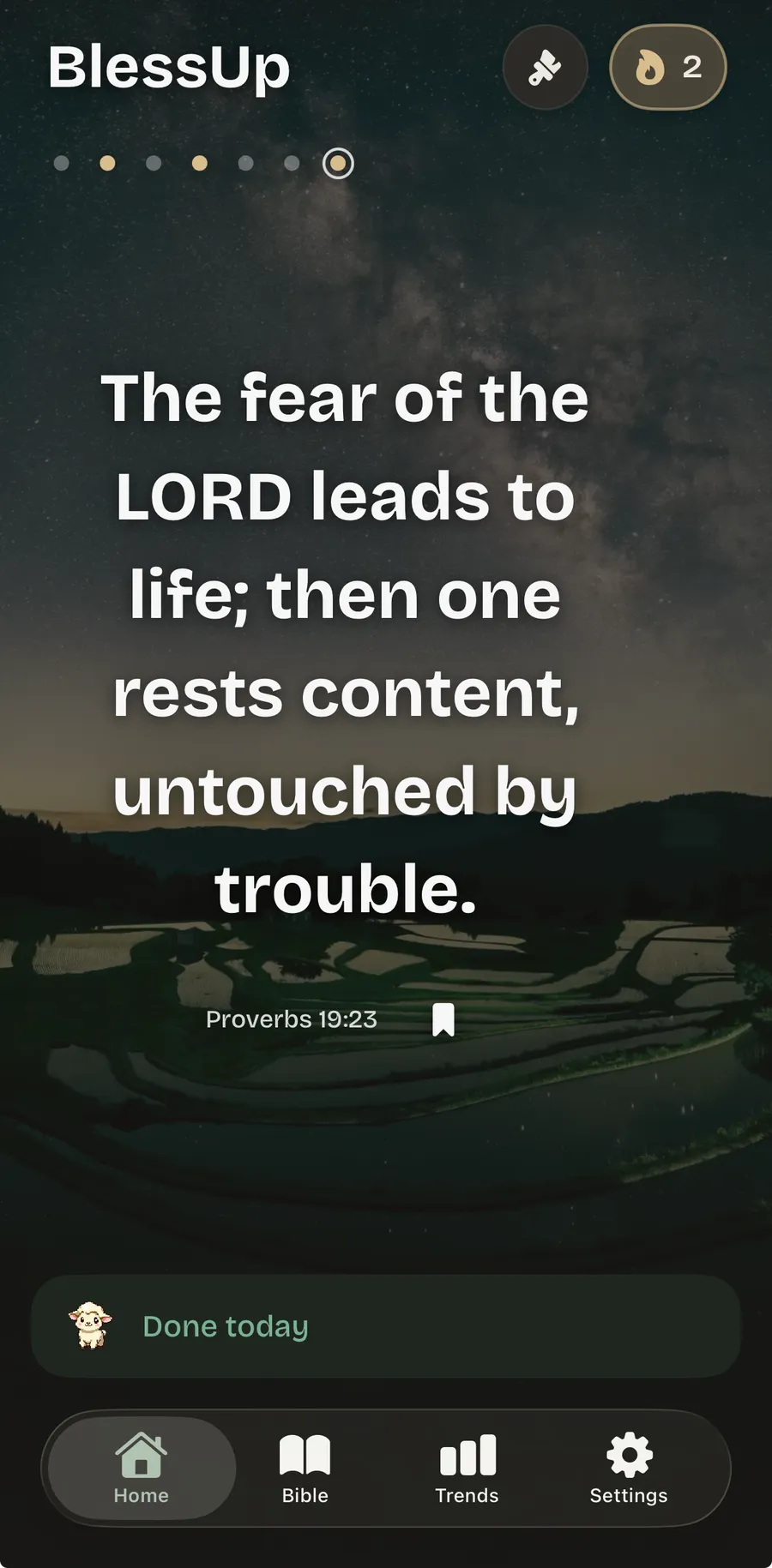
Connection grows the way anything grows — a little, daily, with grace. If it helps to have something waiting rather than a blank page, BlessUp asks two questions about how the day actually is, then hands you a prayer written for that answer instead of one written for a better mood. Reading and prayer both count toward the same streak, and a missed day is covered rather than punished. BlessUp is free to download on the App Store.
Borrow words when you have none
Every tradition has a solution for this and it is the same solution: use somebody else's words until yours come back.
- The Psalms. Pray one a day, in order, out loud. They cover the full emotional range including the parts you would not have chosen. If anxiety is the specific weight, twelve passages read honestly is a narrower place to start.
- The Lord's Prayer, slowly. One line at a time, with a pause after each. It takes four minutes and it asks nothing of your mood.
- Written prayers. A prayer book, a collect, a liturgy. Using set words is not insincerity — it is the same reason you sing hymns you did not write.
Praying words you did not compose feels like cheating right up until you realise the alternative was not praying at all.
How long does a dry season last?
Honestly: nobody can tell you, and anyone giving a number is guessing. What we can say something about is habit, which is a narrower question.
The best real-world study of habit formation is Lally and colleagues, published in the European Journal of Social Psychology in 2010. Ninety-six volunteers adopted a daily behaviour and rated how automatic it felt for twelve weeks. Two findings matter here. The time to reach 95% of a person's own automaticity ceiling ranged from 18 to 254 days — an enormous spread, which is why the popular "21 days" and "66 days" figures mislead. And, in the authors' words, "missing one opportunity to perform the behaviour did not materially affect the habit formation process."
That second sentence is the one to keep. The dry season is not made worse by one missed morning. It is made worse by the story people tell themselves about the missed morning, which is a different problem and a solvable one. That is the whole argument behind why streaks make people quit.
Three things not to do
- Do not audit your own sincerity. Asking "do I really mean this?" mid-prayer is the fastest way to stop praying. You are not qualified to judge the case and you are not required to.
- Do not escalate. Responding to dryness with a longer, harder regimen usually ends in quitting within two weeks. Go smaller, not bigger.
- Do not do it alone for months. Tell one person — a pastor, a friend who prays. If you do not currently have a church to ask, the BlessUp church finder covers 54 US cities. Dryness is remarkably common and remarkably unspoken, and saying it out loud usually reveals the person you told has been there.
The point is not to manufacture a feeling. It is to still be praying in six weeks, so that if the feeling comes back, it has somewhere to land.
Frequently asked questions
Is it a sin to pray when you don’t feel like it?
No. Praying without feeling is closer to faithfulness than to hypocrisy, because you are doing it despite getting nothing back. Scripture itself contains prayers by people who describe God as distant, including Psalm 42 and Psalm 88.
What is spiritual dryness?
Spiritual dryness, sometimes called aridity, is a period where prayer feels empty and God seems absent, without any accompanying loss of belief. It is described throughout Christian writing and is generally treated as a season rather than a sign that faith has failed.
How long does spiritual dryness last?
There is no reliable answer and anyone offering a specific number is guessing. What can be said is that keeping the practice small enough to sustain matters more than intensity, and that in habit research the time to reach a stable habit varied from 18 to 254 days between individuals.
Does prayer actually make you happier?
The most-cited evidence is a Harvard T.H. Chan analysis of more than 5,000 youth followed 8 to 14 years, which found that daily prayer or meditation in childhood and adolescence was associated with being 16% more likely to report higher happiness as a young adult. It is an observational study of religious upbringing, so it shows association, not cause, and it did not study adults taking up prayer.
Should I stop praying until I mean it again?
Stopping is what turns a dry week into a dry year, because the practice is what carries you until the feeling returns. Shorten it instead. Ninety honest seconds is a real prayer, and it keeps the habit alive.
Small daily readings, cover to cover. That is the whole plan.
No guilt. Ever. Grace is built in. Funded by readers, never by ads.