Prayer Before Bed: A Five-Minute Night Prayer Routine
By Dom · · 11 min read
The lights are off and the phone is face down. You start the way you always do, "Thank You for today," and by the second sentence your mind has gone to the email you did not send, then to tomorrow's meeting, then to something awkward you said at lunch. Ten minutes later you are wide awake and the prayer has turned into a planning session.
Bedtime prayer does not need to be longer or holier to fix that. It needs a shape. Here is a short one, taken from the way the church has prayed its last hour for centuries, cut down to fit a tired night.
Key takeaways
- Night prayer is "the last prayer of the day, said before retiring," in the words of the Catholic Church's guidelines, and its psalms are chosen for confidence in God.
- A four-part shape that fits in about five minutes: a line of Scripture, a short look back, handing tomorrow over, and one closing sentence of trust.
- Write tomorrow down, then pray over it. In a sleep-lab study of 57 young adults, five minutes spent writing a specific to-do list before bed led to falling asleep faster than writing about finished tasks.
- 44% of U.S. adults pray at least daily, according to Pew's 2023-24 Religious Landscape Study.
- Falling asleep mid-prayer is not failing. On a night with nothing left, the closing line alone is a complete prayer.
Why the last prayer of the day is different
A morning prayer looks forward. There is a day ahead, and it is natural to ask for help with it. A night prayer comes at the other end, when the day is finished whether you liked how it went or not. Nothing you pray at 11pm will get the email sent. That is the gift of it. It is the one prayer of the day that is about letting go rather than getting ready.
The trouble is that a tired mind does not let go easily. Left alone, a bedtime prayer tends to become one of two things: a fast list of requests said on the edge of sleep, or a replay of every awkward moment since breakfast. Neither is much of a rest. A simple shape fixes both, because it gives the prayer somewhere to go and a place to stop.
You would not be unusual for wanting one. Pew Research Center's 2023-24 Religious Landscape Study found that 44% of U.S. adults say they pray at least once a day. Many of those prayers happen at night, in bed, in the dark, with no one watching and no script.
The church already prays this hour
Night prayer is not something you have to invent. Christians have kept a last prayer of the day for centuries, and many still do. In the Catholic Church it is called Night Prayer, part of the Liturgy of the Hours, and older books call it Compline. The U.S. Conference of Catholic Bishops' page on the Hours quotes the Church's guidelines: "Night prayer is the last prayer of the day, said before retiring, even if that is after midnight." The same page notes that the psalms chosen for Night Prayer are full of confidence in the Lord.
Two things in that are worth keeping, whatever your tradition. First, the hour is defined by your bedtime, not the clock. If you go to sleep at 1am, that is when night prayer is. Second, its mood is trust. It is not the hour for solving problems. It is the hour for handing them to God.
Scripture has the same instinct. "On my bed I remember you; I think of you through the watches of the night," says Psalm 63:6 (NIV). The psalmist is not getting anything done in bed. He is remembering who God is. That is a prayer anyone can pray with the lights off.
A five-minute shape for a tired night
This shape borrows the outline of the church's night prayer and cuts it down to about five minutes. It works in bed, sitting on the edge of it, or anywhere else. The times are rough guides, not rules.
| Step | About | What you do | On a night with nothing left |
|---|---|---|---|
| 1. Quiet and a line of Scripture | 1 minute | Breathe out. Read or say one short line, like Psalm 63:6. | Say the line from memory with your eyes shut. |
| 2. Look back at the day | 1–2 minutes | Notice one thing to thank God for and one thing to bring to Him. | One "thank you." That is enough. |
| 3. Hand tomorrow over | 2 minutes | Write down what is waiting for you tomorrow, then give the list to God. | Name the one thing you are most worried about. |
| 4. A closing line of trust | 30 seconds | End with one sentence that leaves the night in God's hands. | This step alone is a complete prayer. |
Step 1 slows you down. The point of the opening line is to change the subject in your head. Psalm 63:6 works well because it is already about lying in bed. Any short line you love will do.
Step 2 is a brief look back, not a trial. Pick one good thing and say thank you for it. Pick one hard thing and hand it over. If you want a fuller version, praying the examen before bed walks through the five steps St. Ignatius taught for reviewing a day. Here, two minutes is plenty.
Step 4 closes the door. It can be your own words: "It's yours now. Good night, Lord." Or you can borrow Simeon's. When the old man in the temple finally held the infant Jesus, he said, "Sovereign Lord, as you have promised, you may now dismiss your servant in peace" (Luke 2:29, NIV). It is a prayer about being ready to rest because God has kept His word, and it fits the end of a day very well.
Put together, a whole night prayer can be as short as this:
- "On my bed I remember You, Lord.
- Thank You for today, especially for the call with Mum. I bring You the argument at work; I do not know what to do with it.
- Here is tomorrow on this page. I give it to You tonight and will pick it up in the morning.
- It is Yours now. Keep me through the night. Amen."
Four lines, one for each step. Swap in your own day and it is yours.
Handing over tomorrow instead of rehearsing it
Step 3 is the one people skip, and it is the one that helps most on the nights your mind will not stop.
Most bedtime worry is not about the past. It is about tomorrow: the meeting, the bill, the conversation you are dreading. A prayer that only says "please help with tomorrow" leaves all of it spinning. Writing it down gives the worry a place to land.
There is some evidence for this, though it is about writing and not about prayer. In a 2018 Baylor University sleep-lab study led by Michael Scullin, 57 healthy young adults aged 18 to 30 spent five minutes writing before bed, then slept overnight in a lab where their sleep was measured. Those asked to write a to-do list for the next few days fell asleep significantly faster than those asked to write about tasks they had already finished. The more specific the to-do list, the faster they fell asleep.
That was one night, in a lab, with young adults, and nobody was praying. It does not show that prayer helps you sleep, and we are not claiming it does. What it suggests is modest and useful: putting tomorrow on paper seems to help a busy mind set it down.

So make the list a prayer. Keep a small notebook by the bed. Write tomorrow's tasks and worries, one per line, as specifically as you can: not "work," but "call Sam about the invoice before 10." Then put your hand on the page and pray something like: "This is tomorrow. I am giving it to You tonight. I will pick it up again in the morning." The list is still there when you wake up. You just do not have to carry it through the night.
If words for the prayer itself are the hard part, what to pray about when you do not know what to say has plain starting points.
When you fall asleep halfway through
Some nights you will get as far as step 2 and wake up at 3am with the lamp still on and the notebook on the floor.
That is not a failed prayer. Falling asleep while talking to God is a fairly good picture of trust. A child who falls asleep mid-sentence is not being rude to a parent. The rest of the prayer can wait until tomorrow night.
What matters over weeks is not whether each night's prayer was complete. It is whether you keep coming back to it. The shape above helps because it is short enough to restart on any night, even after a week of missing it. If you want the wider picture of how prayer becomes a steady habit rather than a string of fresh starts, how to pray consistently covers the research and the cues that make it hold.
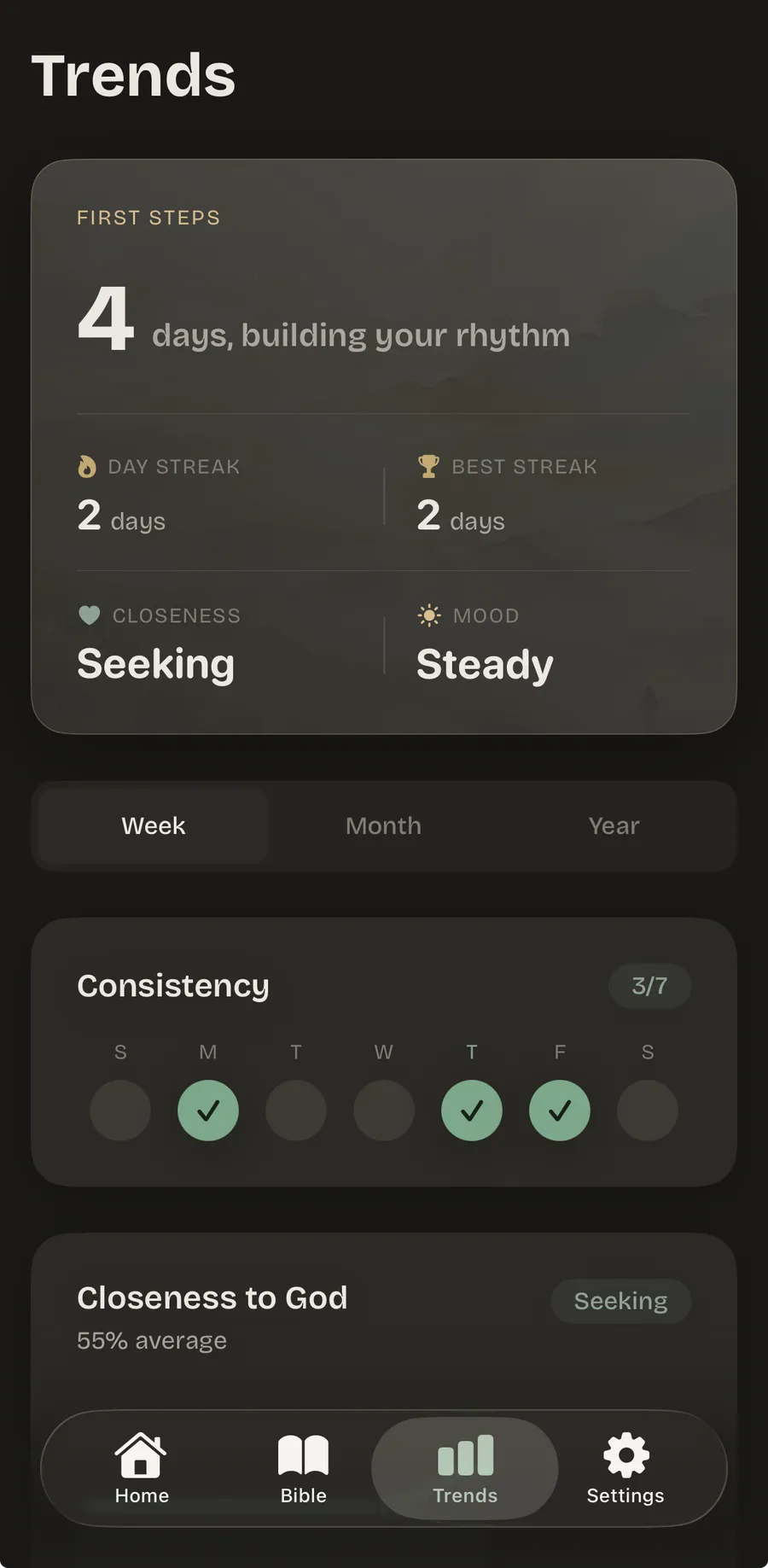
If night prayer keeps slipping the way habits slip, the fix is to make a missed night cost nothing. In BlessUp a prayer counts toward the same streak as a chapter read, and one missed day is covered by a grace day automatically, so falling asleep mid-prayer one night does not reset anything. The apps you have shielded lock again each night at a reset time you set around bedtime, and in the morning a chapter opens them. See how grace days keep a streak going
Night and morning belong together
The last prayer of the day and the first one are two ends of the same rope. At night you hand tomorrow to God. In the morning you pick it back up with Him. The list from step 3 is the thread between them: the tasks you gave to God at night are the same ones you pick back up with Him over breakfast. The habit research slightly favours mornings for building a new routine, and our post on the examen says so too. Night prayer is still worth keeping, because it closes a day that has already happened rather than one still in front of you. For the other end of the day, building a morning prayer routine uses the same idea of a small, fixed shape. And if you have questions about how prayer and reading fit together in the app, the BlessUp FAQ covers it.
Frequently asked questions
What should I pray before bed?
A simple shape works better than a long list. Start with one line of Scripture, such as Psalm 63:6, thank God for one thing from the day, write down what is waiting for you tomorrow and hand it to Him, then end with a single sentence of trust. On a tired night the closing sentence alone is enough.
What is Night Prayer or Compline?
Night Prayer, traditionally called Compline, is the last of the daily Hours in the Catholic Liturgy of the Hours. The USCCB describes it as the last prayer of the day, said before retiring, even if that is after midnight, and notes that its psalms are full of confidence in the Lord. Other Christian traditions keep their own forms of a last prayer of the day.
How long should a bedtime prayer be?
As long as you can keep up on an ordinary night. Five minutes is a good target, and the four-step shape in this guide fits in about that. A single honest sentence is still a real prayer, and a short prayer you pray most nights will do more than a long one you manage once a week.
Is it okay to fall asleep while praying?
Yes. Falling asleep mid-prayer is a common experience and not a failed prayer; it can be a picture of trust, like a child falling asleep while talking to a parent. Pick up again the next night rather than trying to make up for it.
Your day starts in the Word, not the feed.
No guilt. Ever. Grace is built in. Funded by readers, never by ads.