How to Pray the Examen
By Dom · · 12 min read
Somebody told you about the examen — a friend who went to a Jesuit school, a retreat, a podcast — and it sounded like the thing your evenings are missing. Then you looked it up and found five steps written for a quiet chapel, and your evening ends with a phone six inches from your face until you fall asleep.
The gap between those two pictures is the whole problem, and it is smaller than it looks. The examen is old, portable and unfussy. It survives being prayed badly, in bed, at the end of an ordinary day.
Key takeaways
- The examen is a five-step review of your day — give thanks, ask for light, review the day, notice where you drew closer or further from God, and look to tomorrow.
- It is Ignatian and Catholic in origin and widely prayed by Protestants. Ignatius asked every Jesuit to pray it twice a day, at midday and at night.
- Neither the Jesuits' own guide nor Notre Dame's puts a time on it. Prayed twice daily, as Ignatius asked, it was never meant to be long.
- “Review your day” is the step people stall on. If most of your day happened on a screen, your phone already holds a record of where the hours went — useful raw material, not a verdict.
- Attach it to something that already happens every night. Habit research finds that repeating an action in a consistent context is what makes it automatic. How long that takes varies enormously between people, so do not count days.
What the examen is, and where it came from
The examen is a short, structured review of the day you have just lived, prayed with God rather than about Him. You look back over the hours, notice where you were drawn closer to God and where you were drawn away, give thanks, say sorry, and ask for what you will need tomorrow.
It comes from Ignatius of Loyola, the founder of the Jesuits, in the sixteenth century. The University of Notre Dame's McGrath Institute notes that Ignatius thought the examen so important that he required every Jesuit to practise it twice daily, at midday and at night. That detail is worth holding on to. A prayer you are asked to pray twice a day cannot be a long one.
It is Catholic in origin and Ignatian in shape, and it is prayed today by a great many Protestants who have never been near a Jesuit. Nothing in it requires a particular tradition: it is attention, gratitude, honesty and asking. If you want to know how it sits within your own church's practice, that is a good conversation to have with your pastor — we build a Bible app, and this post is about the mechanics.
The prayer it has always echoed is Psalm 139:23–24: “Search me, God, and know my heart; test me and know my anxious thoughts. See if there is any offensive way in me, and lead me in the way everlasting” (NIV). Notice who is doing the searching. That is the posture the examen is after, and it is the reason it does not collapse into self-criticism.

The five steps in plain words
You will find the steps worded slightly differently depending on who is teaching them, which is itself reassuring — this is a practice, not a formula. The Jesuits' own version starts by placing yourself in God's presence and giving thanks, then asks for the grace to understand how God is acting in your life. Notre Dame's opens with gratitude, names sorrow and seeking forgiveness as their own steps, and closes by asking for grace for tomorrow. The review of the day sits at the centre of both.
| Step | Ask yourself |
|---|---|
| 1. Give thanks | What am I glad about today, however small? |
| 2. Ask for light | Show me this day the way You saw it. |
| 3. Review the day | Walk through it from waking. What actually happened, and how did it feel at the time? |
| 4. Notice and name | Where was I drawn closer to God (consolation)? Where was I drawn away (desolation)? Anything I am sorry for? |
| 5. Look to tomorrow | What will I need? Ask for it plainly. |
| + If the day was a blur | Open the screen time report. Which hour am I thankful for? Which would I like back? |
Step three is where almost everyone stalls, and it is worth saying why. “Review your day” sounds simple until you try it at eleven at night and find that the day has gone smooth and featureless, like a wall with no handholds. You remember getting up and you remember now.
Reviewing the day when the day happened on a screen
Here is a practical answer that the older guides could not have given, because the thing it depends on did not exist.
The Pew Research Center's 2025 survey of 5,022 US adults found that 91% now own a smartphone, up from 35% in 2011. So almost certainly you are carrying a device that kept a minute-by-minute record of where your attention went today. Your phone knows what the wall looked like.
Used one way, that record is a stick to beat yourself with, and that is not what this is for. Used another way, it is exactly the handhold step three is missing: a list of the day's actual hours, in order, to bring before God.
So when the review will not start, open the screen time report and read it the way you would read a page of a journal you wrote without noticing. Two questions are enough:
- Which of these hours am I thankful for? Some of them will be. The long call with your sister was screen time too.
- Which hour would I like back? Not to feel bad about. To notice, name and hand over.
That is the examen's own movement — gratitude first, then honesty — applied to the one record of your day that actually exists. If the numbers themselves are a shock, how much time you actually spend on your phone puts them in context before you draw conclusions.
One caution, because it matters more than the technique. The number on that screen is yours, not a score. There is no target, no benchmark, and no version of this prayer that ends with you feeling like a failure. If the report is doing that, close it and pray the examen without it. The record is a servant here.
Attach it to bedtime so it lasts
A practice you intend to keep daily needs a cue, and the evening offers a good one because the evening already has a shape.
Worth saying honestly: mornings have the better evidence for habit-building in general. How to pray consistently covers a 2024 meta-analysis that found morning practice forms habits faster than evening. The examen is the case where you take the harder slot on purpose, because it reviews a day, and at seven in the morning there is no day yet to review. Ignatius’s own answer was to pray it at midday as well as at night.
Gardner, Lally and Wardle's 2012 review in the British Journal of General Practice, “Making health habitual”, sets out the mechanism: habits are actions triggered automatically by a context they have been repeatedly paired with. The review reports an average time to plateau, and in the same breath notes considerable variation across participants and behaviours — enough variation that the popular day-count figures are not worth planning around. The review studies health behaviours in adults rather than prayer, so take it as a principle about repetition and cues, not a finding about the examen. The practical shape of the advice still holds: pick one thing that already happens every night and hang the prayer on it.
Good cues are the boring ones. After you brush your teeth. After the last light goes off. When you put the phone on the charger — which, if the charger is in another room, does a second useful job at the same time.
Two or three minutes is a reasonable first size. You can pray it lying down. You can pray it badly. Ignatius asked for it twice a day, which tells you what kind of prayer he had in mind: brief, repeatable, and not dependent on how the day went.
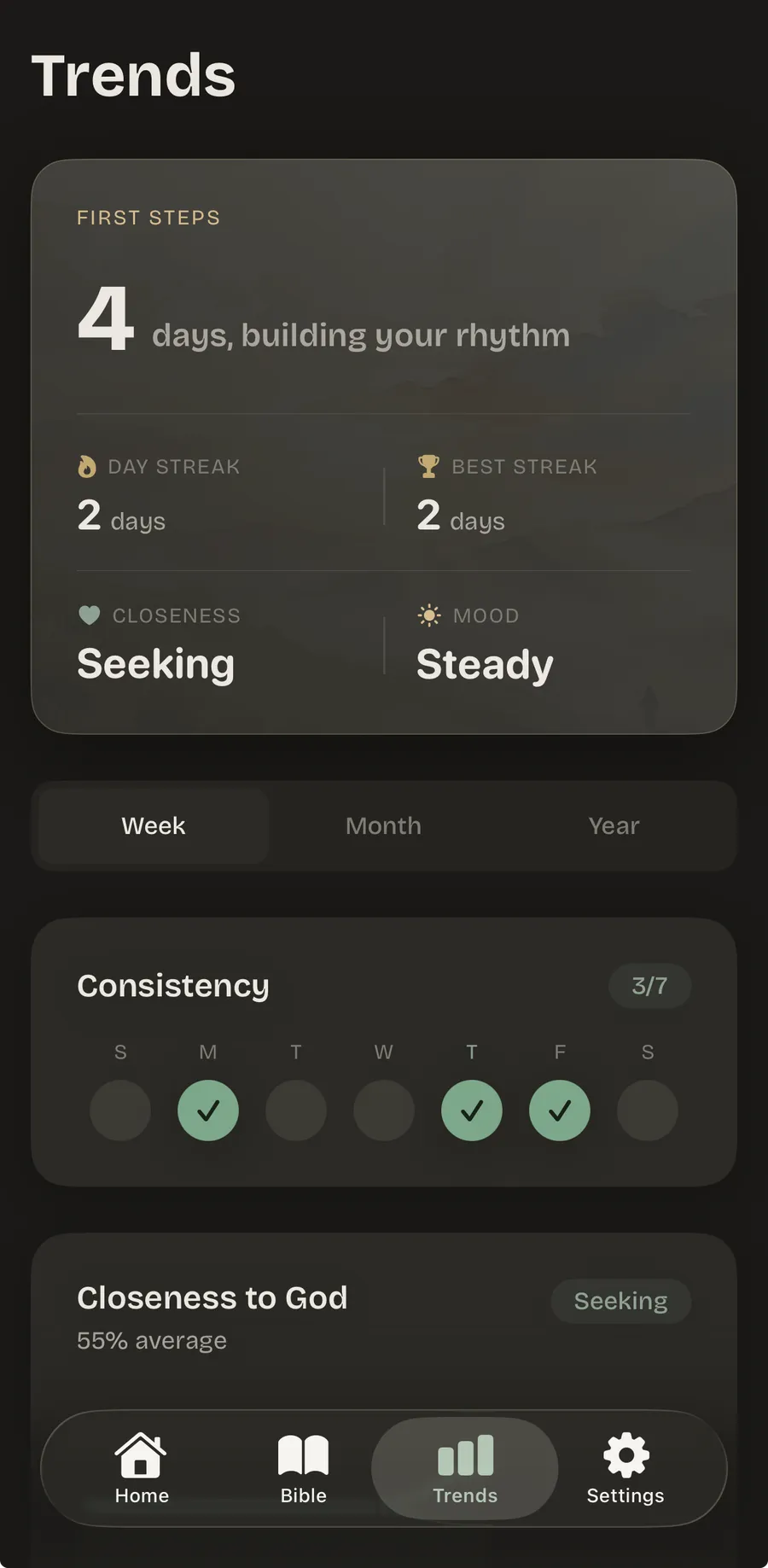
If the part that keeps slipping is the cue rather than the prayer, it helps to have something in the evening that already marks the day as closed. BlessUp re-locks the apps you chose at a reset hour you set around your own bedtime, which is a natural moment to stop and look back — and its daily check-in, which runs with the first unlock of the day, asks two questions that echo what the examen listens for: how close to God you feel, and how you are doing. See how the reset hour works
If you would rather build the habit in the morning instead, the same logic applies at the other end of the day, and a morning prayer routine that sticks works through the cues that tend to hold before breakfast.
When you miss a night
You will fall asleep before you pray it. Probably this week.
The same 2012 review is unusually encouraging on this point: missing an occasional opportunity to perform the behaviour did not seriously impair the habit that was forming, and the gains resumed afterwards. A missed night is a missed night. It is not evidence about you.
There is no backlog to clear, either. You do not owe Tuesday an examen on Wednesday. Yesterday is not the day you are reviewing; today is, and today is still available. Why streaks make people quit is about that instinct to repay, which does more damage than the missed day ever does.
And if the prayer feels flat for a stretch of nights — you do the five steps and nothing happens — that is ordinary and it is not a sign you are doing it wrong. Praying when you don't feel it sits with that honestly. The examen is one of the better prayers to have on a flat night, because it asks you to look rather than to feel.
Where it fits with the rest of your praying
The examen is a review, not a whole prayer life. It pairs naturally with something at the other end of the day and with reading Scripture, and it answers a different question from either: not what should I say, but where have I been.
If your praying is irregular and you want the broader version of this — the cues, the sizes, what to do when it lapses — how to pray consistently covers the whole shape, and the FAQ answers the practical questions people ask about building it around a phone.
Tonight, though, five questions and three minutes is a complete version of this. Start there.
Frequently asked questions
What are the five steps of the examen?
Give thanks for the day, ask for the light to see it as God sees it, review the day from waking to now, notice where you were drawn closer to God and where you were drawn away, and look to tomorrow and ask for what you will need. The wording varies between teachers: the Jesuits' own guide opens by placing yourself in God's presence, while Notre Dame's McGrath Institute opens with gratitude.
How long does the daily examen take?
Neither the Jesuits' own guide nor the University of Notre Dame's puts a time on it, so any specific number you see is someone's practice rather than a rule. Ignatius required Jesuits to pray it twice daily, at midday and at night, which suggests it was never meant to be long. Two or three minutes is a reasonable place to start.
Can Protestants pray the examen?
Yes, and many do. The examen is Ignatian and Catholic in origin, but nothing in the five steps is confined to one tradition: it is gratitude, attention, honesty and asking. If you want to know how it fits your own church's practice, ask your pastor.
What is the difference between the examen and a prayer journal?
A journal is a record you write; the examen is a review you pray, and it does not have to be written down at all. The examen also has a fixed shape that always begins with gratitude and ends by looking forward, which keeps it from drifting into either a diary or a list of faults.
Should you pray the examen in the morning or at night?
Ignatius asked for both, at midday and at night. For one daily examen, night is the common choice because there is a whole day to review and bedtime is an easy cue to attach it to. Habit research generally favours mornings for forming a habit, and a 2024 meta-analysis found morning practice forms habits faster than evening. The examen is the exception worth making, because it reviews a day that has to have happened first. If you want the morning slot, Ignatius’s midday examen is the older compromise.
Small daily readings, cover to cover. That is the whole plan.
No guilt. Ever. Grace is built in. Funded by readers, never by ads.