Digital Boundaries for Christians
By Dom · · 13 min read
You set the limit on a Sunday night. Thirty minutes for Instagram, sixty for YouTube, and for about four days it worked. Then the little card appeared over the feed on a Wednesday evening, and you tapped Ignore Limit without really deciding to. The limit is still switched on. It has simply stopped meaning anything.
That is not a willpower problem. It is a design problem. A limit takes something away and puts nothing in its place, so the only thing between you and the app is a tap. A boundary that holds asks for something first. Here is how to build one, hour by hour, and keep it past the third week.
Key takeaways
- A limit is subtraction; a boundary is a trade. Something specific has to happen before the app opens, or the only thing enforcing it is a tap you can dismiss.
- Where the phone sits matters more than how hard you try. In a study of nearly 800 people, those who left the phone in another room outperformed those who left it on the desk — even switched off.
- Set boundaries by time of day, not as one daily cap. A cap spends itself by lunchtime; an hour-shaped boundary protects the hours you actually care about.
- Two apps, not ten. A boundary on everything collapses in a week. Use the two-question test below.
- Across 20 studies of 2,601 adults, the median time to form a health habit was 59 to 66 days. Design a boundary to survive two months, not a weekend.
Why Christians need boundaries, not just limits
Most advice on this question arrives as a list of subtractions. Cap your minutes. Turn the screen grey. Take a digital sabbath. All of it is fine as far as it goes, and none of it survives a hard Wednesday, because each one is a rule you enforce against yourself in the moment you least want to.
The Christian frame here is not rule-keeping, which is worth saying plainly, because guilt is the usual fuel in this conversation and it is poor fuel. Paul, answering a slogan the Corinthians were repeating back at him, writes: “‘I have the right to do anything,’ you say—but not everything is beneficial. ‘I have the right to do anything’—but I will not be mastered by anything” (1 Corinthians 6:12, NIV). He is answering a question about the body and about food, not about phones, so the application here is ours by inference rather than his by instruction. But the question he hands you is the right one, and it is not how many minutes did I use. It is what has the run of me.
That changes what a good boundary looks like. If the goal were fewer minutes, a timer would do. If the goal is not being mastered, the boundary has to put something else first — and what comes first is the whole point. We have written elsewhere on why screen time is a spiritual problem rather than a productivity one, and why app blockers stop working by the second week. This post assumes both.
One more thing before the plan: none of this requires leaving the modern world. Pew Research Center, surveying 5,022 US adults between February and June 2025, found that 91% own a smartphone, and that 16% are “smartphone-dependent” — Pew’s term for having a smartphone but no home broadband, rising to 27% of adults under 30. For them the phone is not a temptation to manage; it is the only door to the internet there is. A boundary has to be something you can build while still living on your phone.
Which apps need a boundary: a two-question test
The most common way a boundary fails is being set on too much. Someone shields eleven apps on Sunday, finds on Tuesday that two of them were how they check the bus timetable and talk to their sister, and turns the whole thing off rather than fix it. Start with two. Add a third later.
Ask two questions about each app on your home screen.
Does opening it have a natural end? Your banking app ends. Messages end — you answer the person and you are done. A feed does not, because it is not built to. If the app has no last page, the decision to stop has to come from you every time, and you will not win that argument forty times a day.
Do you open it without having decided to? This is the honest one. Not do I use it too much, but did I choose this. If your thumb has already found the icon before the thought arrives, that app is running on a cue, not a choice.
Two yeses means the app needs a boundary. One yes means watch it. Two noes means leave it alone — a boundary on an app you were never compulsive about spends your patience and buys nothing. If you are unsure, your phone already knows: the Screen Time report tells you where the hours went, and the top two entries are usually a confirmation rather than a surprise.
A boundary for each part of the day
A single daily cap treats every hour as interchangeable. It is not. Thirty minutes of scrolling at nine at night costs something different from thirty minutes at six in the morning, and a cap cannot tell the difference — it runs out around lunchtime, having protected nothing you cared about. Boundaries shaped by the hour match the way your day is actually shaped. The point is not to adopt all five rows below; it is to pick the one or two hours that matter most and defend those properly.
| Part of the day | The boundary | What it is traded for | How the phone enforces it |
|---|---|---|---|
| Waking | No feed before the first thing you read | A chapter, a psalm, or five minutes of quiet | Screen Time downtime, ending an hour after your alarm |
| Work or school | Phone in a drawer or another room, not face down beside you | The focused hour you keep saying you cannot find | A Focus mode that silences the shielded apps |
| Meals | Phone off the table whenever another person is at it | The conversation you are already half having | No setting needed — this one is a rule about furniture |
| Church | Bible app open, everything else shut | The hour you chose to be there for | A Focus mode tied to the location or the calendar |
| Bedtime | Charger out of the bedroom | The forty minutes at the end of the day you do not remember spending | Downtime starting at a fixed hour, and a physical charger placement |
Two of those rows lean on the same research. Adrian Ward and colleagues at the McCombs School of Business at UT Austin ran experiments with nearly 800 smartphone users, giving them tests of working memory with the phone either face down on the desk, in a pocket or bag, or in another room. Every phone was on silent. Those whose phones were in another room significantly outperformed the desk group, and slightly outperformed the pocket-or-bag group. It made no difference whether the phone was switched on or off. Ward’s explanation is that not thinking about the phone is itself work: “the process of requiring yourself to not think about something — uses up some of your limited cognitive resources.”
These were laboratory tasks measuring cognitive capacity, not prayer and not Bible reading, so nobody has measured what a phone on the pew does to attention in worship. But it makes one practical point sharply: face down is not away. The distance is doing the work, not the orientation.

Make the boundary a trade, not a timer
Here is the difference in one line. A timer says you have had enough. A trade says this first, then that.
The timer is a bad deal and some part of you knows it, which is why dismissing it feels like nothing. Nobody was helped, nothing was gained, a number ran out. A trade is a deal you might actually take, because something arrives on the other side of it. Read the chapter, then open the app. Ten minutes outside, then open the app. The app is not the enemy in this arrangement, which is why the arrangement survives a real Wednesday.
Be fair to the alternatives: they are not worthless. Apple’s Screen Time downtime and app limits are genuinely useful, and the map above uses them in three of five rows. The claim is narrower than “those tools do not work”: a cap alone gives you nothing in exchange, so when the cap and your mood disagree, your mood wins. Pair the tool with a trade and you have changed what the tap costs.
This is the whole design behind BlessUp: the apps you pick stay shielded until the day’s chapter is read, with the unlock window set to fifteen minutes, an hour, or until a reset hour you choose around your bedtime. It runs on Apple’s Screen Time framework, so the phone keeps the boundary and you do not have to.
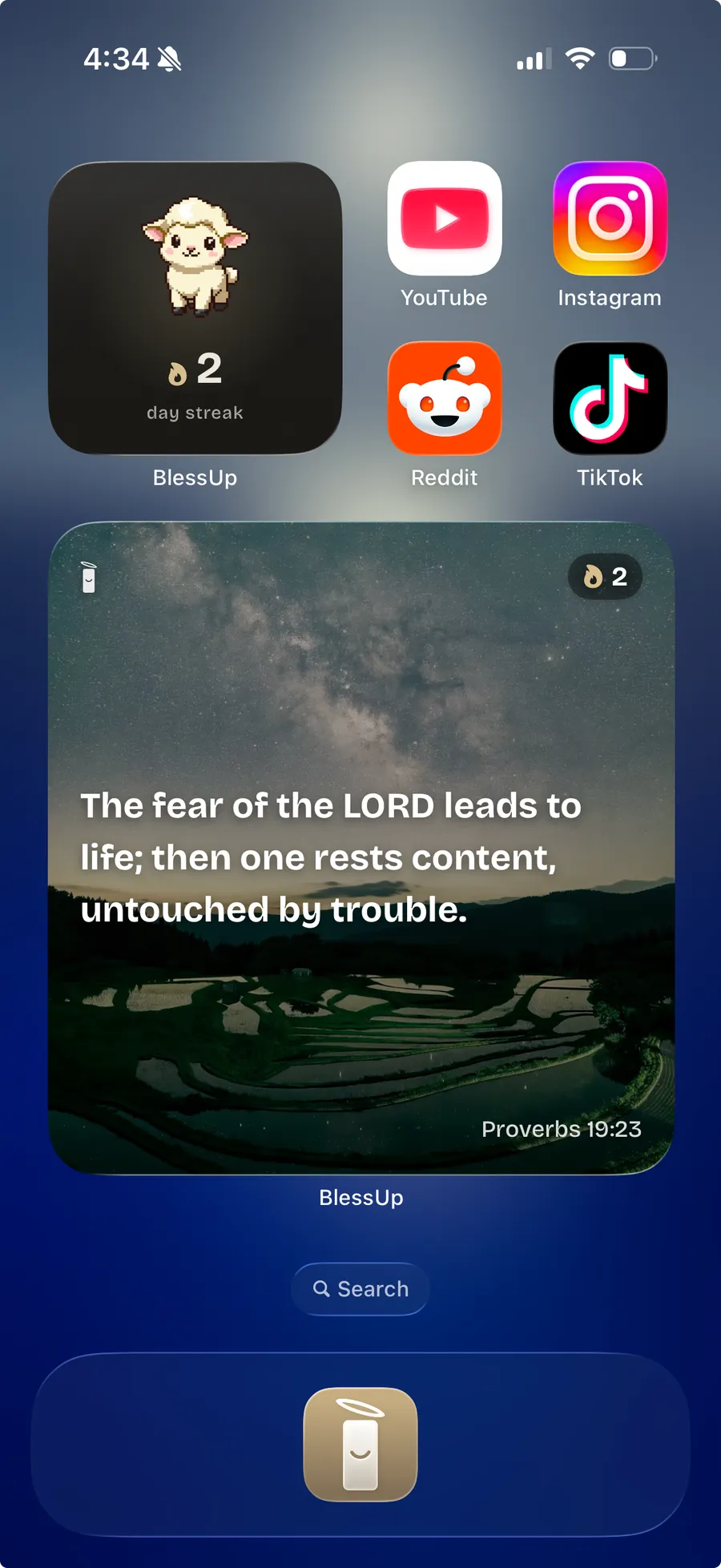
If the limits on your phone stopped meaning anything around week two, the missing piece was probably the trade. BlessUp shields the apps you choose and gives you one specific way through: read the day’s chapter, which runs about nine minutes on a year-long plan. The reset hour is yours to set, so the boundary re-arms itself every night whether or not you remember it. See how the reading gate works
What to do the first time you break it
You will break it. Plan for that now, while you are calm, because the version of you who breaks it will not be in a planning mood.
First, know how long this is supposed to take. A 2024 systematic review pooled 20 studies covering 2,601 adults and found the median time to form a health-related habit was 59 to 66 days, with individual times ranging from 4 to 335 days. Those studies covered flossing, water, exercise and diet rather than phone use, so read it as a rough shape rather than a promise. The shape is the useful part: two months, not a weekend. If you are on day nine and it still takes effort, nothing has gone wrong. That is what day nine is.
Second, one bad evening is not a failed boundary, and treating it as one is the fastest way to lose the whole thing. A scoping review of 14 digital detox studies, following PRISMA-ScR guidelines, found the interventions split between short complete abstinence and sustained, moderate reduction. A complete break has its place — we have written separately about fasting from your phone — but a boundary is the other kind, measured in months, which means it has to absorb a bad night without resetting to zero.
So: do not rebuild the system, do not add three more apps as a penance, and do not decide you are the sort of person this does not work for. Put the charger back where it belongs and do the same thing tomorrow. If the same boundary breaks in the same place three nights running, the boundary is wrong rather than you — move the hour, or swap the trade for one you would choose at that time of night.
If this is less about one app than the pull of the feed generally, start with the doomscrolling habit itself, which is the root most of these boundaries are aimed at. There is more across the faith and technology posts, and our FAQ page answers the questions people ask most.
Frequently asked questions
What are healthy digital boundaries for a Christian?
Boundaries that protect specific hours rather than capping a daily total, and that put something ahead of the app rather than only taking the app away. In practice that is usually two or three rules: nothing from a feed before the first thing you read in the morning, the phone out of the room during focused work, and the charger outside the bedroom at night. The Christian frame is freedom rather than rule-keeping — the question is what has the run of you, not how many minutes you used.
Is it a sin to spend too much time on your phone?
Scripture speaks about what masters us rather than about minutes, so there is no verse that names a number. Paul writes that he will not be mastered by anything, which is a question about who is in charge rather than a limit to measure yourself against. That is a good question to bring to your pastor or church, who know you. We build apps rather than give spiritual counsel, and would rather point you to someone who can do that properly.
How do I set boundaries with my phone without deleting social media?
Deleting the app works for some people, but it is blunt and it takes away the parts you wanted. The alternative is a boundary shaped by time of day: the app stays installed and stays shut during the hours you have chosen to protect. Apple's Screen Time downtime and Focus modes both do this natively, and pairing the closed hours with something specific that comes first makes the boundary far more likely to survive past the second week.
What does the Bible say about technology use?
Nothing directly, since none of it existed when Scripture was written. What it does speak to is attention, mastery and what we set our minds on, and those apply here by inference rather than by instruction. The most useful passage is probably 1 Corinthians 6:12, where Paul distinguishes between what is permitted and what is beneficial, and refuses to be mastered by anything. For how that applies to your own situation, ask your pastor.
How long does it take for a new phone habit to stick?
Longer than most advice suggests. A 2024 systematic review of 20 studies covering 2,601 adults found a median of 59 to 66 days to form a health-related habit, with individual times ranging from 4 to 335 days. Those studies looked at behaviours like flossing, exercise and diet rather than phone use, so the number is a rough guide. The practical takeaway is to design a boundary that can survive about two months, bad nights included.
One chapter is the only key. See what your mornings look like on the other side of it.
No guilt. Ever. Grace is built in. Funded by readers, never by ads.