Why Spiritual Discipline Is So Hard
By Dom · · 10 min read
You have started this before. A new plan in January, a fresh notebook, a reading every morning for eleven days. Then a late night, a sick child, a trip. By the third week the plan was a tab you did not want to open, and somewhere along the way you quietly decided the problem was you.
Most answers to why spiritual discipline is so difficult say the same true thing: depend on the Spirit, and keep going. You have tried. This post adds the part those answers leave out. What people call one failure is usually three different ones, and each has its own fix.
Key takeaways
- Struggling is the norm, not a personal defect. Lifeway found 31% of Protestant churchgoers read the Bible daily.
- Most people who stop are hitting one of three problems: the daily decision, a missing cue, or the day after a miss.
- Habit research defines a habit as an action set off by a cue. An intention with no cue has to be re-decided every day.
- In the habit studies that timed it, formation took a median of 59 to 66 days, with individuals ranging from 4 to 335.
- Missing the occasional day did not seriously set habit formation back. Treating the miss as the ending is what does.
Three different problems people call the same thing
"I'm not disciplined" sounds like one diagnosis. It is really a label stuck on three separate breakdowns, and they happen at different moments.
- The decision costs more than the practice. Reading takes about nine minutes. Deciding to read, what to read and whether today is the day takes longer and hurts more.
- There is no cue, only an intention. "I'll read every morning" is a plan with no trigger. Something has to remind you, every day, and on the busy days nothing does.
- The missed day becomes the ending. One gap turns into a feeling of being behind, and the feeling does more damage than the gap.
They feel the same from the inside. They are not the same problem, and advice aimed at one does little for the others. Try harder does not help with a missing cue. A better cue does not help with shame.
You are also far from alone. Lifeway Research's State of Discipleship study, an online survey of 2,130 US Protestant churchgoers in March 2025, found that 31% say Bible reading is a daily habit. That is among people who attend church at least monthly and value the Bible highly. The struggle you have had is the ordinary one.
Failure one: the decision costs more than the practice
Picture the moment. It is morning. You are tired. Your phone is in your hand, and it is very good at deciding things for you. Against that, the reading asks you to make a choice: open the Bible, find the place, work out what today's passage is.
Each part is small. Together they are a decision made fresh every day, at the worst possible time, by the least rested version of you. In a review of habit research in the British Journal of General Practice, Benjamin Gardner, Phillippa Lally and Jane Wardle note that advice aimed at conscious motivation tends to be short-lived, because motivation and attention wane. Decisions run on exactly the thing that runs out.
The fix is to decide once, not daily. Choose the plan in advance, so the question "what should I read?" is already answered. Keep the size fixed and modest. About nine minutes a day reads the Protestant Bible cover to cover in a year, which we work out in how long it takes to read the Bible in a year. A known, small size is much easier to say yes to than an open one.
Failure two: there is no cue, only an intention
An intention is a promise to remember. A cue is a thing that does the remembering for you.
Gardner, Lally and Wardle define habits as actions triggered automatically by a contextual cue that has become linked with doing them. Think of how you lock the front door. You do not decide to, most days. Pulling the door shut does the deciding.
Most reading plans never get a cue. They get a time ("6:30") or a vague slot ("mornings"). Those hold while life is regular and vanish the first time it is not.
The fix is to attach the reading to something you already do every day without fail: the first coffee, the phone coming off the charger, the train doors closing. Same place, same moment, every day. We go further into what shortens habit formation in how long it really takes to build a habit.

Failure three: the missed day becomes the ending
This is the one that usually ends things. You miss a day, then two. Now you are "behind." Catching up means reading three days' worth, which is harder than the original ask. So you put it off, and the gap grows, and every time you think about the plan it arrives with a small weight of guilt.
That weight is the real problem, not the gap. The research on this is clear and kind. Gardner, Lally and Wardle report that missing the occasional opportunity did not seriously impair habit formation. Automaticity picked back up after a missed day. The habit was not lost. The plan was abandoned because of what the miss seemed to mean.
The fix is a rule, decided before you need it: after a miss, read today's reading and move on. No catching up. No starting over. We lay out that morning-after rule in what to do when you miss a day.
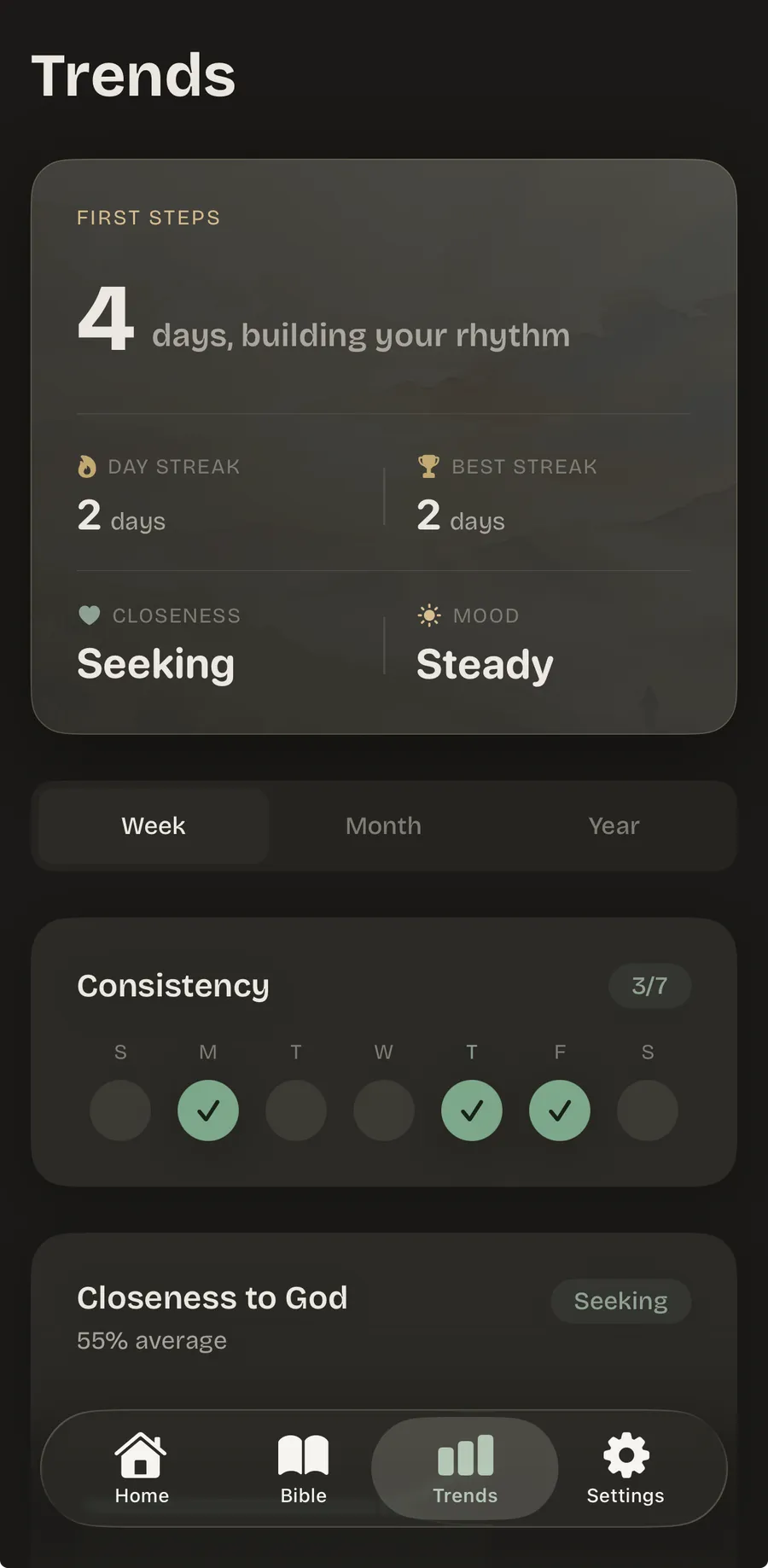
If it is always the day after a miss that ends it, the fix is to make the miss cost nothing. BlessUp reads that way by design: read a chapter and your apps open, and if you miss a day a grace day covers it automatically. Nothing resets, and your place in the plan is held. The morning after, the app says so plainly: "Your place is held. Yesterday was a grace day. Nothing was lost." See how grace days work
The three failures at a glance
| Failure | What it feels like | When it tends to show up | What the evidence says | The one change |
|---|---|---|---|---|
| Decision cost | "I'll do it once I've sorted out what to read." | Tired mornings, from the first week | Motivation and attention wane, so advice that relies on them is short-lived | Decide the plan and the size once, about nine minutes |
| Missing cue | "I forgot until bedtime, again." | When routine breaks: travel, a new schedule | Habits are actions triggered automatically by a cue in the setting | Attach it to something you already do daily |
| Shame after a miss | "I'm so far behind now, there's no point." | The day after the first missed day | An occasional miss did not seriously impair habit formation | Read today's reading; never catch up, never restart |
What the habit research actually says about how long this takes
Part of why week three feels like failure is that we expect the habit to be settled by then. It usually is not.
A 2024 systematic review and meta-analysis of 20 studies, covering 2,601 adults, looked at how long health habits take to form. Only four of the studies measured the time directly. Their medians ran from 59 to 66 days, and individuals ranged from 4 to 335 days. The review also found morning practices and habits people chose for themselves tended to be stronger.
Two limits matter. These were health behaviors like exercise, eating and drinking water, not prayer or Scripture. And the four timed studies are a small base. But the shape is useful. Three weeks in, you are not failing. You are about a third of the way to where most people in those studies landed, and some take much longer.
Where grace fits, and where it does not replace a method
None of this replaces grace. Paul tells Timothy to "train yourself to be godly. For physical training is of some value, but godliness has value for all things" (1 Timothy 4:7-8, NIV). Training is a word with a method in it. Athletes do not train by feeling motivated each morning. They set things up so that showing up is the easy path.
Grace is what makes it safe to look at the method honestly. If a missed week meant God was disappointed in you, you would never want to examine why it happened. Because it does not, you can look at the three failures above without flinching, pick the one that is yours, and change one thing. Christians across traditions have long held that God's welcome does not depend on a streak. We talk about that more in why grace days work where streaks break.
If the hard stretch is the middle of a long plan rather than the start, how to actually finish a Bible reading plan maps where one-year plans usually stall. And if the struggle runs deeper than habits, or you are carrying real guilt about it, please talk to your pastor. We build tools; your pastor knows you. You can read more about who we are on our about page.
There is some encouraging news in the wider picture, too. American Bible Society's State of the Bible 2026, a survey of 2,649 US adults by NORC at the University of Chicago, found that 74% of people who use a reading guide, schedule or plan have read most or all of the Bible. That is an association, not proof a plan causes finishing. But it fits everything above. Structure is not the opposite of devotion. For most people, it is how devotion survives a Tuesday.
Frequently asked questions
Why do I keep quitting my Bible reading plan?
Usually because of one of three separate problems: the daily decision about what and when to read costs too much, the plan has no cue that reminds you automatically, or a missed day turns into a feeling of being behind. Each has its own fix, and none of them means you lack devotion.
How long does it take for a spiritual habit to stick?
There is no study of spiritual habits specifically. For health habits, a 2024 review found the four studies that measured it had median times of 59 to 66 days, with individuals ranging from 4 to 335 days. So judge a new practice after about two months, not two weeks.
Does missing a day ruin your progress?
No. Habit research found that missing the occasional opportunity did not seriously impair habit formation. What tends to end a plan is the decision to catch up or start over after a miss. Read today's reading and carry on.
Is struggling with spiritual discipline a sign of weak faith?
Not in itself. Lifeway found 31% of Protestant churchgoers read the Bible daily, so struggling is the common experience, not a rare one. Many difficulties are practical, like a missing cue. If you are carrying guilt or doubt about it, your pastor is the right person to talk to.
It was never a devotion problem. It was three solvable ones wearing the same name.
No guilt. Ever. Grace is built in. Funded by readers, never by ads.