What Are the Spiritual Disciplines?
By Dom · · 10 min read
The phrase turns up in sermons, small groups and book titles, usually without anyone stopping to define it. You nod along, and later you go looking for a list, and you find one — somebody's list, of twelve or ten or seven things, with no explanation of who decided or why the next page you open has a different set.
So here is the straight answer: what a spiritual discipline is, the two lists most English-speaking churches actually draw on, why they differ, and which one is worth starting with if your attention is in as many pieces as most people's.
Key takeaways
- A discipline is a practice, not an achievement. It is something you do to put yourself in the way of God's work, not something you complete or earn credit for.
- Richard Foster's Celebration of Discipline lists twelve, in three groups: inward, outward and corporate.
- Donald Whitney's Spiritual Disciplines for the Christian Life treats ten, a shorter and more explicitly Bible-centred set. The lists overlap on prayer, fasting, worship, service and Scripture.
- The old split is abstaining and engaging — disciplines that remove something (fasting, silence, solitude) and disciplines that add something (study, prayer, worship, service).
- Start with Scripture intake. Lifeway's discipleship research found reading and studying the Bible to be the activities most associated with spiritual growth — and about nine minutes a day covers the whole Bible in a year.
What a spiritual discipline is (and is not)
A spiritual discipline is a practice Christians take up deliberately, and repeat, to make room for God to work in them. Prayer is one. Fasting is one. Reading Scripture is one.
The word comes from training rather than punishment, which is the whole difference. Paul uses the image directly: “Train yourself to be godly. For physical training is of some value, but godliness has value for all things” (1 Timothy 4:7–8, NIV). An athlete's training does not earn them the race. It puts them in a condition to run it.
That analogy carries the one thing worth saying clearly before any list: the disciplines are means of grace, not ways of earning God's favour. Christians across traditions are firm about this, and Renovaré, Foster's own organisation, makes the same point about the closely related rule of life — it is “neither an attempt to prove ourselves to God, nor to impose anything on other people”. If a practice starts working as a scoreboard, something has gone wrong with how it is being held, not with the practice.
Three things a discipline is not. It is not a personality type — nobody is naturally good at these. It is not a rule imposed on other Christians; the lists below are descriptions of a tradition, not a standard to measure your neighbour against. And it is not a technique that produces a guaranteed result, which is why this post will not promise you one.
The two lists most churches use: Foster and Whitney side by side
Two books account for most of what English-speaking churches mean by “the spiritual disciplines,” and they come from different corners of the church, which is why their lists differ.
Richard Foster's Celebration of Discipline (1978) is the broader and more contemplative of the two. Foster is a Quaker, and his twelve range well beyond the devotional into simplicity, submission and celebration. Donald Whitney's Spiritual Disciplines for the Christian Life (NavPress, revised 2014) comes from a Reformed Baptist setting and treats ten, with Bible intake given two chapters rather than one and a stronger emphasis on evangelism and stewardship. Neither is the official list, because there is no official list. They are two careful attempts at the same tradition.
| Foster (twelve) | Whitney (ten) | Needs sustained attention? |
|---|---|---|
| Study (inward) | Bible Intake | Yes — most of all |
| Prayer (inward) | Prayer | Yes |
| Meditation (inward) | — | Yes |
| Fasting (inward) | Fasting | No |
| Solitude (outward) | Silence and Solitude | Yes |
| Simplicity (outward) | Stewardship | No |
| Service (outward) | Serving | No |
| Submission (outward) | — | No |
| Worship (corporate) | Worship | Partly |
| Confession (corporate) | — | No |
| Guidance (corporate) | — | No |
| Celebration (corporate) | — | No |
| — | Evangelism | No |
| — | Journaling | Partly |
| — | Learning | Yes |
Foster groups his twelve as inward (meditation, prayer, fasting, study), outward (simplicity, solitude, submission, service) and corporate (confession, worship, guidance, celebration) — roughly, what you do alone in yourself, what you do with your life in the world, and what you can only do with other Christians.
The overlap is the interesting part. Prayer, fasting, worship, service and Scripture appear on both, from two traditions that disagree about a good deal else. That is about as close to a consensus core as this subject has.

Disciplines of abstaining and disciplines of engaging
There is an older way of cutting the same material, and it is more useful than either list on its own.
Some disciplines work by subtraction: you abstain from something ordinary and good for a set time. Fasting removes food. Silence removes speech. Solitude removes company. Simplicity removes accumulation. What they have in common is that they create a gap, and the gap is the point — you find out quickly what you had been using the thing to avoid.
Others work by addition: you engage with something deliberately. Study, prayer, worship, service, confession, celebration. These fill rather than empty.
The practical value of the split is that it tells you what a beginner should not start with. The abstaining disciplines are harder than they look, and silence is the hardest of all to begin. There is a reason for that beyond piety: in eleven studies, Timothy Wilson and colleagues found that people typically did not enjoy spending 6 to 15 minutes alone in a bare room with nothing to do but think, and many preferred an unpleasant distraction to it. That was a laboratory setting and not a spiritual practice, but if your first attempt at silence feels intolerable rather than holy, you are having the ordinary human reaction and not failing at something everyone else finds easy.
Which disciplines a phone erodes first
Look back at the third column of the table. The disciplines that need sustained attention — Scripture intake, prayer, meditation, silence and solitude, learning — are precisely the ones a phone takes first, because they are the ones that require you to stay with one thing for more than a few minutes.
Nobody's phone stops them serving at a food bank or giving generously. Plenty of people's phones stop them reading twenty minutes of Scripture. The erosion is uneven, and it falls hardest on the practices that form the interior life, which is why the disciplines can feel newly difficult without anything about your faith having changed.
The numbers on the reading side are stark enough. Pew Research Center's Religious Landscape Study, surveying US adults in 2023–24, found that 22% read scripture outside religious services at least once a week, while 61% seldom or never do. That is a description of a population rather than a diagnosis of you, and it says nothing about anyone's sincerity. But it does mean that if Scripture intake is the discipline that keeps slipping, you are not the exception. You are the pattern. More on the shape of that in screen time as a spiritual problem.
Where to start: one discipline, sized to a real day
One. Not a programme.
If you have no strong preference, start with Scripture intake, and there is evidence behind that rather than just tradition. Lifeway Research's Transformational Discipleship study, which surveyed Protestant churchgoers, reported that “reading and studying the Bible are still the activities that have the most impact on spiritual growth and maturity”. That is an association found among churchgoers rather than proof that reading causes maturity, and the people who read most are likely to differ in other ways too. Still, of all the places to put a first effort, this is the one with the most behind it.
Then size it for the day you actually have. The arithmetic is friendlier than people expect: how long it takes to read the Bible in a year works out at about nine minutes a day for the Protestant canon, from real word counts rather than a round number. If you want to go deeper than reading, how to study the Bible is the next step, and if prayer is the one calling you, how to pray consistently is the fuller guide.
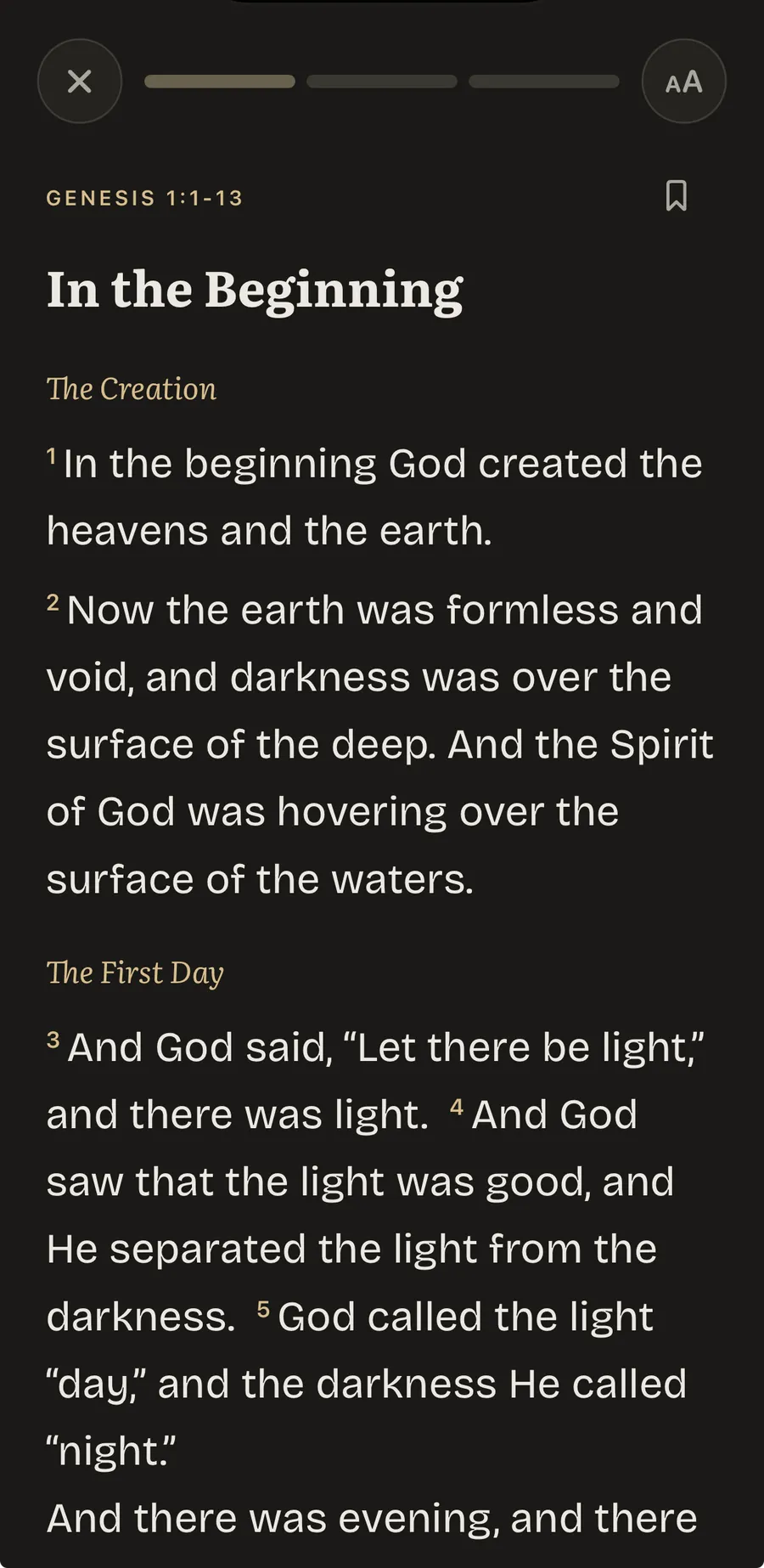
The part that stops most people is not the discipline itself, it is deciding where to begin on a Tuesday morning with sixty-six books in front of them. BlessUp removes that decision: the day's reading is already waiting, day one is Genesis 1 to 3, and reading it is what opens the apps you have shielded. It is free to download on the App Store.
Whichever you pick, expect it to take longer to settle than you want, and decide now what happens on the day you miss — because you will miss. The answer that keeps people going is not a stricter rule but a gentler one: grace days rather than broken streaks. And for what any of this means in your own tradition, your pastor is the right person to ask; we build apps, and the questions we get asked most are on our FAQ page.
Frequently asked questions
What are the spiritual disciplines?
Practices Christians take up deliberately and repeat in order to make room for God to work in them - prayer, fasting, Scripture reading, worship, service, silence and others. The word comes from training rather than punishment: Paul tells Timothy to train himself to be godly, and the point of training is to put you in a condition to do something, not to earn it. They are means of grace rather than ways of earning God's favour.
How many spiritual disciplines are there?
There is no fixed number, because there is no official list. The two most widely used in English-speaking churches are Richard Foster's twelve, in Celebration of Discipline, and Donald Whitney's ten, in Spiritual Disciplines for the Christian Life. They overlap on prayer, fasting, worship, service and Scripture, and differ elsewhere because they come from different traditions - Foster is a Quaker, Whitney writes from a Reformed Baptist setting.
What are the inward, outward and corporate disciplines?
That is Richard Foster's three-part grouping of his twelve. The inward disciplines are meditation, prayer, fasting and study. The outward are simplicity, solitude, submission and service. The corporate are confession, worship, guidance and celebration. Roughly, the inward ones shape the interior life, the outward ones shape how you live in the world, and the corporate ones can only be practised with other Christians.
Which spiritual discipline should I start with?
Scripture intake, for most people. Lifeway Research's Transformational Discipleship study of Protestant churchgoers reported that reading and studying the Bible are the activities most associated with spiritual growth and maturity, though that is an association rather than proof of cause. Start with one, not a programme, and size it to the day you actually have: about nine minutes a day covers the Protestant canon in a year. Avoid starting with silence or fasting, which are harder to begin than they look.
Are spiritual disciplines biblical?
The practices are - prayer, fasting, solitude, study, worship and service all appear in Scripture, and Jesus assumes several of them. The organised lists are not: those are the church's later work of gathering the practices and naming them, which is why the lists differ from author to author. Traditions vary in how much weight they give the category, so for how it is understood in your own church, ask your pastor.
Genesis to Revelation, about nine minutes at a time. Start tomorrow morning.
No guilt. Ever. Grace is built in. Funded by readers, never by ads.