The First Thing You Check in the Morning
By Dom · · 13 min read
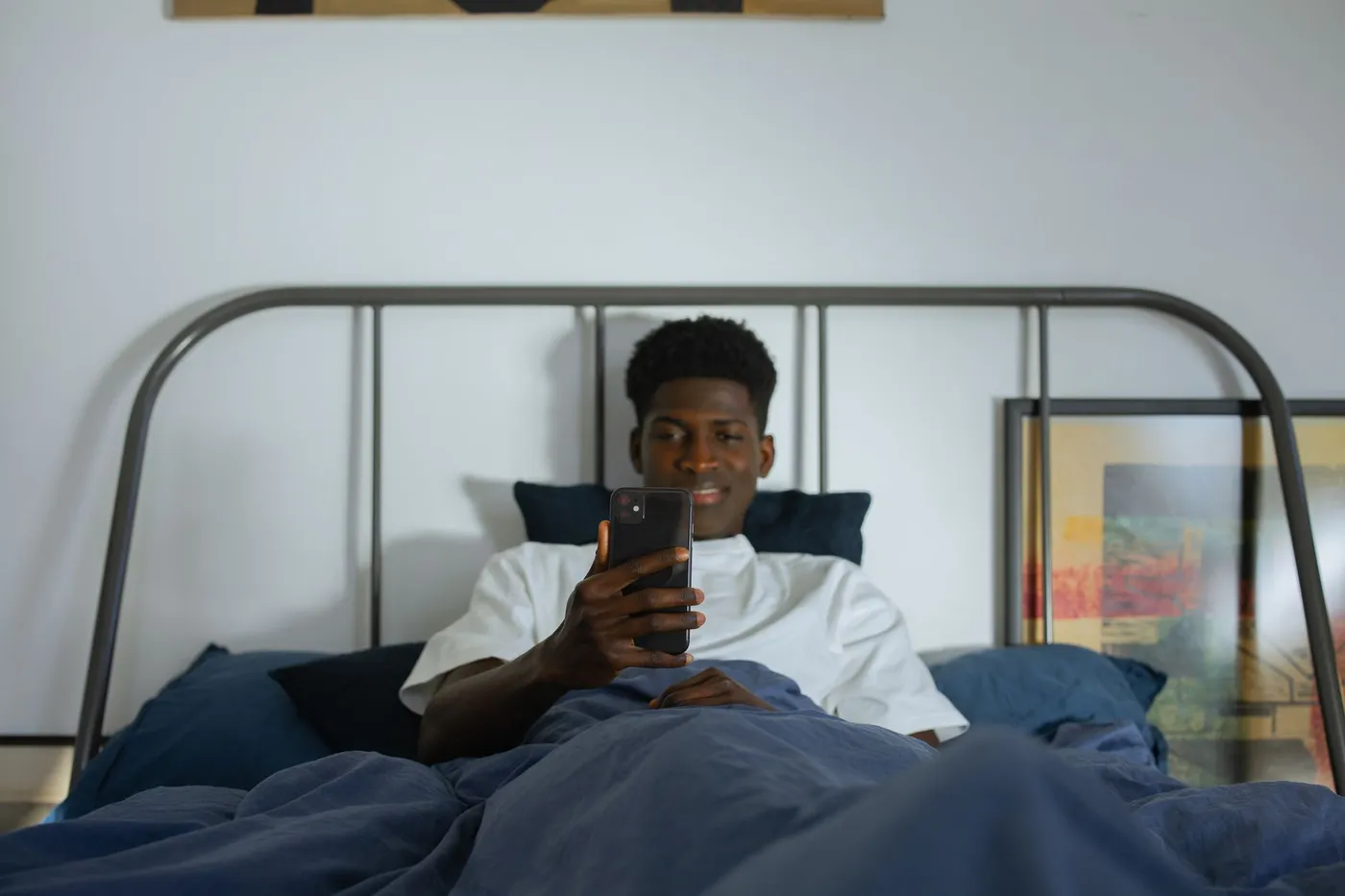
Your eyes open. Before you have decided anything at all — before coffee, before your feet are on the floor — your hand has already found the phone on the nightstand and your thumb is moving. Somewhere between the third notification and the first video, ten minutes are gone.
You have almost certainly been told this is ruining your day. That it spikes your cortisol, hijacks your focus, sets a tone you spend the next fourteen hours failing to shake. It is one of the most repeated claims in the whole wellness genre, and it is repeated with remarkable confidence for something so rarely sourced. So this article does the boring thing nobody does: it checks.
Key takeaways
- The evidence is thinner than the claim. In a 90-day study of 40 adolescents, day-to-day phone use did not predict next-morning mood or that night's sleep.
- One study points the arrow backwards. On days those teens woke up feeling worse than usual, they used their phones more passively later — mood predicted the scrolling, not the reverse.
- The cortisol claim does not hold up. A randomized trial that cut recreational screen time to a median 2.7 hours a week found no effect on stress biomarkers.
- Cutting screen time still helped. The same trial found well-being up 8.48 points on the WHO-5 index and mood disturbance down 6.83 points in two weeks.
- The reach is not really a decision. Sleep inertia lowers what you are capable of in the first minutes awake, which is why the habit needs a different door rather than more willpower.
What people say checking your phone first thing does
Search the phrase and the results agree with each other to an unusual degree. The morning check floods you with cortisol. It puts your brain into a reactive state before you have had a chance to set your own agenda. Blue light disrupts something. It destroys your attention span for the rest of the day. It sets the tone.
These claims share a shape: a small, ordinary action at the start of the day produces a large, diffuse effect across all of it. That shape is appealing because it makes the fix feel proportionate. Change one minute, change fourteen hours. It is also the kind of claim that ought to make you ask for the study, because effects that large from causes that small are rare in behavioural science.
So here is the audit. Four sources, all read in full, and an honest verdict on each popular claim — including the ones that survive.
What the evidence on screen time actually supports
Start with the strongest thing available, because it is genuinely strong. In a cluster-randomized trial published in NPJ Mental Health Research, Pedersen and colleagues assigned 89 Danish families, including 164 adults, either to cut recreational screen use to under three hours a week or to carry on as normal. Over two weeks the intervention group came in at a median of 2.7 hours a week against 15.5 hours for the control group — a real, verified reduction, not a self-reported intention.
The results were clear. Well-being on the WHO-5 index rose 8.48 points relative to control, and total mood disturbance fell 6.83 points. Those are meaningful differences from a two-week change in behaviour, and they are the reason nobody should read this article as a case for leaving things as they are.
But notice what was tested. The trial cut recreational screen time by roughly thirteen hours a week, across the whole week, for everybody in the household. It says nothing about the first four minutes after your alarm. Reducing screen time substantially helps; that finding is being quietly borrowed to support a much narrower claim it was never designed to make. If you want the wider version of this argument, it is the subject of screen time as a spiritual problem rather than a productivity one.
The study that points the arrow the other way
The popular claim assumes a direction: phone use happens, and mood follows. A 2026 study in the Journal of Research on Adolescence tested that assumption directly and found it running backwards.
Chen and colleagues combined daily morning surveys with passive sensing on participants' own phones — logged app time rather than self-reported estimates, which people are famously bad at. The analysis covered 3,192 daily observations from 40 Android-using adolescents aged 15 to 20, tracked over 90 days.
Two findings matter here. First, on days when a teen reported higher-than-usual negative feeling in the morning, they spent more of that day in passive phone use — scrolling without posting or replying. The effect held within each person, so each participant served as their own control. Second, and more pointedly: day-to-day fluctuations in phone use did not predict next-morning mood, and did not predict that night's sleep quality or duration either.
Read plainly, that is the reverse of the story you have been told. The mood came first and the scrolling followed it. The phone looked less like the cause of a bad morning and more like the thing a bad morning reaches for.
Hold this loosely, because the study is small in the ways that matter. Forty participants, all adolescents, all Android users — the sample shrank from 126 because Apple's platform does not permit that kind of logging — and the data were collected between August 2020 and February 2021, when most of them were in remote or hybrid school. None of that makes the finding wrong. It does mean this is one careful study against a confident consensus, and the honest summary is not "the arrow points the other way" but "the direction is genuinely contested, and almost nobody writing about your morning has told you so."
Why the reach is not really a decision

There is a second reason the willpower framing misfires, and this one is well established. Sleep inertia — the period right after waking when physical and cognitive performance sit well below normal — is not a metaphor. Decision-making in particular is measurably impaired.
Oh and colleagues, writing in JMIR Formative Research, built an alarm app around exactly this problem. Thirty-six adults, average age 27.5, were split across three alarm-dismissal methods for two weeks and asked to do fifteen squats each weekday morning. Participants who dismissed the alarm by pressing a button completed the target within ten minutes 75.8% of the time. Those who had to solve an arithmetic problem managed 87.5%, and those who had to take a specific photograph managed 94.2%. The task did not add motivation. It added a few seconds of being genuinely awake before the next choice arrived.
Note what the paper does not say. It gives no figure for how long sleep inertia lasts, observing only that it fades within some minutes and varies by person and context. Any article that tells you to wait a precise number of minutes before touching your phone is not getting that number from this literature.
Meanwhile, something is waiting. Common Sense Media's 2023 report on about 200 Android-using 11- to 17-year-olds found that over half received 237 or more notifications a day. That is a teenage sample and should not be read as your number, but it describes the shape of the thing accurately: the lock screen is not neutral ground. It is a queue that has been accumulating since you fell asleep, and it meets you at the exact moment your judgement is at its weakest. If you have never checked what that costs you in aggregate, your own screen time report is more persuasive than any study.
If the reach happens before you are awake enough to weigh it, more resolve is the wrong tool — the decision is being made in the two seconds where you have the least of it. BlessUp shields the apps you pick and puts one specific thing in the way: the day's chapter. Read it, and they open. The choice gets made once, on an evening when you are thinking clearly, instead of every morning at the worst possible moment. See how the reading gate works.
Which morning phone claims do not survive checking
Here is the ledger. Each row is a claim you will find repeated on the first page of results, set against what these four sources actually establish.
| The claim | What these sources show | Verdict |
|---|---|---|
| It sets the tone for your whole day | Daily phone use did not predict next-morning mood in the 90-day adolescent study; morning mood predicted later passive use instead | Not supported |
| It spikes your cortisol | The randomized trial found no significant effect on any cortisol measure; only awakening cortisone shifted, with an effect size near zero | Not supported |
| It wrecks your sleep that night | Neither active nor passive daily phone use predicted sleep quality or duration that night | Not supported |
| Morning blue light is the problem | None of these four sources tested morning light exposure at all | Not tested here |
| You are not really choosing to reach for it | Sleep inertia measurably lowers performance right after waking; a task that forced a few seconds of alertness raised follow-through from 75.8% to 94.2% | Partly supported |
| Cutting screen time improves how you feel | WHO-5 well-being up 8.48 points and mood disturbance down 6.83 points after two weeks at a median 2.7 hours a week | Supported, for a large sustained cut |
What follows if the causal story is weaker than advertised
Three of the six claims do not hold. So does the habit still matter?
It does, and the reason is better than the one being sold. If phone use is partly downstream of how you already feel — the direction Chen's data points — then the morning check is not a poison so much as a groove. On a heavy morning you reach for it more, which makes the heavy morning longer, which puts you further from whatever you had meant to do. Nothing about that requires a cortisol spike to be worth interrupting.
And there is a simpler argument that needs no study at all. The first thing you attend to is one of the very few things in a day that is still entirely yours. By nine o'clock other people's requests have arrived. The commute, the inbox, the school run and the meeting are all going to take their share. The ten minutes after you wake are, for most people, the last unclaimed stretch on the calendar — and handing them to a queue assembled overnight by strangers is a choice, even when it does not feel like one.
That is why the practical move is a swap rather than a delay. Do not try to hold out longer against the phone; sleep inertia will win that fight most mornings. Decide instead what occupies the slot first, and make it something concrete enough to actually start half-awake. A chapter is a good size for this: it has a beginning and an end, it asks nothing of you but attention, and it takes about nine minutes. For a fuller version of that morning shape, see how to build a morning prayer routine that sticks, and for the wider habit of catching yourself mid-scroll, how to stop doomscrolling covers the ground this post deliberately does not.
There is an old line about mornings that has outlasted every wellness claim in the ledger above. "Because of the Lord's great love we are not consumed, for His compassions never fail. They are new every morning; great is your faithfulness" (Lamentations 3:22-23, NIV). It is offered here as a picture rather than a rebuke: the morning arrives as something given, not as a performance you can spoil in the first four minutes. Whatever you did with yesterday's, today's is new.
Which is the real conclusion, and it is a gentler one than the genre allows. If you checked your phone this morning, you did not forfeit the day, and no honest reading of the evidence says you did. But the morning is not fragile. It is just the one part of the day still unspoken for — and it is worth spending on purpose. Common questions on the research are below, and if you are curious how BlessUp handles this in practice, the frequently asked questions cover the mechanics.
Frequently asked questions
Is it bad to check your phone first thing in the morning?
The honest answer is that the evidence is weaker than the claim. Studies that follow people day by day have generally not found that a day's phone use predicts worse mood the next morning or worse sleep that night. What is better supported is that large, sustained reductions in recreational screen time improve mood and well-being. So the morning check is worth changing, but for the sake of what you do instead, not because a few minutes of scrolling poisons the day.
Does morning phone use really raise cortisol?
There is no good evidence that it does. In a randomized trial of 89 families, cutting recreational screen use to a median of 2.7 hours a week produced no significant effect on any measure of salivary cortisol. The only stress biomarker that moved at all was awakening cortisone, and its effect size was near zero. The cortisol claim circulates widely and is not supported by the trial most often invoked to support it.
Does checking your phone in the morning affect your mood all day?
A 90-day study of 40 adolescents tested exactly this and found the opposite direction. Daily fluctuations in phone use did not predict next-morning mood. What did show up was the reverse: on days when those teens reported higher-than-usual negative mood in the morning, they used their phones more passively later that same day. The sample is small and adolescent, so it does not settle the question, but it does mean the popular one-way story is contested.
How long should you wait before checking your phone?
No study named here gives a number, and any specific figure you see quoted is almost certainly invented. Research on sleep inertia notes only that it fades within some minutes of waking and that its duration varies by person and situation. A more useful rule than a countdown is a swap: decide what the first thing is, rather than how long you can hold out against the second.
The morning is not fragile. It is just the one part of the day still unspoken for.
No guilt. Ever. Grace is built in. Funded by readers, never by ads.