How to Go to Confession
By Dom · · 11 min read
It is Saturday afternoon and you are sitting in the car outside the parish, engine off. Confessions started twenty minutes ago. You have not been in years, maybe not since school, and the questions are all small and all loud. What do I say first? What if I forget the prayer? What will he think when I tell him how long it has been?
This guide answers each of those, in order, with the actual words. It is written for the Catholic who wants to go back and is not sure how. You do not need to have it all worked out before you walk in.
Key takeaways
- If it has been years, you are in the majority. In Pew’s 2025 survey, 47% of US Catholics said they never go to confession and only 23% go at least once a year.
- The opening words are simple: make the Sign of the Cross and say, “Bless me, Father, for I have sinned. My last confession was…” and give the weeks, months or years.
- You can go face to face or behind a screen. The US bishops’ guide says to choose whichever is most comfortable for you.
- A short examination the night before: Exodus 20:1-17, Matthew 5 and 1 Corinthians 13 add up to roughly 1,600 words, or about seven minutes of reading.
- If you freeze, say so. The US bishops’ guide says that if you are unsure or uneasy, just ask the priest to help you.
If it has been years, you are not unusual
The first thing to know is that the gap you are embarrassed about is normal. It is, in fact, the most common experience in the Church right now.
The Pew Research Center asked US Catholics how often they go to confession in a survey conducted in February 2025. Only 23% said at least once a year. Another 30% said less often than that. And 47%, nearly half, said they never go. Even among Catholics who attend Mass every week, 53% go at least once a year, which means a large share of the people in the pews on Sunday are in the same position you are.
Ten years earlier the picture was a little different. In Pew’s 2015 survey of US Catholics, 43% said they went at least once a year.
| Survey | At least once a year | What that includes, or what the rest said |
|---|---|---|
| Pew, 2015 | 43% | 7% monthly, 14% several times a year, 21% once a year |
| Pew, 2025 | 23% | 30% less often than yearly; 47% never |
None of this is a reason to stay away. It is a reason to stop believing you will be the strangest person the priest sees this week. You will not be. If you are also returning to Mass after a long time, our guide to going back to church after time away covers the first Sunday.
The night before: a three-passage examination of conscience
Before confession, Catholics make an examination of conscience: an honest look back over the time since your last confession. The US bishops’ guide, The Light Is On for You, describes it in four steps: begin with a prayer asking for God’s help, review your life with questions based on the Ten Commandments, tell God how sorry you are, and resolve not to sin again.
Printed checklists can run to several pages, and after a long time away, a long list can feel like a wall. Here is a gentler way in. Read three passages of Scripture slowly, the night before, and let each one ask its own question.
| Passage (NABRE) | About | Reading time | The question it asks |
|---|---|---|---|
| Exodus 20:1-17, the Ten Commandments | 320 words | 1.5 minutes | Where have I put something in God’s place, and how have I treated the people closest to me? |
| Matthew 5, the Beatitudes and the Sermon on the Mount | 1,040 words | 4.7 minutes | Where has anger, contempt or a grudge taken root in me, even if nobody else saw it? |
| 1 Corinthians 13, love | 260 words | 1.2 minutes | Where have I been impatient, unkind or keeping score? |
| All three | About 1,620 words | About 7.4 minutes |
Read each passage once through. Then read it again, slower, and notice where you wince. That wince is usually the thing to bring. Jot a word or two on a slip of paper so you do not have to hold it all in your head. Then stop. The goal is honesty, not a perfect inventory.
If this kind of looking back is new to you, the Ignatian examen prayer is a gentle daily version of the same habit, and it makes the night before confession feel much less foreign.
What happens in the confessional, step by step
The rite itself is short. This is the order the US bishops give in The Light Is On for You, with the words you say:
- The priest greets you or gives a blessing. He may share a brief Scripture passage.
- You make the Sign of the Cross and say: “Bless me, Father, for I have sinned. My last confession was…” and give the number of weeks, months or years. If you are not sure, a rough number is fine: “about fifteen years.”
- You confess your sins. Say them plainly. The priest will help you. If you are unsure how to go on, or you feel uneasy, the guide says to just ask him to help you.
- You finish by saying: “I am sorry for these and all of my sins.”
- The priest gives you a penance and may offer some advice.
- You pray an Act of Contrition, and the priest, acting in the person of Christ, absolves you of your sins.
That is the whole of it. After a long time away it may take a little longer than for someone who goes every month, and that is fine.
Catholics ground the priest’s part in what Jesus said to the apostles after the resurrection: “Receive the holy Spirit. Whose sins you forgive are forgiven them, and whose sins you retain are retained” (John 20:22-23, NABRE). The USCCB’s own overview of the sacrament of Penance puts it this way: Jesus entrusted the ministry of reconciliation to the Church.
Face to face or behind the screen
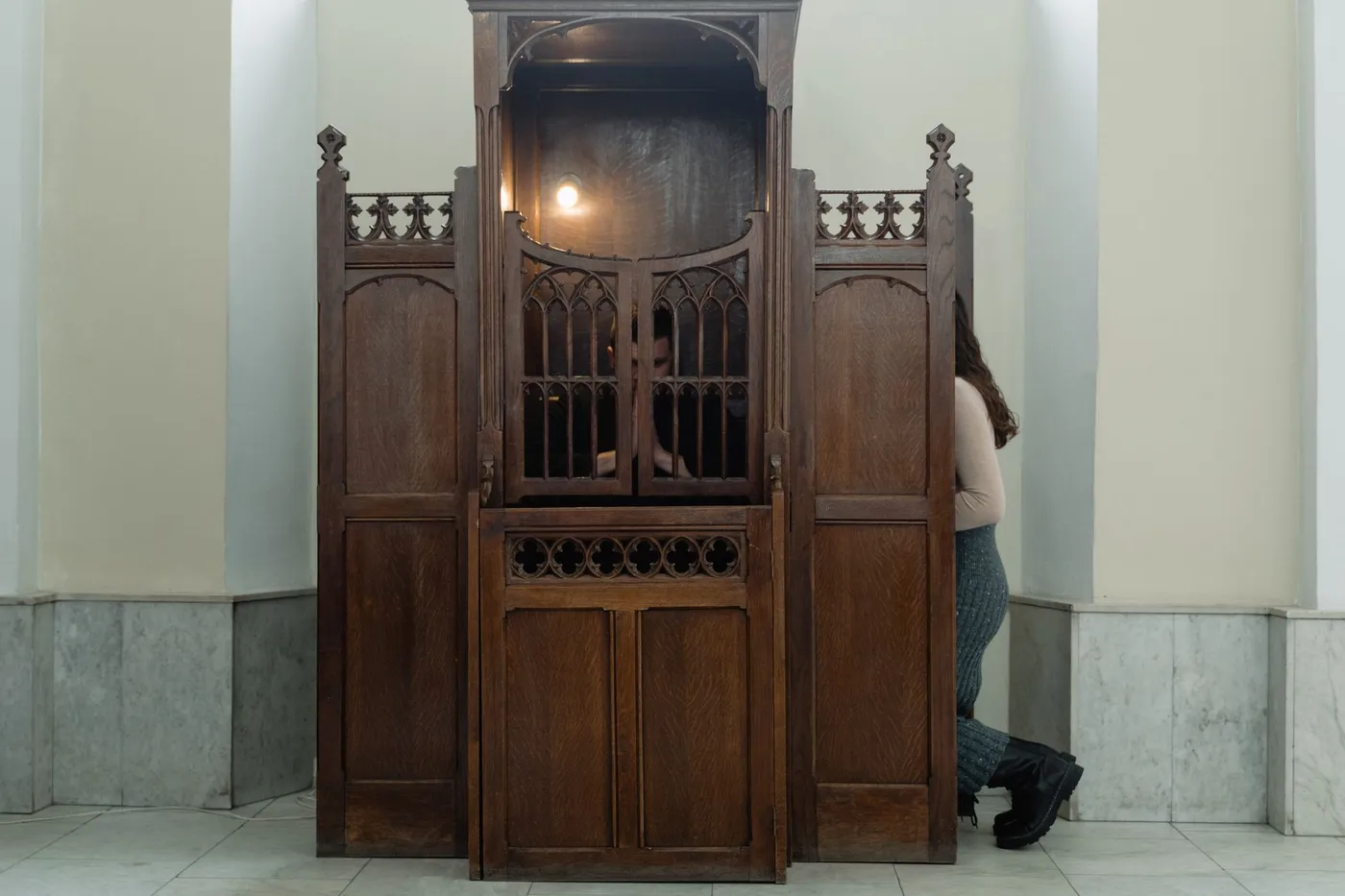
The US bishops’ guide says confession may be face to face or anonymous. You can kneel behind a screen and speak through a grille, and the priest does not see you. Or you can sit in a chair across from him and talk face to face.
It is simple about the choice, too: choose the option that is the most comfortable for you. Neither is more “real” than the other. If the thought of eye contact is what has kept you in the car, take the screen. If a screen makes you feel more nervous, not less, take the chair.
Penance, the Act of Contrition, and absolution
The same guide describes the forgiveness of sins as having four parts:
- Contrition: real sorrow for having offended God, with a firm resolve not to repeat the sin. The guide calls it the most important act of the penitent.
- Confession: naming your sins aloud to the priest.
- Penance: the prayer or action the priest gives you, as part of your healing.
- Absolution: the words the priest speaks by which God reconciles you to Himself.
The older Catholic Encyclopedia entry on the Sacrament of Penance uses the same frame, naming contrition, confession and satisfaction as the acts of the penitent.
Your penance is whatever the priest gives you. If you did not catch it, ask him to repeat it. Doing it before you leave the church means it is not left hanging.
The Act of Contrition has several versions. This is the one printed in the US bishops’ guide:
God, I am heartily sorry for having offended you, and I detest all my sins because I dread the loss of heaven and the pains of hell; but most of all because they offend you, my God, who are all good and deserving of all my love. I firmly resolve with the help of your grace to confess my sins, do penance, and to amend my life. Amen.
You do not need to have it memorized to go. Write it on a card or keep it open on your phone, set to airplane mode, and read it when the time comes.
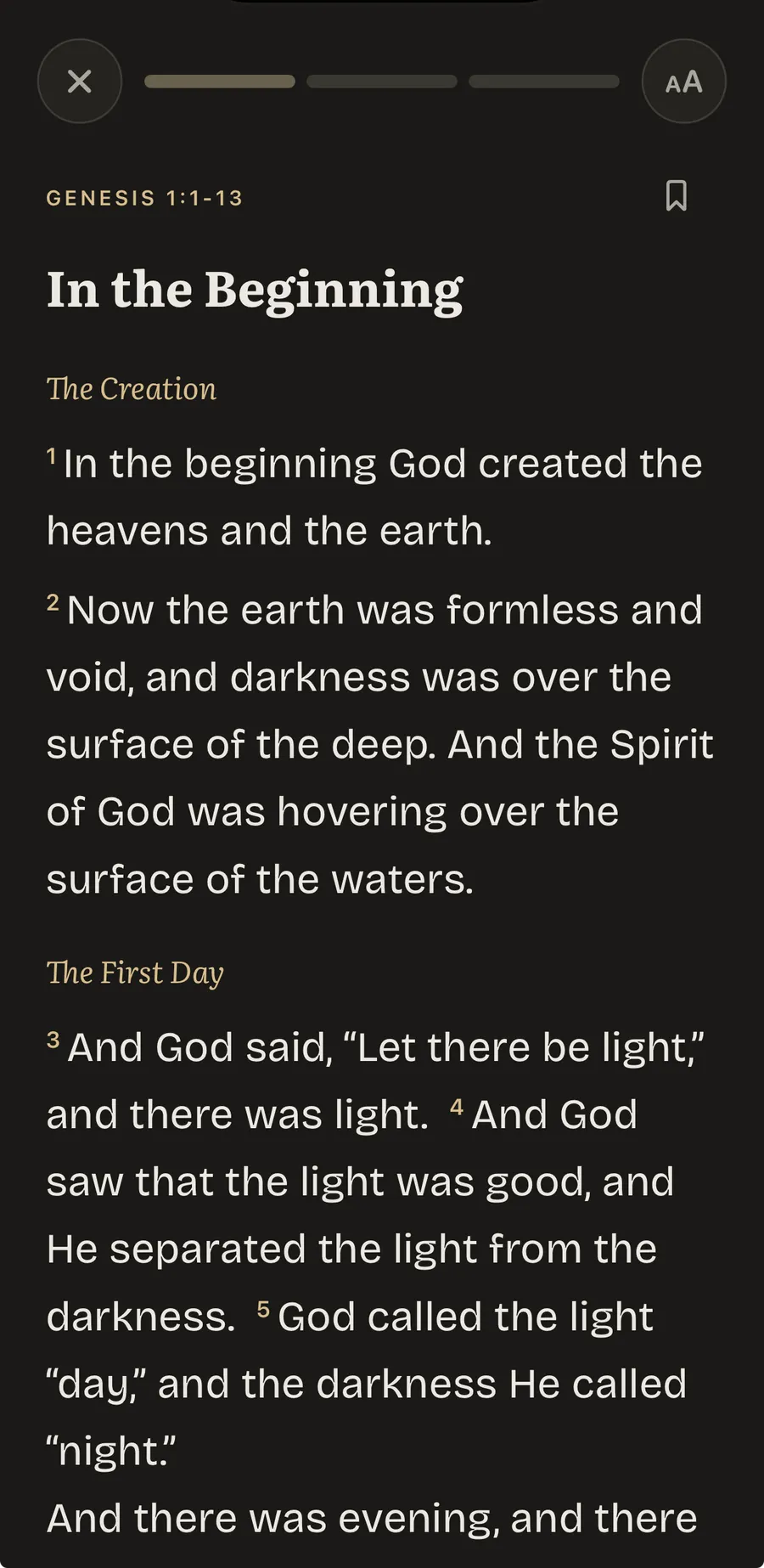
The hardest part of going back is often the night before, not knowing where to begin. The three-passage examination above works because it hands you a starting point, and the same is true of reading Scripture every day. BlessUp sets out each morning’s chapter so you never have to choose one, and the Catholic plan runs Genesis to Revelation, including the deuterocanonical books, at about 10.3 minutes a day. Every study lesson carries a Catholic commentary, and the app pre-selects the NABRE for Catholic readers. Read the day’s chapter and the apps you have chosen to shield open. See where the Catholic plan starts
If you forget something, or freeze
This is the fear that keeps most people in the car, so here is what the Church’s own documents actually ask.
The Catechism of the Catholic Church (paragraph 1456) asks penitents to confess the mortal sins they are aware of after a diligent self-examination. That is what the night before is for. It asks for honest effort, not a perfect memory. If something comes back to you afterwards, ask a priest what to do; that is exactly the kind of question he is there for. The Catechism (1458) also says that confessing everyday faults, though not strictly necessary, is strongly recommended.
If your mind goes blank in the booth, say so. “Father, it has been a long time and I am nervous” is a perfectly good sentence to begin with. The US bishops’ guide tells you to answer his questions without hiding anything out of fear or shame, and to place your trust in God, a merciful Father who wants to forgive you.
And if the thing you are carrying is less a list than a heaviness, our look at Bible verses about forgiveness is worth reading afterwards. So is the thought behind why a missed day should never reset you to zero: coming back is always allowed, and it is never too late to begin again.
To find a parish near you, and its confession times, our church finder lists churches in 54 US cities. Parish websites and bulletins usually list the hours.
Frequently asked questions
What do you say at the start of confession?
After the priest greets you, make the Sign of the Cross and say, "Bless me, Father, for I have sinned. My last confession was..." and give the number of weeks, months or years. Then confess your sins, and if you are unsure how to go on, ask the priest to help you.
Do I have to confess every sin I can remember?
The Catechism of the Catholic Church (1456) asks you to confess the mortal sins you are aware of after a diligent self-examination. It asks for honest effort, not a perfect memory. Confessing everyday faults is not strictly necessary but is strongly recommended (1458). A priest can answer questions about your own situation.
What if it has been 20 years since my last confession?
Then you are far from alone. In Pew Research Center's 2025 survey, 47% of US Catholics said they never go to confession. Tell the priest roughly how long it has been, say you are nervous if you are, and ask him to help you. The US bishops' guide says to do exactly that.
Can I read my sins from a list?
Nothing in the rite as the US bishops describe it asks you to recite from memory, so a short note to keep your place is a reasonable thing to bring. Jotting a word or two during the examination of conscience the night before is an easy way to make one. If you are unsure, ask the priest.
What happens if I forget the Act of Contrition?
Bring it with you on a card or on your phone and read it. The US bishops' guide simply says to say an Act of Contrition expressing your sorrow, and if you lose your place, the priest can help you through it.
Read the three passages tonight. Together they take about seven minutes.
No guilt. Ever. Grace is built in. Funded by readers, never by ads.