How to Have a Quiet Time With God
By Dom · · 13 min read
You have started one before. Maybe several. The first three mornings went well, the fourth got away from you, and by the end of the second week the Bible was back on the nightstand with the ribbon still somewhere in Genesis. Nothing dramatic ended it. It just stopped being the thing that happened first.
That is worth saying plainly at the top, because most guides to a quiet time describe an unhurried hour that almost nobody has, and then the reader concludes the problem is them. It usually is not. The shape of a quiet time is simple and every guide agrees on it. The part that decides whether it lasts is upstream of the shape.
Key takeaways
- A quiet time is Scripture and prayer, in that order, and fifteen minutes is a real one. It does not have to be an hour, and it does not have to be at dawn.
- Pick the cue before the content. Habit research finds that repeating an action in a consistent context is what makes it automatic, so the same time and the same chair matter more than the perfect plan.
- About nine minutes a day reads the Protestant canon cover to cover in a year: 724,811 words over 365 days at a normal reading pace. The Catholic and Orthodox canons run to 10.3 and 10.9 minutes.
- Decide what you are reading before the morning arrives. Among people who use a reading plan or guide, 74% have read most or all of the Bible.
- One missed morning does not undo it. In the habit research, missing an occasional day did not seriously impair the habit that was forming.
What a quiet time is, and what it does not have to be
A quiet time is a set period you spend with God on your own, usually daily, usually built around reading Scripture and praying. That is the whole definition. The name is a convention rather than a rule — some traditions call it devotions, some just call it time with God, some do not name it at all.
What it does not have to be is long, early, or eloquent. It does not require a journal, a study method, a devotional book or a candle. Those are all fine, and none of them is the thing. A reader who has fifteen minutes and uses them is having a quiet time. A reader waiting for the hour that never comes is not.
It is also more common than it feels at 6am when you are the only one awake. Lifeway Research found in a survey of 2,130 US Protestant churchgoers — people who attend a service at least once a month, polled in March 2025 with a margin of error of 2.21 points — that 31% say Bible reading is a daily habit, and another 30% read a few times a week. Across all US adults the figure is lower: Pew Research Center's 2023–24 Religious Landscape Study found that 22% read Scripture outside of religious services at least weekly.
The Lifeway number has moved, which is the encouraging part. In 2007 only 16% of churchgoers read daily. Whatever else is true about the last two decades, daily Bible reading has roughly doubled inside that group.
Pick the cue before you pick the content
Most advice starts with what to read. Start one step earlier, with when and where, because that is what the research on habits actually points at.
Gardner, Lally and Wardle's 2012 review in the British Journal of General Practice, “Making health habitual”, describes habits as actions triggered automatically by a context that has been paired with them often enough. Their advice is one sentence long: repeat an action consistently in the same context. The review covers health behaviours in adults, not prayer, so treat it as a principle rather than a study of quiet times. The principle still transfers, and it is the opposite of how most people try to build this.
In practice that means choosing a cue that already happens every day without your help. After the coffee is poured. After the shower. Once you sit down at your desk, before the laptop opens. The cue is the part you do not have to remember, so it carries the part you do.
The place does the same quiet work. After a week or two, sitting in the chair is itself a little of the prompt — which is why the couch you scroll on is a poor choice and the kitchen table is usually a good one.
Morning is the traditional recommendation and there is something to it — the day has not started making claims on you yet. Scripture is fond of mornings without ever requiring them. Psalm 5:3: “In the morning, Lord, you hear my voice; in the morning I lay my requests before you and wait expectantly” (NIV). And Mark 1:35 has Jesus up before dawn, going out to a solitary place to pray. But if you work nights, or your mornings belong to small children, the evening version of this is a real quiet time and not a consolation prize. The consistent cue beats the impressive hour.
The order: Scripture first, then prayer
Put the reading before the praying. This is a small thing that changes the whole fifteen minutes.
Most guides open the sitting with a short prayer before the reading — a line asking God to open the passage. Keep that if you were taught it; it takes seconds and it settles you. The order here is about where the substantial praying goes, and it goes after.
Prayer from a standing start is hard. You sit down, close your eyes, and the mind goes straight to the day's list — the email, the appointment, the thing you said yesterday that you wish you had said better. Reading first gives the prayer something to be about. You come to it with a sentence already in your head, and the praying tends to follow that sentence instead of the list.
A workable order, once the cue has fired:
- Read the day's passage. Not a search for the right passage. The one that was already chosen.
- Go back to one line. Whatever caught, reread it slowly. If nothing caught, reread the first verse. This is the simplest form of what older traditions call meditation, and it takes a minute.
- Pray what you just read. Thank God for something in it, ask for something it raised, then pray for one other person by name.
That is it. If you want to write a line down afterwards, write a line down. If the prayer side is the part you find hardest, a morning prayer routine that sticks goes deeper on that half than this post does.
What to read, so there is no decision each morning
Here is the failure almost nobody names. A quiet time that requires you to decide what to read is a quiet time with a small negotiation at the front of it, every single day, at the hour when you have the least appetite for negotiating. Some mornings you win it. Over a month, you do not.
So remove the decision. Read a book straight through, or follow a plan, but settle it once rather than daily. The American Bible Society's State of the Bible 2026 found that nearly three-quarters — 74% — of people who use a Bible reading guide, schedule, plan or program have read most or all of the Bible. That is a correlation and not a promise: the sort of person who picks up a plan may already be the sort who reads. But it points the same direction as the habit research, which is that the structure carries you on the mornings motivation does not.
If you have no idea which book, the honest answer is that it matters less than starting. Where to start reading the Bible covers the usual entry points, and a beginner's reading plan lays out a first month. And on the mornings when the whole portion is plainly not going to happen, what to read when you only have ten minutes is the short version worth keeping in reserve.
The other decision worth settling once is length, and length can be arithmetic rather than a guess. A year through the whole Bible is a known quantity: the Protestant canon is 724,811 words, which over 365 days is 1,986 words a day, which is almost exactly nine minutes at a normal reading pace of 220 words a minute. The longer canons run a little longer. How long it takes to read the Bible in a year works through the whole calculation.
| Part | About | What happens |
|---|---|---|
| The cue | — | Same trigger, same chair, most days |
| The phone | — | Charging in another room |
| Read | 9 min | The day's portion, chosen in advance |
| Sit with one line | 2 min | Reread the sentence that caught |
| Pray | 3 min | Thanks, one request, one other person |
| Total | ~14 min | Catholic canon 10.3 min of reading, Orthodox 10.9 |
Fifteen minutes is not a rule either. It is a size that fits a normal weekday, which is the only test that matters.
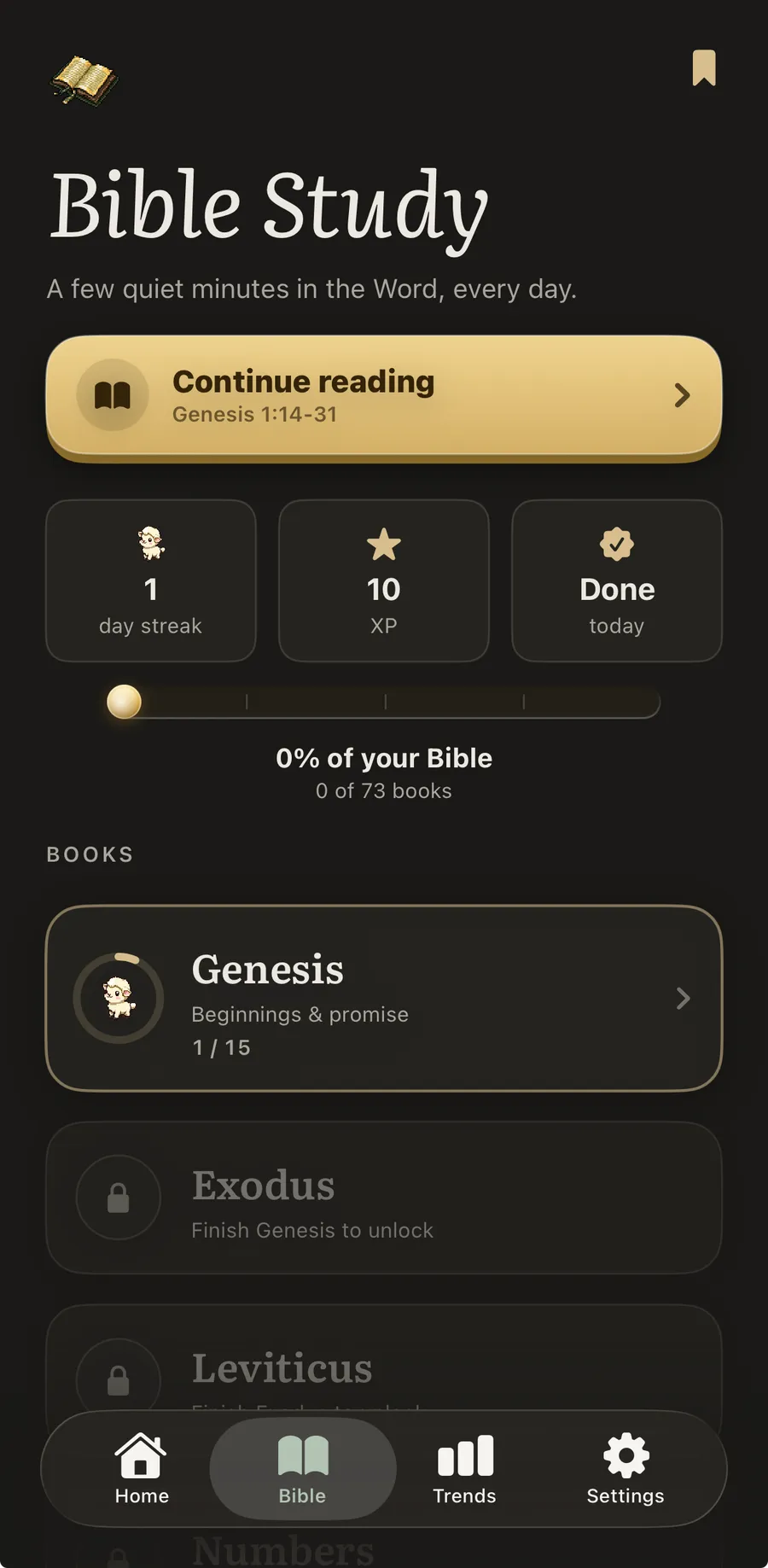
If the reason your quiet time keeps dying is that the morning is already spoken for, the nine minutes above is the number worth holding on to — that is the day's reading on a year-long plan, not a marketing round-down. BlessUp does that arithmetic for your tradition, has the day's portion waiting before you sit down, and keeps the apps you chose shut until you have read it. Day one is Genesis 1 to 3. BlessUp is on the App Store
Where the phone sleeps
Every part of this is straightforward except one, and the one is the phone.
If the phone is the alarm, it is in the room. If it is in the room, it is in your hand within a minute of waking, and the feed gets the first clear attention of your day. The quiet time then has to compete with something that has already started. It usually loses, not because you do not want it, but because you are no longer arriving at it fresh.
The obvious fix is distance: charge the phone in the kitchen, buy a cheap alarm clock. It is worth trying, and it is worth knowing in advance that it tends to slip. As a morning routine that does not start with your phone sets out, the weakness of the kitchen-charging trick is not insufficient distance. It is that it is a rule you have to re-decide every night, and re-decided rules drift.
What holds better is the same principle the rest of this post runs on: attach the reading to a cue that is already stable, rather than trying to suppress a habit that is. If the phone is going to be in your hand within the first ten minutes either way, the useful question is not how to prevent that. It is what has to happen before it — decided once, on an evening when you are thinking clearly, instead of at 6am when you are not.
The morning it does not happen
It will not happen some mornings. The alarm gets slept through, a child is sick, you simply forget. What you do with that morning decides whether this is a habit or another attempt.
The research is more forgiving than the instinct is. In the same 2012 review, summarising work by Lally and colleagues, missing an occasional opportunity did not seriously impair the habit being formed; the automaticity gains resumed afterwards.
So the rule is: do not make up the reading. Pick up where you left off, at today's date. Trying to repay the debt is what turns one missed morning into a quit, because by Thursday you owe three days and it all feels like arrears.
If a week has gone by rather than a day, the same rule holds and only the feelings are different. What to do when you miss a day is about exactly that morning.
It is worth setting up whatever you read with so that it behaves the same way. In BlessUp a missed day is absorbed by a grace day, your place is held, and nothing is reset or owed — the FAQ covers how that works.
You are not behind. There is no schedule you have fallen off. There is a chair, a cue, and a passage that is still there tomorrow.
Frequently asked questions
What do you do during a quiet time with God?
Read a passage of Scripture, sit with one line of it, and pray. Reading first gives the prayer something to be about, which is easier than praying from a standing start. Journaling, a devotional or a study method can be added, but none of them is required.
How long should a quiet time be?
About fifteen minutes is a real quiet time and fits a normal weekday. Nine minutes of that can be the day's portion of a one-year Bible plan: the Protestant canon is 724,811 words, or 1,986 words a day, which is roughly nine minutes at 220 words per minute. Longer is fine when you have it, but length is not what decides whether the habit lasts.
What should I read during my quiet time?
Something decided in advance, so the morning does not begin with a choice. A gospel read straight through, a book of the Bible, or a plan all work. American Bible Society's State of the Bible 2026 found 74% of people who use a reading guide, schedule, plan or program have read most or all of the Bible, though plan users may already be more committed readers.
Is it better to have a quiet time in the morning or at night?
Whichever one you can repeat. Morning has the advantage that the day has not started making claims on you yet, and Scripture often pictures prayer early. But habit research points at consistency of context rather than time of day, so a quiet time that reliably happens at nine at night beats one that theoretically happens at six in the morning.
What if I miss my quiet time?
Pick up at today's date and do not try to make up the reading. In the habit research, missing an occasional day did not seriously impair habit formation. Reading double the next day is what turns one missed morning into a quit, because the backlog grows faster than the motivation to clear it.
Every morning, your reading is already waiting. You will never wonder where to start.
No guilt. Ever. Grace is built in. Funded by readers, never by ads.