The Best Time of Day to Read the Bible
By Dom · · 11 min read
The alarm goes off at 6:40. You meant to read before work, and you still mean to. But the phone is already in your hand to silence the alarm, and by the time you put it down it is 6:58 and the kids are up. Tonight, you tell yourself. At 10:30 you open the Bible in bed and wake up at 1am with the lamp still on.
Search for the best time of day to read the Bible and most answers end in the same place: whenever works for you. That is kind, but it does not help someone who has no "whenever." So here is an actual answer, the reasons for it, and what it costs.
Key takeaways
- Our answer is the morning, before the phone. It is the one slot where nothing else has been spent yet, and it matches a pattern Scripture itself describes (Psalm 5:3).
- The first minutes after waking are the weakest. Researchers call it sleep inertia: ability and especially decision-making are lower just after you wake. A morning slot works best when the first task is small and already decided.
- Evenings have a real cost. In a 4-month study of 75 people, phone use in bed was linked to worse sleep, and participants spent 42% of their time in bed on their phones. Reading Scripture on that same device at night competes with sleep.
- Size matters more than the hour. The Protestant Bible in a year is 1,986 words a day, about nine minutes. That is small enough for a tired morning.
- Plan for the missed day. A fallback slot and grace for the miss keep one bad morning from ending the habit.
The answer, and then the reasons
Read in the morning, before you open anything else on your phone. If mornings truly cannot work, read at lunch. Read at night only if the other two are gone, and if you do, read from a printed Bible away from the phone.
That is a real position, and it can be wrong for some readers. Shift workers, new parents and people with certain health conditions will have good reasons to choose differently, and we are app builders, not pastors. But most people asking this question are not asking for permission. They want someone to pick, with reasons. Here are ours, including the honest case against mornings.
| Slot | What works for it | What works against it | Fits nine minutes? |
|---|---|---|---|
| Morning, before the phone | Nothing else has claimed you yet; the day's other demands have not started | Sleep inertia: grogginess and weaker decisions in the first minutes after waking | Yes, if the reading is decided the night before |
| Lunch or a midday break | You are fully awake; a natural pause in the day | Easily taken by work, errands or the phone itself | Yes, but the window is often shorter than it looks |
| Evening, in bed | Time to reflect on the day that just happened | Tiredness, and the phone in bed is linked to worse sleep | Yes, on paper; less often in practice |
What sleep inertia does to the first minutes after waking
Start with the honest problem. The first minutes after you wake up are, for most people, the worst minutes of the day for thinking clearly.
Researchers call this sleep inertia. A 2022 study in JMIR Formative Research describes it as the state after waking in which people's abilities are significantly lower than normal, and notes that decision-making in particular suffers. That study followed 36 people for two weeks as they tried to do a set morning exercise. When the plan failed, it was usually because of oversleeping or the grogginess itself. What helped was a small, simple task at the moment of waking, which got people moving and into the target behavior quickly.
The study was about squats, not Scripture, and it was small. But the lesson carries over. A groggy mind is bad at deciding things. If your morning reading starts with "what should I read today?", you are asking the weakest version of yourself to make a choice. That is where many morning plans quietly end: not in rebellion, but in a 6:40 decision you were too tired to make.
So the morning slot needs two things. The reading must already be chosen before you wake up, and the first step must be small. Open to a marked page. Read one chapter. Nothing else.
Why the morning slot wins anyway: the first-input argument
If mornings are the groggiest slot, why pick them? Because of what comes first.
This part is our argument, not a study. Whatever you take in first sets the tone for what follows. If the first thing you read each day is the news, your inbox or a feed, the day starts as a response to other people's demands. That is the pattern we wrote about in the first thing you check in the morning. If the first thing you read is Scripture, everything after it arrives second.
The morning is also the only slot that has not been spent yet. By lunch, work has taken its share. By evening, you have made a whole day of choices and have little left. In the morning, the only thing standing between you and the reading is the phone in your hand.
And there is a scriptural pattern here, not only a practical one. "In the morning, LORD, you hear my voice; in the morning I lay my requests before you and wait expectantly" (Psalm 5:3, NIV). David is describing prayer, not a reading plan, and the verse is not a command about the clock. But it shows a person who gives God the first part of the day on purpose. Reading in the morning follows the same instinct.
The honest case for evenings, and what it costs
Evenings have real strengths. At night you can read with the whole day behind you. A passage about patience lands differently after a day that tested yours. Some readers find that evening reading turns into prayer more naturally, because they have something to bring to it.
The cost is mostly about the device. Many people read the Bible at night on the same phone they scroll in bed. A 2022 study in Personal and Ubiquitous Computing tracked 75 people for four months, matching logs of their phone use with sleep data from a wearable ring. On average, they spent 42% of their time in bed on their phones. Phone use in bed was linked to taking longer to fall asleep, more time awake in the night, and changes in heart rate. Phone use outside of bed did not show the same effect.
That was a small study of phone use in general, not Bible reading. But it points to a practical rule. If you read at night, read somewhere other than bed, or read from paper. Otherwise the reading app becomes the doorway to the rest of the phone, and the verse you meant to end the day with becomes the start of a long stretch of scrolling.
There is also the simple problem of tiredness. Falling asleep on the second paragraph is not a spiritual failure. It is a body at the end of a long day. Evening reading can work, but it asks for more from you than the morning does.
Pick the slot, then size it: nine minutes and why that number
Here is the part most advice skips. The slot matters less than the size of what you put in it.
A reading that takes forty minutes will not survive a groggy morning or a tired evening. A reading that takes nine minutes will survive both. And nine minutes is not a guess. The Protestant Bible is 724,811 words. Spread over 365 days, that is 1,986 words a day, which is about nine minutes at an ordinary reading pace of 220 words a minute. The Catholic and Orthodox canons run a little longer, at about 10.3 and 10.9 minutes. The full breakdown is in how long it takes to read the Bible in a year.
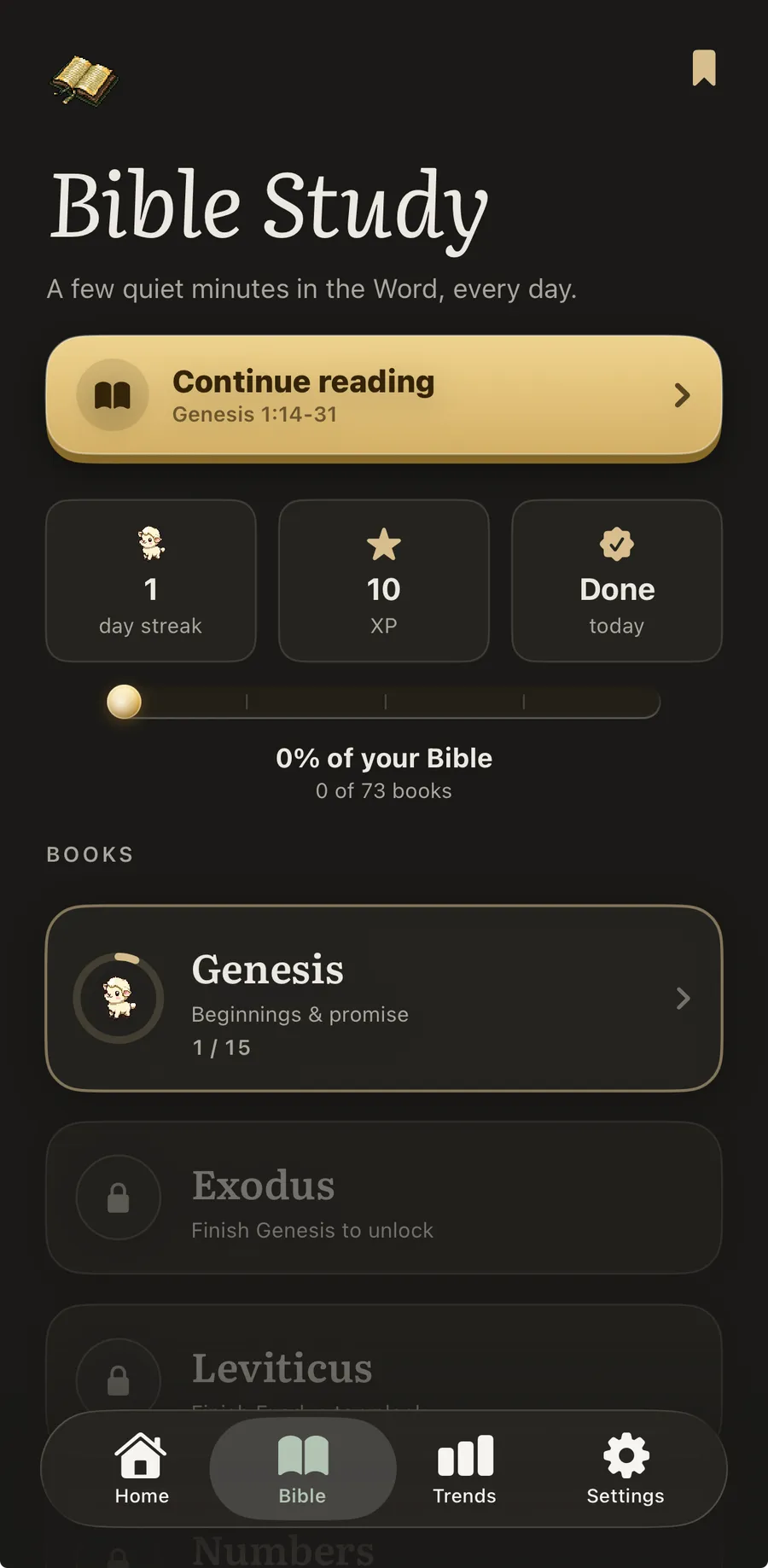
You do not need a free hour. You need about nine minutes, the Protestant plan's 1,986 words a day, and a morning where the phone waits its turn. BlessUp shields the apps you choose until you read the day's chapter, and the day's portion is already waiting when you open it. The apps re-lock at a reset time you set around bedtime, so tomorrow morning starts the same way. Start on day one, Genesis 1 to 3
Structure helps too. American Bible Society's State of the Bible 2026, a survey of 2,649 US adults, found that 74% of people who use a reading guide, schedule or plan had read most or all of the Bible. That is a correlation, not proof: people who pick a plan may already be more committed. But a plan does exactly what a groggy morning needs. It makes the choice for you the night before.
If nine minutes still feels like too much on some mornings, what to read when you only have ten minutes has smaller options that still read something whole.
What to do on the days your slot disappears
Some mornings the slot will vanish. A sick child, an early flight, an alarm that did not go off. Plan for it now, while you are not tired.
Pick a fallback slot ahead of time. If the morning is gone, read at lunch. If lunch is gone too, read before you pick up the phone in the evening, sitting at the table instead of in bed. Deciding this in advance means the missed morning is a change of plan, not a failure.
And if a whole day goes by, let it go. According to Lifeway Research, fewer than 1 in 3 churchgoers in its State of Discipleship study read the Bible daily. Lifeway's advice for busy readers is to set aside a certain time each day and to treat that time as foundational rather than one more thing to fit in. A missed day does not undo that. What ends most reading habits is not the miss, but the rule that one miss means starting over. We made the case against that rule in why streaks make people quit, and what grace days do instead.
If you want to build the whole morning around this, a morning routine that does not start with your phone walks through it, and how to have a quiet time with God covers what to do with the minutes once you have them. More reading guides are on our spiritual discipline hub, and app questions are answered in the BlessUp FAQ.
Frequently asked questions
Is it better to read the Bible in the morning or at night?
For most people, the morning. It is the one slot where nothing else has claimed your attention yet, and the reading comes before the phone. Evening reading can work well for reflection, but tiredness and phone use in bed make it harder to keep. If you read at night, read from paper and not in bed.
What does the Bible say about reading Scripture in the morning?
There is no command about a time of day. Psalm 5:3 describes David bringing his requests to God in the morning and waiting expectantly. It is about prayer, not a reading plan, but it shows someone giving God the first part of the day on purpose.
How long after waking up should you read?
There is no set number of minutes. The first minutes after waking are the groggiest, so make the first step small and already decided: open to a marked page and read one chapter. Some people read after a glass of water or a short walk. What matters most is that the reading comes before the phone.
What if I am not a morning person at all?
Then pick the next slot that is not yet spent, often lunch, and keep the reading small. About nine minutes a day reads the Protestant Bible in a year. Choose a fallback slot too, and treat a missed day as a change of plan rather than a reason to stop.
Pick the morning. Then make it small enough that a tired version of you can still do it.
No guilt. Ever. Grace is built in. Funded by readers, never by ads.