How to Focus When You Read the Bible
By Dom · · 10 min read
You open to the day's chapter. Four verses in, you notice you have been thinking about an email, a text you forgot to answer, and whether the dryer finished. You go back to verse one. By verse six it has happened again, and the phone on the table has lit up twice.
If that is most mornings for you, it does not mean you love Scripture less than other people do. It means you are reading with a normal human mind in a room that is working against it. Both of those can be changed, and the room is the easier one.
Key takeaways
- Losing the thread is normal. In a Harvard study of 2,250 volunteers, minds wandered 46.9% of the time on average. Drifting is how attention works, not a verdict on your faith.
- Where the phone sits matters more than willpower. In experiments with nearly 800 people at UT Austin, those whose phones were in another room did significantly better on attention tests than those with phones on the desk, even when the phones were off.
- Read a unit with an end. One chapter, with a clear finish line, holds attention better than an open-ended "read for a while."
- Read it aloud, and read whole books in order. Hearing the words and knowing where you are in the story both give your mind something to hold on to.
Why you lose the thread (and why it is not about your faith)
Most advice on this question starts inside you: pray first, concentrate harder, ask the Spirit to help. Prayer before reading is a good habit, and nothing here argues against it. But when that is the only advice, the reader who still drifts is left with one explanation, and it is usually a harsh one.
A better starting point is how attention works for everyone. Matthew Killingsworth and Daniel Gilbert at Harvard built an iPhone app that checked in with 2,250 volunteers at random moments and asked what they were doing and what they were thinking about. As the Harvard Gazette reported, people's minds were wandering 46.9% of the time on average, and at least 30% of the time during almost every activity measured. These were volunteers who chose to download an app, not a sample of people reading the Bible. But the pattern is plain enough: a wandering mind is the normal state, and coming back is the skill.
So the question is not "why am I like this?" It is "what in my setup makes drifting easy, and what can I change before I open the book?" The table below pairs the five most common causes with a change you make ahead of time and a way back in when it happens anyway.
| What pulls you away | Change before you start | When it happens anyway |
|---|---|---|
| The phone within reach | Put it in another room, not face down on the table | Leave the buzz unanswered until the chapter is done |
| A passage with no visible end | Decide the unit first: one chapter | Check how much is left; a finish line pulls you forward |
| Unfamiliar names and lists | Know which book you are in and roughly what it is about | Read the list at a steady pace and ask what it is doing, not who each person is |
| The wrong hour | Read at the same time each day, before the day's demands start | Stand up, or read the next paragraph out loud |
| A verse on its own | Read books in order instead of scattered verses | Go back to the start of the paragraph, not just the sentence |
Where the phone goes while you read
This is the change with the best evidence behind it, and it takes about ten seconds.
Adrian Ward and his colleagues at the University of Texas at Austin ran experiments with nearly 800 smartphone users. Before a set of computer-based attention and memory tests, people were told to leave their phones face down on the desk, in a pocket or bag, or in another room. In the university's summary of the study, the people whose phones were in another room did significantly better than those with phones on the desk, and slightly better than those with phones in a pocket or bag. Turning the phone off did not close the gap. The phone's presence was the problem, not its noise.
Those were lab tests of working memory, not Bible reading. But reading a chapter well asks for the same thing: holding the last few verses in mind while you take in the next ones. If a silent phone on the desk costs attention in a lab, it is reasonable to expect it costs something at your kitchen table too.
So the fix is physical. Charge the phone in another room and read from a printed Bible. If you read on your phone, turn on Do Not Disturb and close every other app first. It is not a test of character. It is moving an object across the house.

Read a unit with an end to it
"Read your Bible for a while" is hard to focus on, because there is no finish line. Your mind keeps asking how long this will take, and that question is itself a distraction.
A chapter answers it. You can see where it starts and where it stops. Most chapters take a few minutes at an ordinary pace, and a plan that reads the Protestant Bible in a year works out to about nine minutes a day. We did the full word-count arithmetic in how long it takes to read the Bible in a year, so there is no need to repeat it here. The point for focus is simpler: nine minutes is short enough to hold your attention the whole way, and long enough to read something whole.
If even that feels like too much on some days, choose a smaller unit on purpose rather than trailing off. What to read when you only have ten minutes has options that fit a short window. A short passage read with attention does more than a long one you skimmed.
Read it aloud
When your eyes keep sliding off the page, use your voice. Reading aloud slows you down to the speed of speech, and it gives your attention two things to follow at once, the words you see and the words you hear. It is much harder to plan dinner while you are saying a verse out loud.
There is a long precedent for this. When Ezra read the Law to the people who had returned to Jerusalem, the Levites "read from the Book of the Law of God, making it clear and giving the meaning so that the people understood what was being read" (Nehemiah 8:8, NIV). That was a public reading to a crowd, not someone alone with a Bible at 6am, so the lesson carries over by inference. But notice what the passage values: not getting through it, but understanding it.
You do not need to perform. A low voice is enough. If you live with others, read quietly or use an audio Bible and follow along on the page.
Most of focus is setup: the phone out of reach, a chapter with an end. If the phone is still the thing that keeps winning, change what the phone does. BlessUp uses Apple's Screen Time to shield the apps you choose until you read the day's chapter. So the pull toward Instagram becomes a reason to finish the reading instead of a reason to stop. The chapter has a clear start and end, and your place is held for tomorrow. See how the reading gate works
Read the whole book, in order
Much of what makes Scripture hard to focus on is reading it in pieces. A verse on its own has no before and after. Your mind has nothing to connect it to, so it drifts.
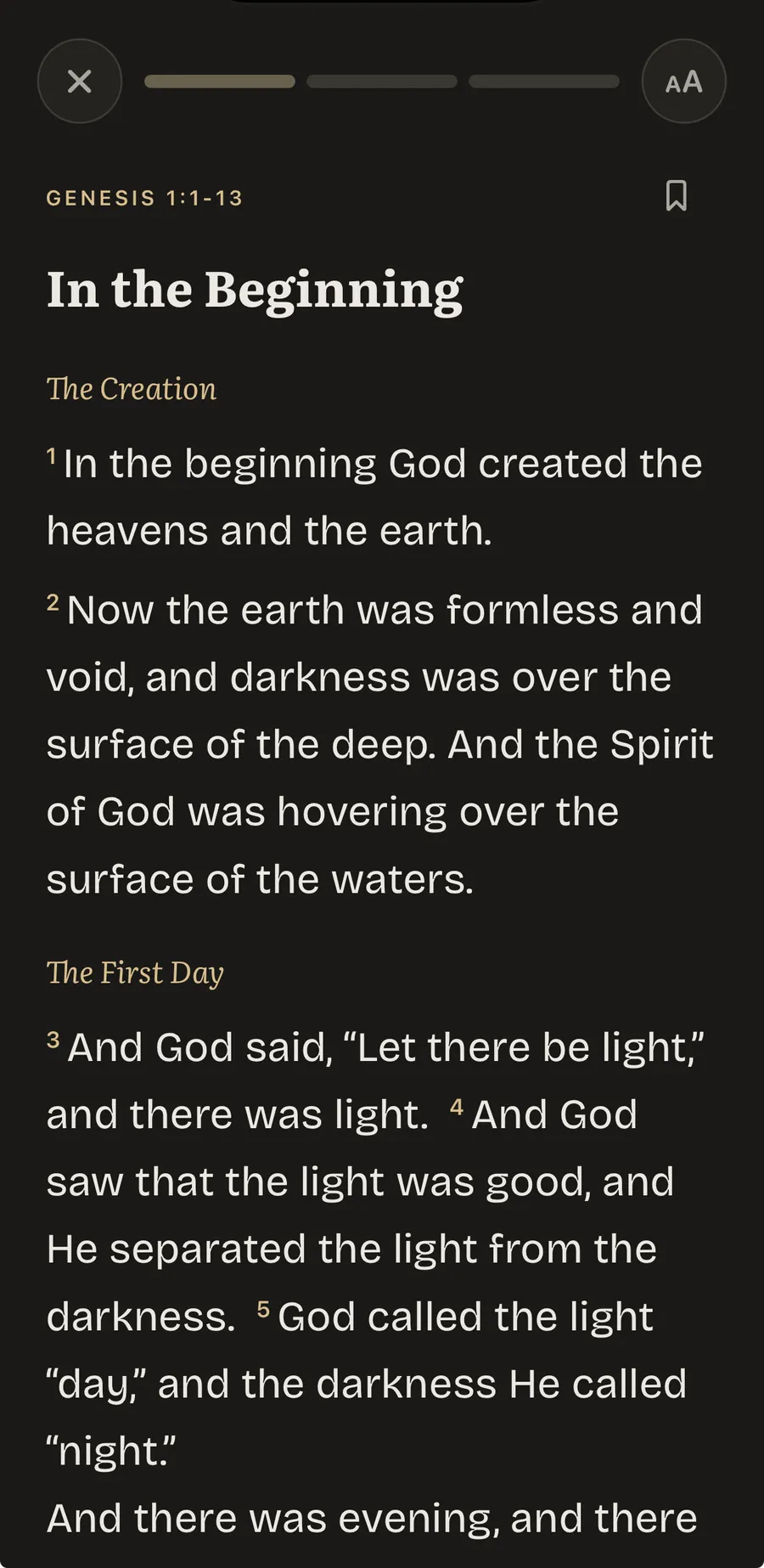
Reading one book from start to finish fixes that. By chapter three of Mark you know who the people are and where the story is going, and each new chapter hooks onto what you already read. If you are not sure which book to begin with, where to start reading the Bible suggests an order that does not open with the hardest parts.
It also helps to spend thirty seconds before you read reminding yourself where you are. What happened yesterday? Who is speaking? That small step gives your attention a place to land.
The passages that are genuinely hard to follow
Sometimes the problem is not the phone or the hour. Some passages are simply hard: long lists of names, detailed laws for ancient worship, prophets speaking into events most of us cannot place. It is normal for attention to fade there.
Read those sections at a steady pace, without stopping on every name, and ask one question: what is this passage doing here? A genealogy is often tracing a family line forward to someone who matters later. You do not need to hold every name to see that.
When a passage stays confusing, write the question down and move on. Come back to it with a study Bible, a friend or your pastor. For a method to use on the days you want to go deeper, see how to study the Bible. Reading and studying are different jobs, and it is fine to do the first one today and the second one later.
If prayer is where your mind wanders most, our sibling guide on how to focus when you pray covers that separately. For more on building a steady reading life, browse our spiritual discipline guides, and for questions about the app, the BlessUp FAQ.
Research from Pew Research Center found that 22% of US adults read scripture outside religious services at least once a week, while 61% seldom or never do. If you are sitting down to read at all, you have already done the hardest part. The rest is setup.
Frequently asked questions
Why can't I focus when reading the Bible?
Usually for ordinary reasons: a phone within reach, a passage with no clear end, unfamiliar names, or reading at a tired hour. Minds wander often during every activity, so drifting is normal. Changing your setup, such as putting the phone in another room and reading one chapter, helps more than trying harder.
How long should I read the Bible each day?
Long enough to read one complete unit with attention. For many people that is one chapter. A plan that reads the Protestant Bible in a year works out to about nine minutes a day at an ordinary reading pace, which is short enough to stay focused the whole way.
Is it better to read the Bible out loud?
It often helps with focus. Reading aloud slows you to the pace of speech and gives your attention both sight and sound to follow. You do not need to perform; a quiet voice is enough, or you can follow an audio Bible on the page.
What should I do when I don't understand what I'm reading?
Keep a steady pace, ask what the passage is doing in the book, and write down your question. Come back to it later with a study Bible, a friend or your pastor. Reading and studying are different tasks, and you do not have to do both in the same sitting.
How do I remember what I read in the Bible?
Read whole books in order so each chapter connects to the last, take thirty seconds before you start to recall where the story is, and read with your phone out of the room. Many readers also find that writing one sentence about the chapter afterward helps it stick.
Every morning, your reading is already waiting. You will never wonder where to start.
No guilt. Ever. Grace is built in. Funded by readers, never by ads.