How to Study the Bible
By Dom · · 13 min read
You read the chapter. You closed the Bible. By lunchtime you could not have said what it was about, and by Thursday you could not have said which book it was in. That is not a spiritual failure or a memory problem. Reading and studying are two different activities, and only one of them is designed to leave anything behind.
Studying the Bible is a method, which is good news, because methods can be learned in an afternoon and repeated on a bad morning. Here is the one nearly everything else is built on, and what twenty minutes of it looks like on a Tuesday.
Key takeaways
- Three steps, always in this order: observation (what does it say), interpretation (what did it mean), application (what does it ask of me). Skipping to the third is the single most common mistake.
- Study one book, not one topic, and read the whole book straight through before you study any part of it.
- Twenty minutes is enough for one chapter: about three minutes reading, eight observing, five interpreting, four on application and prayer.
- Just 31% of US Protestant churchgoers read the Bible daily, per Lifeway Research’s survey of 2,130 churchgoers in March 2025. The barrier is not access — 77% of Americans owned a Bible in the 2025 State of the Bible.
- You need three things: a readable Bible, something to write on, and the discipline to leave the commentary shut until you have formed your own view.
Reading and studying are two different jobs
Reading covers ground. Studying stays put. They fail in opposite ways: a plan that never slows down leaves a year of vague impressions, and a study habit that never moves on leaves three chapters you know well and sixty-three books you never opened. Most people need both. A year-long plan covers the Bible at about nine minutes a day (how long it takes to read the Bible in a year has the arithmetic); study is the other days’ twenty minutes.
Lifeway Research found in a survey of 2,130 US Protestant churchgoers, fielded 19–26 March 2025 with a margin of error of plus or minus 2.21 points, that just 31% read the Bible daily — with another 30% reading a few times a week. The American Bible Society’s 2026 State of the Bible, based on 2,649 interviews conducted 8–27 January 2026 by NORC at the University of Chicago, put the Scripture-engaged share of US adults at 17%.
Notice what is not the problem. The 2025 State of the Bible, as reported by Lifeway Research, put Bible ownership at 77% of Americans, with 66% of Bible users reading it on a screen at least sometimes. Almost nobody is short of access. What they are short of is a method they can repeat on a Tuesday.
The three steps, and why the order is not negotiable
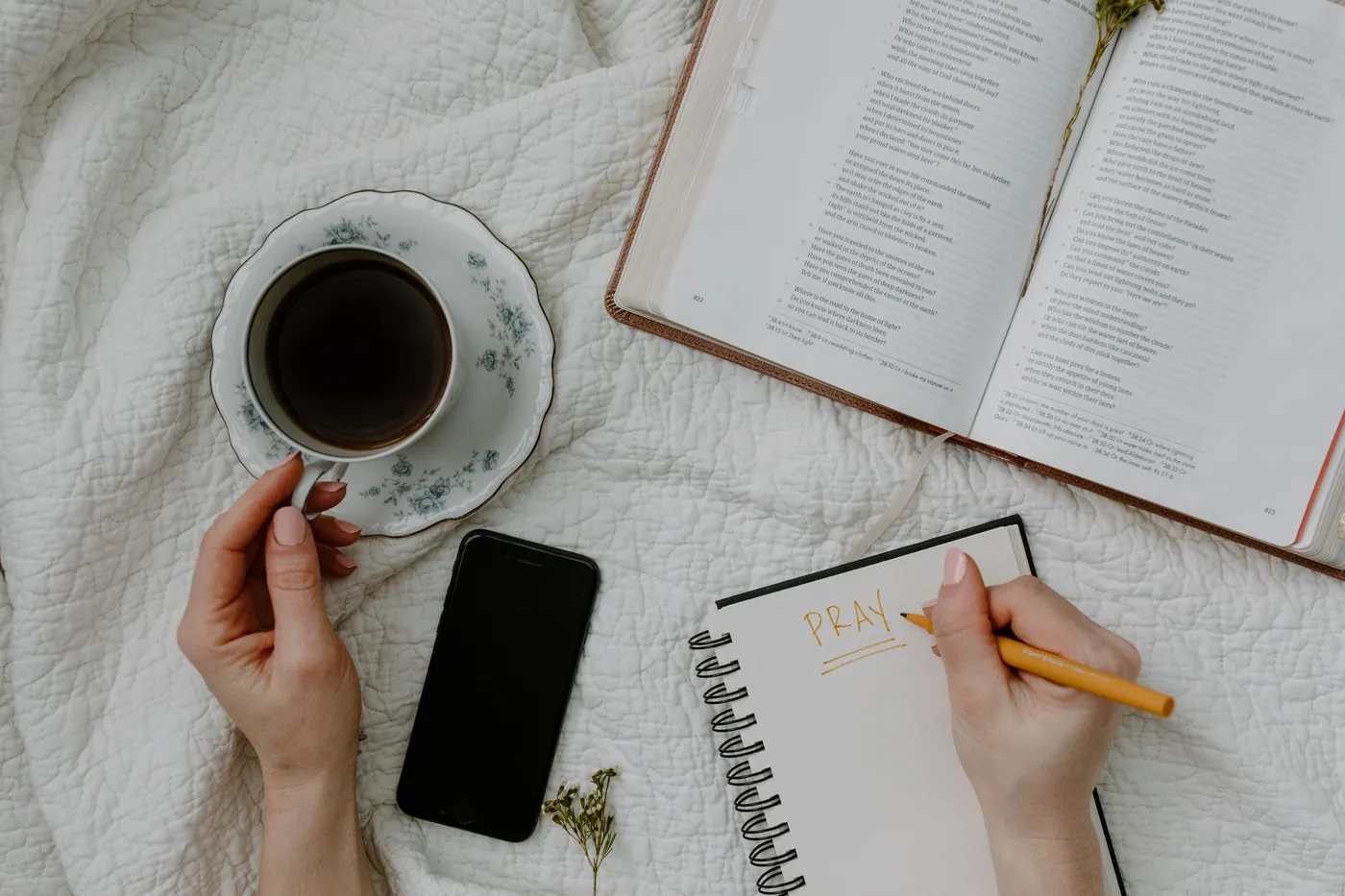
The approach usually called inductive study, taught by most Protestant study guides, reduces to three questions asked in a fixed sequence. It is not the only serious way to read: lectio divina and the liturgical reading of the Catholic and Orthodox traditions are older disciplines with a different aim. This post teaches the three questions because a beginner can run them alone on a weekday.
- Observation: what does it say? Not what it means. What is actually on the page. Who is speaking, to whom, about what, and which words keep coming back.
- Interpretation: what did it mean? What the author was saying to the people he was writing to, in their situation, in that book.
- Application: what does it ask of me? Specific, personal, and small enough to do this week.
You may have met these steps under other names. SOAP (Scripture, Observation, Application, Prayer) is this method with interpretation folded into observation, which is its weakness: it lets you jump from what the page says to what it asks of you without asking what it meant. Verse mapping and topical study start from a word or theme rather than a passage; useful later, a trap first, because a topic pulls verses out of their arguments.
The order is the entire discipline. You cannot interpret what you have not observed, and an application built on a misreading is your own opinion wearing a verse. Precept Ministries, whose curriculum is built on this method, puts it the other way round: the first question is what God is saying about Himself, because the question about your life answers itself once that one is done.
| Step | The question | Roughly | How it goes wrong |
|---|---|---|---|
| Observation | What does the passage actually say? | 8 minutes | Skipped entirely, because it feels like nothing is happening |
| Interpretation | What did it mean to its first readers? | 5 minutes | Reaching for a commentary before you have formed a view |
| Application | What does it ask of me this week? | 4 minutes, prayer included | Answered first, so the text ends up agreeing with you |
The method on one chapter: 1 John 1
Here are the three steps on ten verses, to show what twenty minutes produces. Read 1 John 1 in the NIV first; it is about 250 words.
Observation. Write down the repeated words and the shape of the sentences. In the NIV, “we” appears twenty times in ten verses; “sin,” “sins” or “sinned” five; “fellowship” four; “light” three; “darkness” and “truth” twice each. The first three verses pile up verbs of witness: heard, seen, looked at, touched. Then verses 6 to 10 are five sentences in a row beginning “If we,” alternating a claim (6), a walk (7), a claim (8), a confession (9), a claim (10). Eight minutes, and you have not interpreted anything yet.
Interpretation. Now the pattern means something. An eyewitness is writing to people being told that they can have fellowship with God without their conduct changing, or that they have no sin to deal with. The three “if we claim” sentences are the claims he answers; the two between them, walking in the light and confessing, are what fellowship looks like. One sentence about God: He is light, and fellowship with Him runs through admitting the darkness, not denying it.
Application. One sentence, checkable by Friday: the thing I have been claiming is fine gets said out loud tonight, to God and to one person.
Then, and only then, the commentary, and more than one if you can: verse 9, on confession, is the kind of line the traditions handle with different emphases, which is why every study lesson in the app carries four separately written commentaries.
Start with one book, and read the whole thing first
The most common beginner mistake is to study a topic rather than a book. Topics feel efficient and quietly remove every verse from its context. Precept’s advice is blunt: the Bible is closer to a library of books and letters than a collection of verses, and a habit is easiest to keep when you dig into one book at a time.
So before you study a single verse, read the whole book start to finish, several times, ideally in one sitting. “One sitting” is a checkable number: the table gives it, from the book-by-book word counts The Gospel Coalition Canada published, at 220 words a minute. Read it aloud once.
| Book | Chapters | Words | One sitting | Why start here |
|---|---|---|---|---|
| Ruth | 4 | 2,039 | 9 min | A complete story with a beginning and an end. Easiest book to read in one sitting. |
| Philippians | 4 | 1,629 | 7 min | A letter written from prison about joy. The argument is unusually easy to trace. |
| Jonah | 4 | 1,082 | 5 min | Short, strange, and it ends on a question rather than a moral. |
| 1 John | 5 | 2,141 | 10 min | Circles the same few words, as chapter 1 showed above. |
| Mark | 16 | 11,304 | 51 min | The fastest Gospel, and the one the 2026–27 lectionary year is built around. |
If you are choosing a first book to read rather than to study, the calculus is slightly different and we worked it through separately in where to start reading the Bible.
What you actually need
A Bible you can read without translating it in your head, something to write on, and twenty minutes. That is the kit. Everything else is useful, and a trap if you reach for it too early; as Precept puts it, wrestling with a passage yourself, and sometimes being wrong, is what makes it stick.
When each earns its place matters more than a list. A journal, on day one: a question you did not write down is one you will not answer on Thursday. A concordance, or the search box in any Bible app, at observation, when a repeated word makes you wonder where else the author uses it. A study Bible at interpretation, once you have a view to check; its notes are a commentary in the margin, a second opinion, not a first. A full commentary last, after a person if you have one.
In a 2006 study by Roediger and Karpicke in Psychological Science, students tested on a passage after reading it remembered more of it a week later than students who spent the same time rereading, though the rereaders felt more confident at the time. Answering a question about a chapter is a different act from rereading it, which is why the app’s lessons end on one.
Any mainstream translation will do for study; what matters is that you can hear it. If your tradition points you somewhere specific, follow it; what actually differs between the Protestant, Catholic and Orthodox Bibles has the map. Reading a passage in a second translation is one of the cheapest study tools there is.
Twenty minutes, on a normal weekday
The method, compressed to fit before work.
- Minutes 1–3. A one-line prayer for understanding, then read the chapter straight through, no notes. You are getting the shape.
- Minutes 4–11. Read it again with a pen. Write down the repeated words. Write down every question it raises, including the stupid ones.
- Minutes 12–16. Answer as many of your questions as the passage itself answers, using the paragraphs either side. Then write one sentence: what this passage is saying about God.
- Minutes 17–18. One sentence on what it asks of you, specific enough to be checkable by Friday.
- Minutes 19–20. Pray that sentence back.
Do that four times on the same chapter across a week and you will know it in a way a commentary cannot give you. Do it once and skip three days and you have proved nothing. Most study habits collapse in week three, not week one, and the collapse is about the slot, not the will.
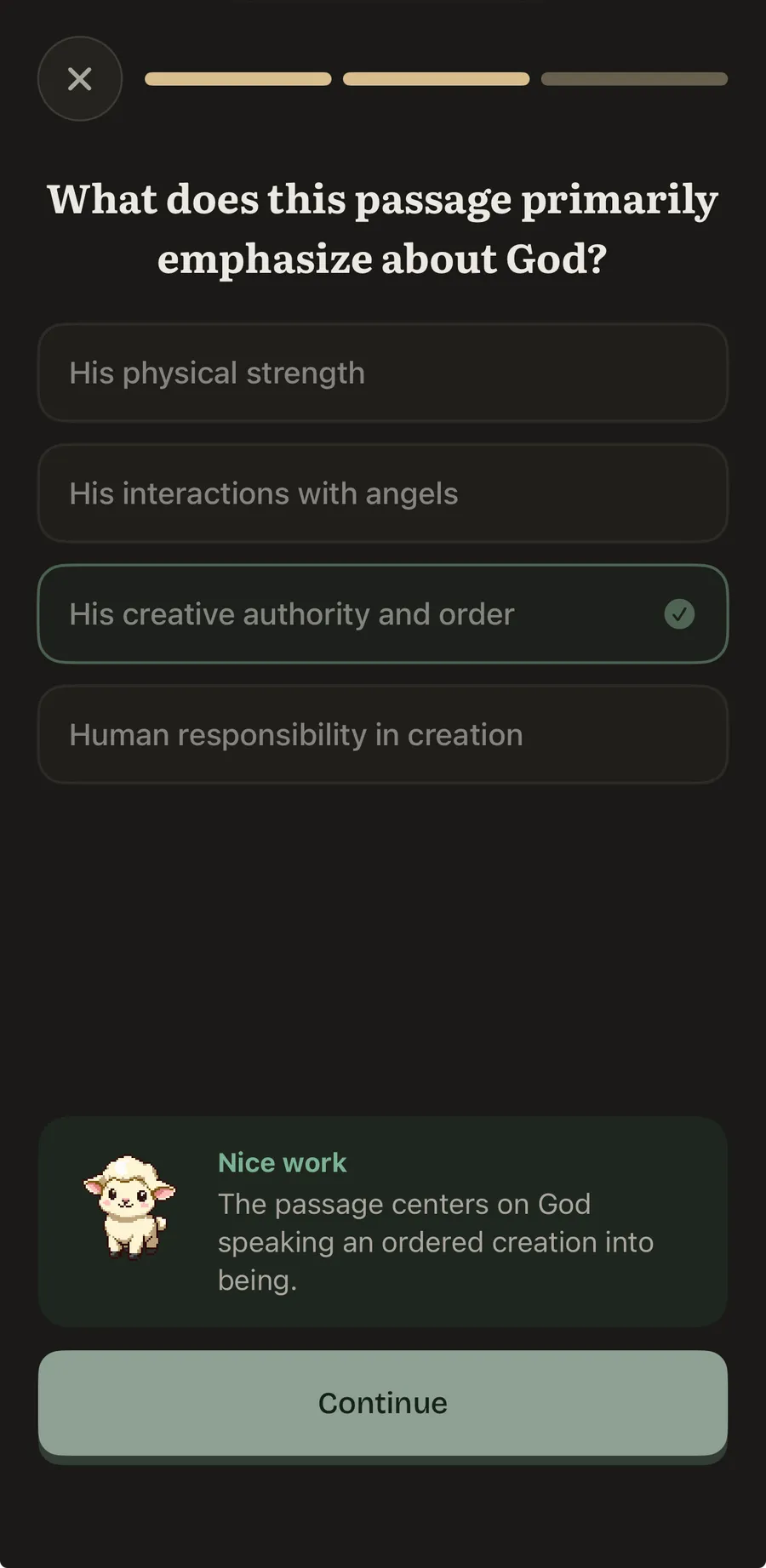
The part that stops most people is not the reading, it is having no way to tell whether they understood it. BlessUp’s study track is built around that gap: 372 lessons across 78 books, about four minutes each, every one with a comprehension question and the reasoning shown, plus four separately written commentaries — Non-Denominational, Protestant, Catholic and Orthodox — so the passage is explained the way your own tradition explains it. Reading the day’s chapter is also what opens the apps you have shielded, which solves the slot problem rather than the willpower one. Look at how a study lesson is built
How to tell whether you are making it up
This is the fear that keeps people from studying alone, and it is a reasonable fear. Four checks, in order of cost.
- Does the passage itself support it? If you cannot point at the words that got you there, you did not get it from the text.
- Does the rest of Scripture agree? A reading that requires one verse to stand alone against everything else is almost always a misreading.
- Read it in another translation. Ambiguity in one rendering is often resolved in another, and free.
- Then check a commentary, and then a person. In that order. A pastor or a study group will catch things no book will.
The Bereans in Acts 17:11 are commended for exactly this posture — they “examined the Scriptures every day to see if what Paul said was true” (NIV). Not credulity, not cynicism: checking. If you have nobody to check with, finding a church in a new city and the church finder exist for that.
When you miss a week
You will. What ends a study habit is almost never a decision to stop; it is a missed Tuesday that becomes a missed fortnight and then the feeling that starting again means starting over. It does not. Open the next passage in the book you were in and carry on; the case for that is in what to do when you miss a day. Nobody is grading the gap.
2 Timothy 3:16–17 says Scripture is useful for teaching, rebuking, correcting and training in righteousness, all of which happen over time to people who keep showing up. Twenty minutes, most days, on one book at a time. That is the method.
Frequently asked questions
How long should Bible study take?
Twenty minutes is enough for a real study of one chapter: three minutes reading it through, eight observing, five interpreting, and the rest on application and prayer. Consistency matters far more than length. Four twenty-minute sittings on the same chapter in a week will teach you more than one long session a month.
What is the inductive Bible study method?
Three steps taken in a fixed order: observation, which asks what the passage actually says; interpretation, which asks what it meant to the people it was written to; and application, which asks what it requires of you. The order matters, because an application built on an unexamined reading is just your own opinion with a verse attached.
Where should I start studying the Bible?
Start with one short book rather than a topic, and read the whole thing before you study any part of it. Ruth, Philippians, Jonah and 1 John are all four or five chapters and can be read in a single sitting. Mark is the fastest of the four Gospels if you want to start with the life of Jesus.
What is the difference between reading the Bible and studying it?
Reading covers ground; studying stays put. A reading plan moves you through the whole Bible at a set pace, while study slows down on one passage until you can say what it means and why. Most people need both, on different days, and neither one replaces the other.
Do I need a study Bible or a commentary to start?
No. A readable Bible, something to write on and twenty minutes is the whole requirement. Commentaries and study notes are useful, but reaching for them before you have formed your own view short-circuits the part of the process that makes a passage stick. Do the work first, then check it.
Your day starts in the Word, not the feed. BlessUp is free to download.
No guilt. Ever. Grace is built in. Funded by readers, never by ads.