Daily Bible Verse App: Start Every Day in Scripture
By Dom · · Updated · 8 min read
A single verse can reframe your whole day. A good daily Bible verse app makes sure you see one without having to go looking for it.
BlessUp does that. It is also fair to say up front that the verse is where the app starts, and a full reading plan is what it is built around. This page covers both: where the verse shows up, what one verse can and cannot do, and what the next step costs you in minutes.
Key takeaways
- Yes, there is a daily verse. It shows on the Home tab, on a home screen widget and on a Lock Screen widget, drawn from 867 verses in NIV, NKJV and NABRE.
- One verse is a real beginning. A line you know by heart is there for you in a hard moment in a way a searched-for verse is not.
- A verse is not a reading plan. A 13-word verse a day covers under 1% of the Protestant canon in a year.
- Plans go with finishing. In State of the Bible 2026, 74% of people who use a reading guide or plan had read most or all of the Bible, against about a third of all adults.
- The next step is about nine minutes. The Protestant plan is 1,986 words a day, which is 9.0 minutes at 220 words per minute.
A verse you won't miss
It's easy to plan on reading Scripture and then forget by lunch. The plan was real. The morning went somewhere else, usually into the first app your thumb found.
The fix is placement more than willpower. A verse on the screen you were going to look at anyway gets read. A verse inside an app you have to remember to open mostly does not.
So the first thing to ask of any verse app is simple: where does the verse live? If you are weighing widgets in particular, our guide to Bible widgets on iPhone walks through what to look for.
Where the verse actually appears
In BlessUp, the daily verse shows up in three places:
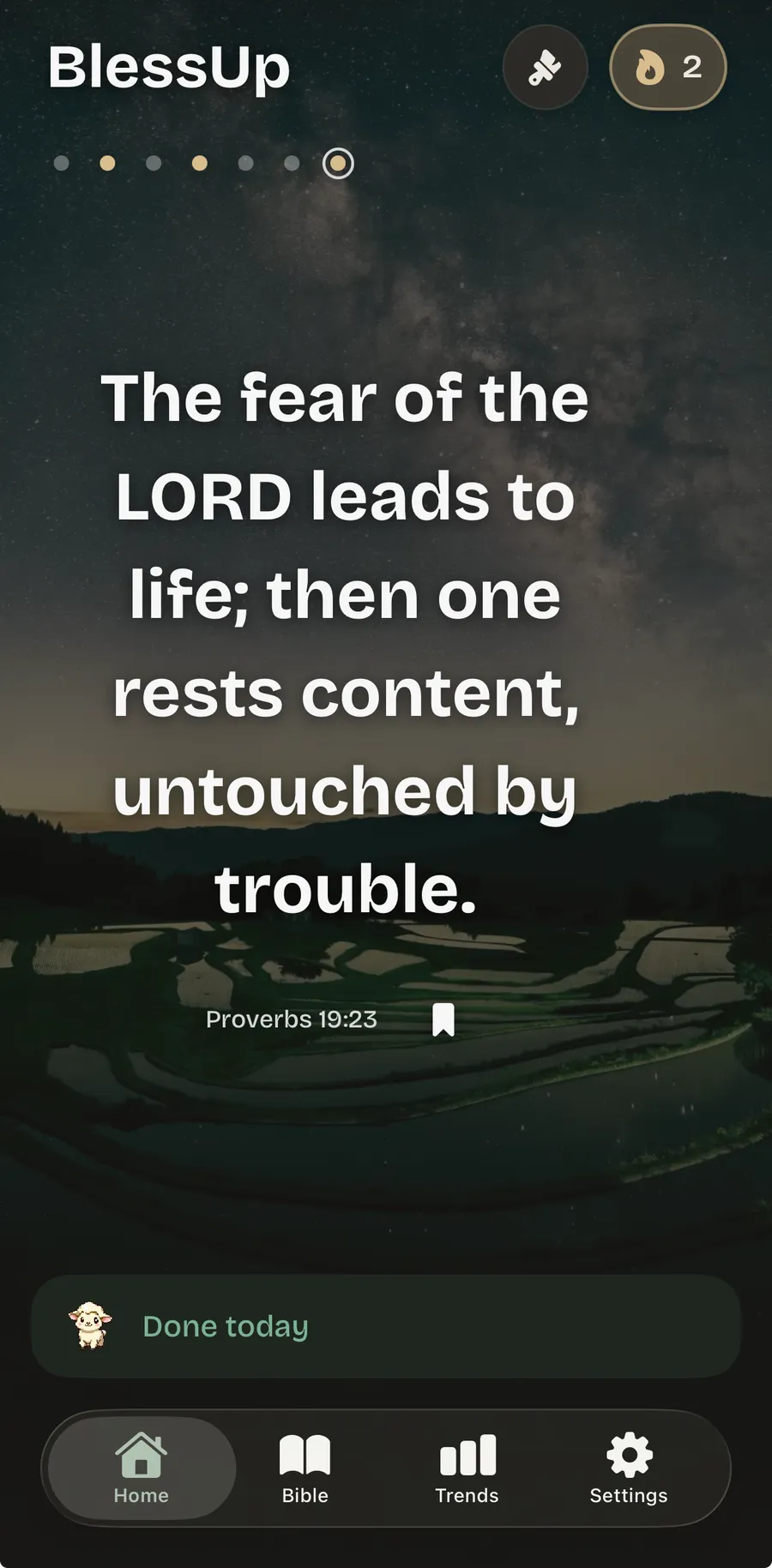
- The Home tab. A verse card sits over a background you choose. Swipe for more verses, and press and hold to save one.
- A home screen widget. The Daily Verse widget keeps the verse in view without opening the app.
- A Lock Screen widget. The same verse, on the first screen you see when you pick up your phone.
The verses come from a set of 867 on a full-year rotation, kept in three translations: NIV, NKJV and NABRE. The app is on iPhone only. There is no Android version.
Here is the part an older version of this page left out. The verse is the doorway, and the plan is the room. Behind the verse is a year through the Bible in 365 daily portions, 372 short study lessons, and a shield that keeps the apps you choose closed until the day's reading is done. How the reading gate works explains that last part in full.
You can enjoy the verse and never touch the rest. But you should know what you are installing.
Why one verse carries real weight
It carries most weight when you already know it — the passages Scripture uses to answer fear are the clearest case, because a verse you have read forty times is available at 2am in a way a verse you had to search for is not.
It's tempting to think a verse a day is too little to matter. Scripture says otherwise. When Jesus was tested in the wilderness, He answered with single lines of Scripture: “Man shall not live on bread alone, but on every word that comes from the mouth of God” (Matthew 4:4, NIV). One remembered sentence of God's word was enough in the hardest moment.
And God promises that His word does its work: “It will not return to me empty, but will accomplish what I desire” (Isaiah 55:11, NIV). A verse is short. It is not small.
Read it, then carry it
The goal is to carry the verse, not only to read it. A short passage you see first thing gives you something to return to through the day, in the small moments when you'd otherwise reach for your feed.
A few small practices turn a glanced-at verse into a carried one:
- Read it twice. Once for the words, once for what they're saying to you today.
- Say it out loud. Hearing Scripture in your own voice helps it settle in.
- Attach it to a moment. Bring the verse back at coffee, on the commute, or before a hard conversation.
- Pray it back. Turn the verse into a short prayer in your own words, and it becomes a conversation instead of a reading.
None of this needs an app. A verse written on a card by the kettle works the same way.
What a verse habit does not do
This is the honest part. A verse a day is good, and it has limits.
It does not take you through the Bible. Psalm 119:105 is 13 words in the NIV. A verse that size every day comes to 4,745 words in a year. The Protestant canon is 724,811 words, so that is well under 1% of it. Even a verse twice as long stays under 2%.
It also arrives without its neighbours. A verse lifted out of its chapter can comfort you, and you may still not know who was speaking, or to whom, or what happened next. Reading the chapter around it is how that fills in.
A devotional entry has the same shape, one lifted line plus reflection: a devotional set beside its chapter.
The research points the same way. The American Bible Society's State of the Bible 2026, a survey of 2,649 U.S. adults taken in January 2026, found that one-third of respondents had read all or most of the Bible. Among those who use a Bible reading guide, schedule, plan or program, it was nearly three-quarters (74%).
That is a link between two things, not proof that one causes the other. People who already read a lot may be the ones who pick up a plan. Still, having a plan and finishing travel together.
If daily reading has been hard for you, you are in large company. Lifeway Research surveyed 2,130 U.S. Protestant churchgoers, people who attend at least once a month, and 31% said they read the Bible every day. Most people in the pews are not there yet either. There is no shame in that, only room.
What about the idea that a small habit grows? An earlier version of this page claimed that with nothing behind it. Here is what the evidence supports. A 2024 systematic review and meta-analysis of habit studies reported median times to form a habit of 59 to 66 days, with individual people ranging from 4 to 335 days. Morning practices and habits people chose for themselves tended to be stronger.
Those studies looked at health habits such as flossing and drinking water, not Bible reading, so hold the numbers loosely. The fair reading is modest: a small morning practice you picked yourself is a sound place to begin, and it settles in over about two months, not a week.
From a verse to a chapter: about nine minutes
So what does the next step cost? Less than most people guess. Here is one verse a day set beside a year-long reading plan, for each of the three canons.
| Daily habit | Words per day | Time per day | Canon covered in a year | What it leaves you with |
|---|---|---|---|---|
| One verse | 13 | About 4 seconds | Under 1% | One line to carry and remember |
| Reading plan, Protestant canon | 1,986 | 9.0 minutes | All of it | Genesis to Revelation, in order |
| Reading plan, Catholic canon | 2,270 | 10.3 minutes | All of it | The same, with the deuterocanonical books |
| Reading plan, Orthodox canon | 2,409 | 10.9 minutes | All of it | The same, with the longest canon of the three |
The gap between the two habits is about nine minutes. That is the whole price of going from a line of Scripture to the full story around it. How long a year through the Bible actually takes shows the arithmetic in full.
You do not have to jump straight to a year-long plan. What to read in ten minutes has short readings that fit the same slot, and where to start reading the Bible covers the first books to pick up.
If you are choosing an app for that next step, a beginner's guide to Bible apps sets YouVersion, Dwell, Hallow, BibleProject and BlessUp side by side.
The hard part of going past a verse is rarely the reading. It is opening a Bible with no idea which page is yours today. In BlessUp the day's reading is already waiting each morning, and reading it is what opens the apps you chose to shield. Day one is Genesis 1 to 3. See what a day looks like.
Scripture without the friction
The Pew Research Center reports that about nine in ten Americans (91%) own a smartphone. For better or worse, the phone is where our eyes land first each morning. So the kindest thing we can do for our faith is put Scripture right there, ahead of everything else on the screen.
A widget does that for a verse. The shield does it for a chapter. You pick the apps that usually win your morning, they stay closed, and the day's reading opens them. If you miss a day, a grace day covers it and your place is held.
The app is free to download, with a paid tier called BlessUp Gold that starts with a 3-day free trial. The FAQ answers the common setup questions, and the Faith and Technology hub gathers our other guides on using a phone well.
If you are weighing BlessUp against an app you already use, how BlessUp compares to Hallow and the same comparison for Haven both start from one question: what actually gets you into Scripture before the feed.
The psalmist calls God's word “a lamp for my feet, a light on my path” (Psalm 119:105, NIV). A lamp doesn't light the whole road at once. It lights the next step.
That is what a daily verse does. It gives you enough light for today, and tomorrow there will be another. And when you want to see more of the road, the chapter is right behind it.
Frequently asked questions
What is the best daily Bible verse app?
The best one is the app that puts the verse where you already look and gives you somewhere to go when one verse is no longer enough. Check three things: a widget, so you see the verse without opening anything; your own translation; and a reading plan behind the verse. BlessUp has all three on iPhone. It has no Android app.
Does BlessUp show a verse on your home screen?
Yes. BlessUp has a Daily Verse widget for the iPhone home screen and another for the Lock Screen, so you can see the verse without opening the app. Inside the app, the Home tab shows the daily verse on a card. You can swipe for more verses and press and hold to save one.
Is a daily verse enough on its own?
It is enough to begin, and beginning is the hard part. A verse gives you one line to carry and remember. It does not take you through the Bible: a 13-word verse each day adds up to under 1% of the Protestant canon in a year. When you want more, a daily reading plan is the next step.
How long does the daily reading take?
About nine minutes a day on the Protestant plan. That is 724,811 words across 365 days, or 1,986 words a day, at 220 words per minute. The Catholic plan runs about 10.3 minutes a day and the Orthodox plan about 10.9. Day one is Genesis 1 to 3 in all three.
Start with the verse. The chapter is nine minutes away.
No guilt. Ever. Grace is built in. Funded by readers, never by ads.