Bible Verses About Fear
By Dom · · 8 min read
It is late, the house is quiet, and something you cannot do anything about tonight has arrived and sat down. You reach for your phone. Twenty minutes later you are further from sleep and no further from the thing.
People search for Bible verses about fear in exactly that state, which is worth saying out loud, because it changes what a useful answer looks like. Not a longer list. A shorter one you can actually hold, and an honest account of what these passages do and do not promise.
Key takeaways
- “Do not be afraid” does not appear 365 times. A scholarly count puts “fear not” at just over 100 times in the Old Testament and about 44 in the New.
- The command almost never stands alone. It comes attached to a reason, and in most cases that reason is presence rather than rescue.
- “Fear of the LORD” is a different word. It means awe, not dread, which is why Proverbs 9:10 calls it the beginning of wisdom.
- Match the passage to the fear. Philippians 4:6–7 for fear that will not stop talking; Matthew 6:34 for fear of the future; Romans 8:38–39 for fear of loss.
- Persistent anxiety is a medical matter. Scripture and a doctor are not competing options.
First, the 365 thing is not true
You have seen the graphic. “Do not be afraid” appears in the Bible 365 times, one for every day of the year. It is a lovely idea and it does not survive counting.
Fr. Felix Just, a Jesuit biblical scholar, has done the count and published the working. “Fear not” and its close equivalents appear slightly more than 100 times in the Old Testament and about 44 times in the New — roughly 145 in total, not 365. You can reach a much higher number, he notes, but only by folding in passages about people who are afraid, or positive equivalents like trusting God or resting in Him. Do that and you pass 700, which overshoots the number the graphic wanted.
The exact total moves depending on which Hebrew and Greek synonyms you include, and honest sources disagree by a few dozen. None of them land on 365.
This matters more than pedantry. If the reason to trust a passage is a coincidence about calendars, then the passage is doing none of the work. What is actually true is stranger and more useful: the command turns up in wildly different situations, to wildly different people, and it is almost never issued alone.
The pattern: “do not fear” almost always comes with a reason
Read the passages in context and a shape emerges. The command is rarely a standalone instruction to feel differently. It comes attached to a because.
| Passage | Said to | The reason attached |
|---|---|---|
| Isaiah 41:10 | Exiles, far from home | “for I am with you” |
| Joshua 1:9 | A new leader replacing Moses | “the LORD your God will be with you wherever you go” |
| Psalm 23:4 | Anyone in the darkest valley | “for you are with me” |
| Luke 12:32 | Disciples worried about provision | “your Father has been pleased to give you the kingdom” |
| 2 Timothy 1:7 | A young pastor under pressure | “God gave us a spirit not of fear but of power, love and self-discipline” |
| 1 John 4:18 | A church afraid of judgment | “perfect love drives out fear” |
Five of the six give the same reason in different words: presence. Not the removal of the threat, not an explanation, not a promise that the valley is shorter than it looks. Someone is with you in it.
That is a meaningfully different claim from “cheer up,” and it is the reason these verses hold up for people in genuinely hard situations. Isaiah 41 is addressed to a nation in exile. Psalm 23 walks straight through the valley rather than around it. Nothing here pretends the fear was unreasonable.

Two different words, both translated “fear”
English flattens something the original languages keep separate, and it causes real confusion.
“Do not be afraid” and “the fear of the LORD” are not the same instruction contradicting itself. The second is closer to awe, or reverence — the recognition that you are small and something else is not. Proverbs 9:10 calls it the beginning of wisdom. It is not the emotion that keeps you awake at three in the morning.
Reading them as one word makes Scripture look incoherent on the subject. Reading them as two makes the pattern clear: dread of circumstance is the thing repeatedly answered, and awe of God is repeatedly commended, and one tends to shrink the other.
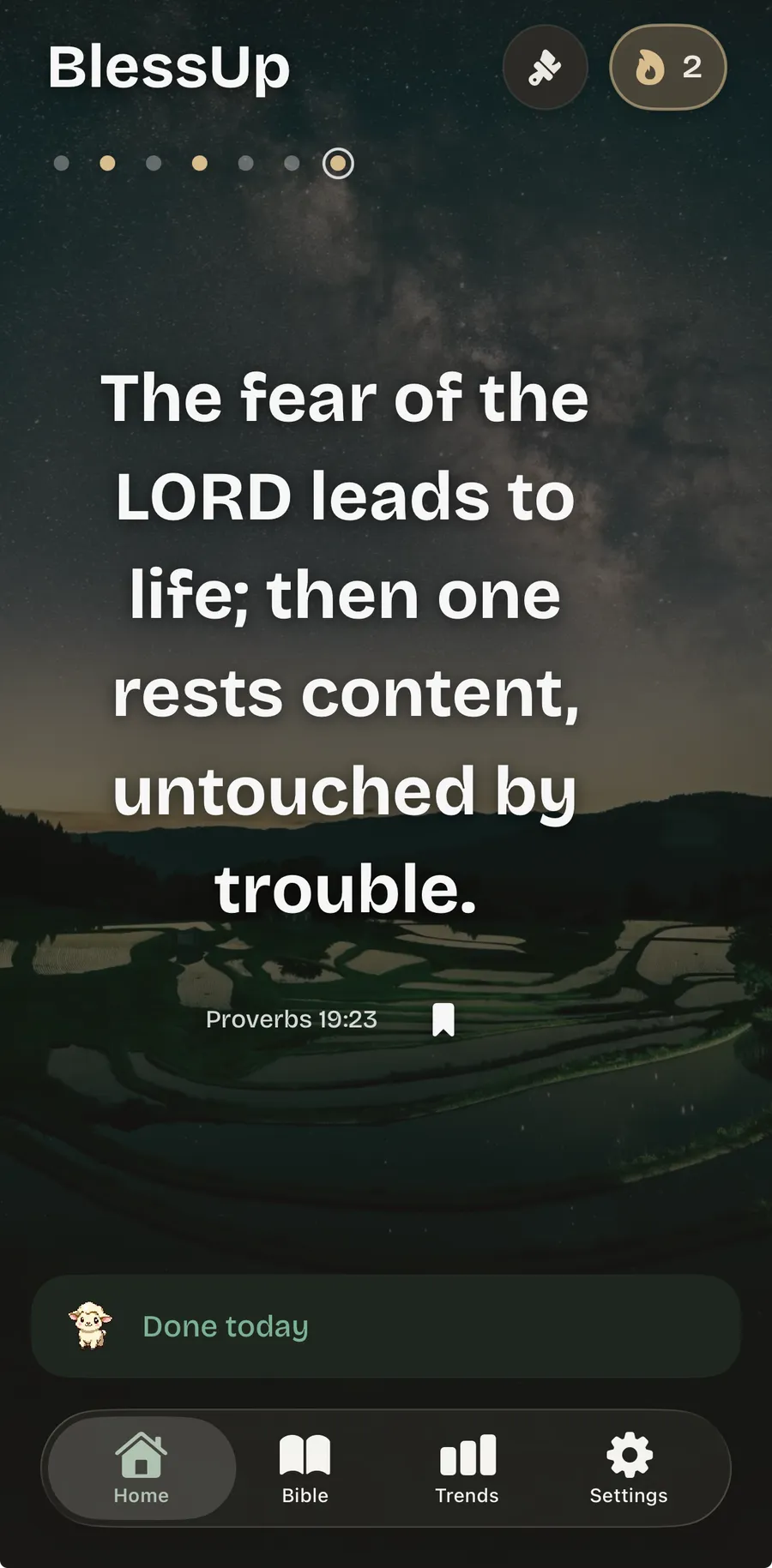
The hard part is rarely finding a verse about fear. It is that at 2am the phone is closer than the Bible, and twenty minutes of the feed is not what anybody wanted at 2am. BlessUp shields the apps you choose behind the day’s reading, so the thing within reach is Scripture rather than the scroll. There is no pressure to feel better first, and no streak to protect. BlessUp is on the App Store.
Six more, with what each is actually for
Different fears want different passages. Matching them is more useful than a list.
- Fear that will not stop talking: Philippians 4:6–7. Note that the peace promised is explicitly said to pass understanding — it is not the feeling of having worked the problem out.
- Fear of what people can do to you: Psalm 56:3–4. “When I am afraid, I put my trust in you” concedes the fear rather than denying it.
- Fear of the future: Matthew 6:34. The instruction is about scope, not optimism.
- Fear that has gone physical: Psalm 94:19, on consolation arriving in the middle of anxiety rather than after it.
- Fear of dying, or of losing someone: Romans 8:38–39. The list is deliberately exhaustive.
- Fear you cannot name: 1 Peter 5:7. Casting does not require a diagnosis first.
Read the surrounding paragraph in each case, not the verse alone. A verse pulled out of its situation is a slogan; the same verse with three sentences either side of it is a person being spoken to. Twelve passages about anxiety, read honestly works through the same discipline on the neighbouring subject.
What this is, and what it is not
Fear is a normal human response and much of it is information. Scripture treats it that way, which is why so many of these passages are addressed to people whose circumstances genuinely warranted it.
It is also worth saying plainly: persistent, disabling anxiety is a medical matter, and a verse is not a treatment plan. Reading Scripture and seeing a doctor are not competing options. If fear is interfering with sleep, work or relationships, talk to a professional, and talk to your pastor or parish — we build software, and neither of those roles is ours.
What a daily reading habit does offer is repetition, which is how any of this stops being an emergency measure. A passage you have read forty times is available at 2am in a way that a passage you searched for is not. Building a morning routine that sticks covers the mechanics of the daily part, where to start reading the Bible covers what to read around it, and the BlessUp FAQ answers the practical questions about saving verses.
Frequently asked questions
Does the Bible really say do not be afraid 365 times?
No. The claim is popular but does not survive counting. The Jesuit biblical scholar Felix Just puts fear not and its close equivalents at slightly more than 100 times in the Old Testament and about 44 times in the New, roughly 145 in total. Counts vary by a few dozen depending on which Hebrew and Greek synonyms are included, and none of them land on 365.
What is the best Bible verse for fear?
Isaiah 41:10 is the one most often reached for, because it states the reason as well as the command: do not fear, for I am with you. Psalm 23:4, Joshua 1:9 and 2 Timothy 1:7 do the same thing in different circumstances. Which one helps depends on the fear, so it is worth reading a few in context rather than memorising one.
What is the difference between fear of the Lord and being afraid?
They translate different ideas that English collapses into one word. Fear of the Lord means awe or reverence, the recognition that you are small and God is not, which Proverbs 9:10 calls the beginning of wisdom. Being afraid is dread of circumstances, which is the thing Scripture repeatedly answers with a promise of presence.
How do I use Bible verses about fear when I am anxious at night?
Read the surrounding paragraph rather than the verse alone, so it reads as someone being spoken to rather than a slogan. The larger help is repetition: a passage you have read many times is available at 2am in a way a passage you searched for is not, which is an argument for a small daily reading habit rather than an emergency one.
Is anxiety a sin according to the Bible?
The passages that address fear are addressed to people whose circumstances genuinely warranted it, and they answer with presence rather than rebuke. We build software rather than offer pastoral counsel, so that question belongs with your pastor or parish. Persistent, disabling anxiety is also a medical matter and worth taking to a doctor.
Genesis to Revelation, about nine minutes at a time. Start whenever you are ready.
No guilt. Ever. Grace is built in. Funded by readers, never by ads.