Where to Read the Christmas Story in the Bible
By Dom · · 11 min read
Every December someone asks where the Christmas story actually is, and the honest answer is that it is in more places than most people expect. There is no single chapter called The Christmas Story. There are twelve passages across three books, and the order they are printed in is not the order the events happen.
So here is the whole thing, laid out in sequence, with how long each piece takes to read. The complete account runs about seventeen minutes.
Key takeaways
- Luke 2:1–20 is the passage people mean. Twenty verses, 387 words, under two minutes to read aloud.
- The complete story is 186 verses across Matthew, Luke and John — 3,733 words, about 17 minutes end to end.
- Matthew and Luke are not two versions of one scene. Matthew follows Joseph and the magi; Luke follows Mary and the shepherds.
- The magi are not at the manger. Matthew 2:11 has them entering a house, and Herod’s response points to a child up to two years old.
- “No room at the inn” is likely “no guest room.” The Greek word Luke uses, kataluma, is translated “guest room” everywhere else in the New Testament.
The short answer: Luke 2
If someone hands you a Bible on Christmas Eve and asks you to read the Christmas story out loud, turn to Luke 2:1–20. That is the passage almost everyone means. Twenty verses, under two minutes, and it contains the census, the birth, the manger, the shepherds and the angels.
But Luke 2 is one movement in a longer piece. The full account of Jesus’ birth is spread across three books, and the parts that are missing from Luke are the parts most people cannot place: Joseph’s side of it, the magi, Herod, the flight into Egypt, and the strange cosmic overture in John that never mentions a stable at all.
The whole Christmas story, in the order it happened
Here is every passage, arranged as the events unfold rather than as the books are bound. The word counts are from the World English Bible, and the times use 220 words per minute, a normal reading pace.
| Passage | What happens | Verses | Words | Time |
|---|---|---|---|---|
| Luke 1:1–25 | Gabriel comes to Zechariah | 25 | 541 | 2.5 min |
| Luke 1:26–38 | Gabriel comes to Mary | 13 | 271 | 1.2 min |
| Luke 1:39–56 | Mary visits Elizabeth; the Magnificat | 18 | 275 | 1.3 min |
| Luke 1:57–80 | John is born; Zechariah’s song | 24 | 404 | 1.8 min |
| Matthew 1:1–17 | The genealogy | 17 | 330 | 1.5 min |
| Matthew 1:18–25 | Joseph’s dream | 8 | 208 | 0.9 min |
| Luke 2:1–7 | The birth | 7 | 132 | 0.6 min |
| Luke 2:8–20 | The shepherds and the angels | 13 | 255 | 1.2 min |
| Luke 2:21–40 | Simeon and Anna in the temple | 20 | 433 | 2.0 min |
| Matthew 2:1–12 | The magi | 12 | 271 | 1.2 min |
| Matthew 2:13–23 | Egypt, Herod, and Nazareth | 11 | 309 | 1.4 min |
| John 1:1–18 | The Word became flesh | 18 | 304 | 1.4 min |
| All of it | Annunciation to Nazareth | 186 | 3,733 | 17 min |
Seventeen minutes. That is the entire Christmas story, every scene, start to finish — shorter than the drive to a Christmas Eve service. Most people have never read it that way, not because it is long but because nobody ever handed them the order.
Why there are two accounts, and why they look so different
Matthew and Luke are not two takes on the same scene. They start in different places and follow different people, which is why the details you remember from one are missing from the other.
Matthew follows Joseph. The genealogy runs through Joseph’s legal line. The angel appears to Joseph, in a dream, and appears to him three more times. The threat is Herod, the destination is Egypt, and the visitors are foreign scholars. Matthew is writing to readers who want to know how this child fits Israel’s promises.
Luke follows Mary. The angel appears to Mary, awake, and the account keeps returning to what she is thinking — she is troubled, she ponders, she treasures things in her heart. The visitors are shepherds, the lowest-status witnesses available. Luke opens with a note to Theophilus explaining that he has investigated everything carefully, and he alone gives the political dating: a census, Quirinius, Caesar Augustus.
John does something else entirely. John 1:1–18 is the third Christmas passage, and it has no stable, no shepherds, no star. It starts before the beginning and arrives at the birth in a single sentence: “The Word became flesh and made his dwelling among us” (NIV). Read after Luke 2, it lands like the last line of a story you thought you already knew.
Three things the passage says that the pageant does not
The magi are not at the manger
Every nativity set puts the wise men beside the shepherds. Matthew does not. In Matthew 2:11 the magi come into a house, not a stable, and Matthew calls Jesus a child rather than a newborn. Herod’s later order targets boys two years old and under, based on the timing he got from the magi themselves. The visit is a separate scene, some months or more after the night the shepherds came.
Matthew also never says how many magi there were. The number three comes from the three gifts.
There may be no inn, and no innkeeper
The innkeeper who turns the couple away is one of the best-loved characters in the Christmas pageant, and he is not in the text. Luke never mentions him. The question is what Luke meant by the word usually translated “inn.”
The Greek word in Luke 2:7 is kataluma. As David Croteau, professor of New Testament and Greek at Columbia International University, notes in a piece for Lifeway Research, the same word is translated “guest room” everywhere else it appears in the New Testament — including the upper room of the Last Supper. The scholar Kenneth Bailey, writing in Bible and Spade, points out that when Luke does mean a commercial inn, as in the parable of the Good Samaritan, he uses a completely different word, pandocheion.
Read that way, the picture changes. A village family’s guest room was already full, so the couple stayed in the main room of the house, where the animals were brought in at night and where a feeding trough would have been. Not a rejection. A crowded house that made room. The NIV renders it “there was no guest room available for them.”
This is a translation question, not a settled fact, and faithful readers land in different places on it. It is worth knowing that the innkeeper is an inference rather than a character.
There are four songs in Luke
Luke 1 and 2 contain four poems that the church has sung for centuries: Mary’s Magnificat (1:46–55), Zechariah’s Benedictus (1:68–79), the angels’ Gloria (2:14) and Simeon’s Nunc Dimittis (2:29–32). If you have ever wondered why the Christmas story feels musical, that is why. It was built that way. If you want them pulled out on their own, the Christmas verses laid out in order collects the lines people actually quote.
Most people do not skip the Christmas story on purpose. They mean to read it, they are not sure where it starts, and by the time they have found it the evening is gone. That is a findability problem, not a discipline problem. BlessUp puts each day’s reading in front of you already chosen, so there is no deciding and no searching — and reading it is what opens everything else on your phone. See how the day’s reading works.
Four ways to read it this December
Pick whichever fits the shape of your month. None of them require a plan you have to keep up with.
- One sitting, 17 minutes. The whole table above, top to bottom, on a quiet evening. This is the version most worth doing once in your life.
- Four evenings. Split it at the natural seams: the announcements (Luke 1), Joseph and the birth (Matthew 1, Luke 2:1–20), the temple and the magi (Luke 2:21–40, Matthew 2), and John 1. Roughly four minutes each.
- Across Advent. One passage every few days through December, finishing with John 1 on Christmas morning. If you want the season’s shape first, what Advent actually marks is the short version, and an Advent reading plan for 2026 lays out the dates.
- Out loud, Christmas morning. Luke 2:1–20 before anything is opened. Under two minutes, and it is the oldest Christmas tradition there is.
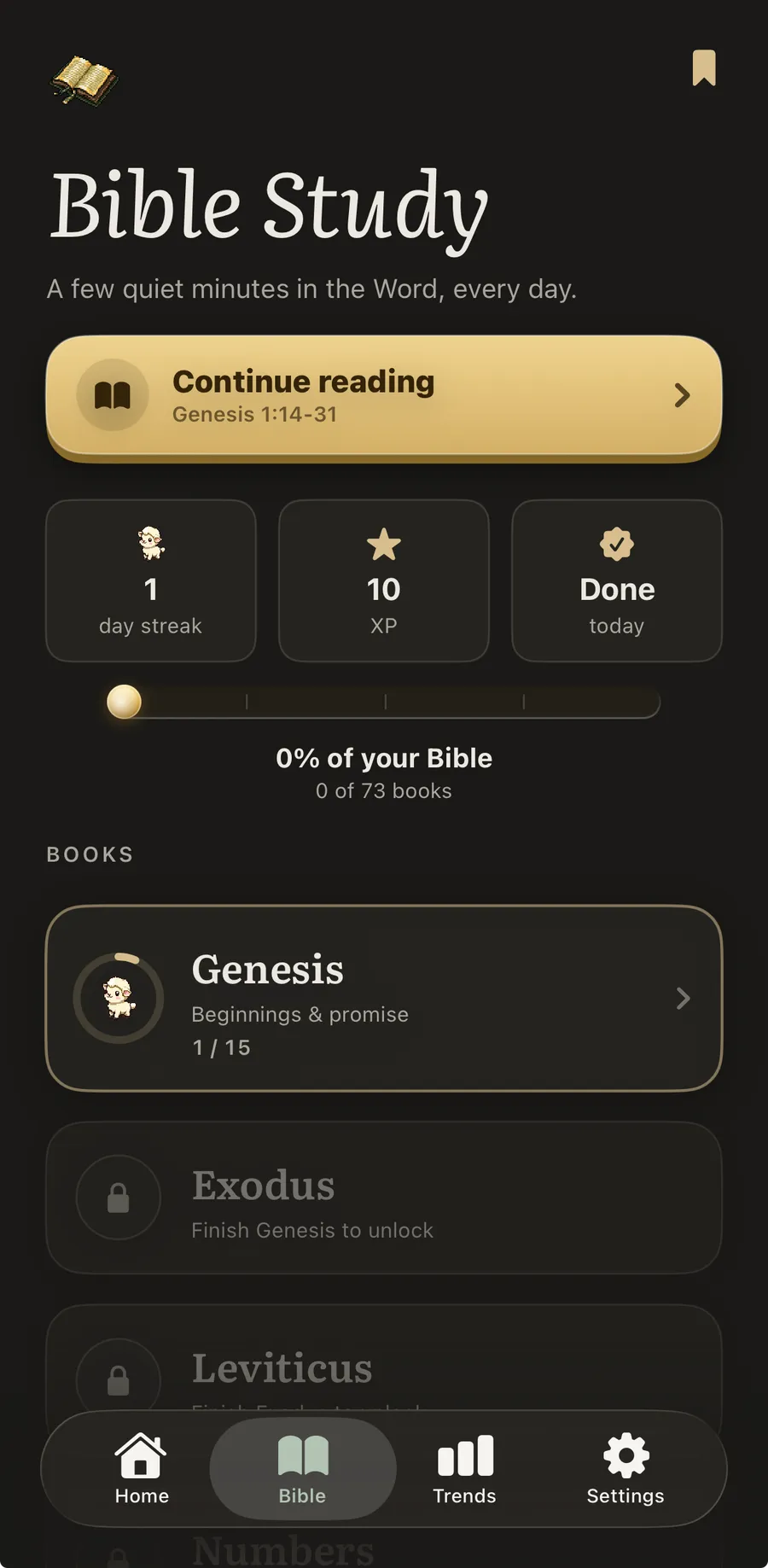
If you want to keep reading after the 25th, there is one chapter for each of the twelve days of Christmas, about three minutes a day.
Which translation to read it in
For reading aloud, the older cadences carry better — the King James and the NKJV were written for the ear. For understanding on a first pass, the NIV or the NABRE are plainer. The Christmas passages are not textually contested, so any mainstream translation gives you the same story.
One thing worth knowing: Catholic and Orthodox Bibles contain books the Protestant canon does not, though none of them touch the nativity accounts. If that difference is new to you, the Protestant, Catholic and Orthodox canons compared walks through what is actually different. On questions of interpretation rather than translation, your pastor or priest is a better guide than any website, including this one.
Why it is worth reading rather than absorbing
Christmas is almost universal in America and increasingly not religious. Gallup found in a December 2024 poll of 1,016 US adults that 88% celebrate Christmas, while attendance at a Christmas Eve or Christmas Day service has fallen to 47%, seventeen percentage points below where it stood in 2010. Exchanging gifts, at 96%, is now the most common Christmas tradition by a wide margin.
Most people, in other words, know the Christmas story the way they know a song lyric: absorbed from the air, never actually read. The American Bible Society’s State of the Bible 2025, based on 2,656 interviews conducted by NORC at the University of Chicago between January 2 and 21, 2025, put the share of US adults who use the Bible outside church at least three times a year at 41%.
Seventeen minutes closes most of that gap for this one story. And the text is stranger and better than the pageant — a teenage girl’s song about thrones being toppled, a father who cannot speak for nine months, a foreign delegation following an astronomical sign, an old man in a temple who says he can die now. It rewards being read. If you want a wider entry point after Christmas, where to start reading the Bible covers the usual first books, and our FAQ answers the practical questions about reading daily.
Frequently asked questions
Where is the Christmas story in the Bible?
The main account is Luke 2:1-20, which contains the census, the birth, the manger, the shepherds and the angels. The full story also includes Luke 1, Matthew 1:18-25, Matthew 2 and John 1:1-18.
Is the Christmas story in all four Gospels?
No. Matthew and Luke give narrative birth accounts, John gives a theological prologue in John 1:1-18, and Mark has no birth account at all, opening instead with John the Baptist and Jesus as an adult.
How long does it take to read the whole Christmas story?
About 17 minutes. The twelve passages that make up the complete account run 186 verses and roughly 3,733 words, which is about 17 minutes at a normal reading pace of 220 words per minute.
Were the wise men at the manger?
Not according to Matthew. In Matthew 2:11 the magi enter a house and find the child, and Herod later targets boys two years old and under based on the timing the magi gave him. The visit happened some time after the night the shepherds came.
Was Jesus born in a stable?
Luke says only that Mary laid him in a manger because there was no room in the kataluma. Since kataluma means guest room everywhere else in the New Testament, many scholars think the family was staying in the main room of a village house, where animals were kept at night, rather than in a separate stable.
Small daily readings, cover to cover. That is the whole plan.
No guilt. Ever. Grace is built in. Funded by readers, never by ads.