Read the Bible in a Year: Make the January Start Stick
By Dom · · 11 min read
It is the second week of January. The plan is on the fridge, the app is installed, and you are four days behind after one late night and a head cold. Today’s reading says Genesis 27. The readings you missed say Genesis 20 through 26. The arithmetic of catching up is the reason you will not open it tonight, and it is the reason you may not open it again in March either.
Nothing has gone wrong. This is simply the week in which most one-year plans are settled, and they are settled by how the plan was built rather than by how much you wanted it.
Key takeaways
- January 1 is the peak, and the fall starts within days. Bible Gateway told Christianity Today that reading-plan traffic dropped 30 percent a week after January 1, by a third by the end of February, and by nearly half by the end of May.
- About nine minutes a day covers the Protestant canon in a year: 724,811 words across 365 days at a normal reading pace. The Catholic and Orthodox canons come to 10.3 and 10.9 minutes.
- The wall has a name, and it is Leviticus. At 1,189 chapters over 365 days, a straight-through plan opens the sacrificial law about four weeks in.
- One missed day is not what ends a plan. In the habit study most often quoted on this, missing a single opportunity did not materially affect habit formation. The backlog is what ends it.
- The start date is the least important decision. A plan begun in February at a pace you can keep will finish ahead of one begun on January 1 at a pace you cannot.
What actually happens after January 1
The scale of the January intention is real. Writing in Christianity Today in December 2025, Elissa Yukiko Gerhardt reported that on January 1 of 2024 alone, more than three million people subscribed to a one-year Bible reading plan on YouVersion. That is one platform, on one day.
What happens next is harder to find, because most providers do not publish it. One did. In 2014, Bible Gateway shared its reading-plan figures with Christianity Today, and Stephen Smith, then an internet systems architect there, described the shape plainly: January 1 was the peak day for starting plans, but traffic dropped 30 percent only a week later. By the end of February, plan traffic was down by a third against January’s levels; by the end of May, by nearly half.
If you are reading this in February with a gap already open, how to catch up on a Bible-in-a-year plan turns the days into minutes.
Two caveats worth stating, because they are usually left off. That is traffic on one website, and it is from 2014. It measures visits, not hearts, and a reader who moves to a paper Bible in week three counts as a loss. Still, it is the clearest public picture anyone has published of what a January cohort does, and the shape of it matches what churches see.
Lifeway Research put the same question to readers rather than to servers. In January 2026, Dawn Sherill-Porter listed five challenges that stop people finishing a plan, and the first is the one nobody plans for: life gets busy. The others are familiarity, the sheer size of the book, a sense that it does not touch modern life, and plain reading difficulty.
None of those is a motivation problem. They are all design problems, and design problems have fixes.
What a year of reading actually costs
Most published estimates put a year of Bible reading somewhere between twelve and twenty minutes a day. Those numbers come from rounding chapters rather than counting words, and they are high enough to talk people out of starting. The arithmetic behind a year of Bible reading is worth doing once, properly, because the honest figure is smaller than the reputation.
| Canon | Total words | Words per day | Minutes per day |
|---|---|---|---|
| Protestant | 724,811 | 1,986 | 9.0 |
| Catholic | 828,590 | 2,270 | 10.3 |
| Orthodox | 879,155 | 2,409 | 10.9 |
Nine minutes is roughly a podcast advert break. It is not the obstacle, and treating it as one is how a plan gets abandoned for reasons that were never about time. Which canon you are reading matters more than most plans admit, and the differences between the Protestant, Catholic and Orthodox canons change the total by more than a hundred thousand words.
Why February is the wall
Here is arithmetic anyone can check. The Protestant canon runs to 1,189 chapters. Spread evenly across 365 days that is about 3.3 chapters a day. Genesis and Exodus together are 90 chapters. So a plan that reads straight through in canonical order opens Leviticus somewhere around day 28 — the last days of January, or the first fortnight of February if your plan divides by length rather than by chapter, since Genesis has long chapters.
It is also the month most New Year resolutions fade; spiritual goals that survive February lays the two curves side by side.
Leviticus is not a hard book because it is badly written. It is hard because it is a priestly manual: sacrifices catalogued by type, purity law, ritual procedure, repeated with the precision the subject demands. Read four weeks into a plan you started for encouragement, it lands as a wall. This is the single most commonly named place where readers stop, and it arrives at exactly the moment New Year momentum has run out.
The second thing that happens in February is worse, because it is invisible. You miss a Tuesday. Now you owe three chapters. You miss the weekend and you owe ten. At some point the debt is larger than the appetite, and the plan stops being a gift and starts being an invoice. Gerhardt’s piece for Christianity Today makes the same case from the other side, arguing that a year plan should be built for endurance rather than speed, starting small and reading in company rather than covering ground.
Pick the plan shape before you pick the date
“Read the Bible in a year” describes a dozen genuinely different structures, and the one you choose decides what you hit first and what a missed day costs you. Ligonier Ministries publishes a list of the main plan shapes every year, and it is the clearest inventory available.
| Shape | What the order puts first | Suits |
|---|---|---|
| Straight through, Genesis to Revelation | Leviticus at about week four | Readers who want the shape of the book itself |
| Chronological | Job folded into the Genesis narrative | Readers who want the story in sequence |
| Book at a time, one Old and one New Testament reading daily | No single wall; a Gospel runs alongside the law | Readers who have abandoned a straight-through plan before |
| A genre for each weekday (the 52-week plan) | Law on one day, Psalms on another, Gospels on another | Readers who stall from boredom rather than difficulty |
| M’Cheyne | Four readings a day, the New Testament and Psalms twice over | Readers who already have a settled daily habit |
If you have quit a straight-through plan before, do not choose it again out of loyalty to the idea. The paired Old and New Testament shape exists precisely because Leviticus in isolation defeats people, and a Gospel reading alongside it changes the week entirely. If you are newer to this, a beginner reading plan that starts somewhere other than Genesis 1 is a better first year than a canonical march.
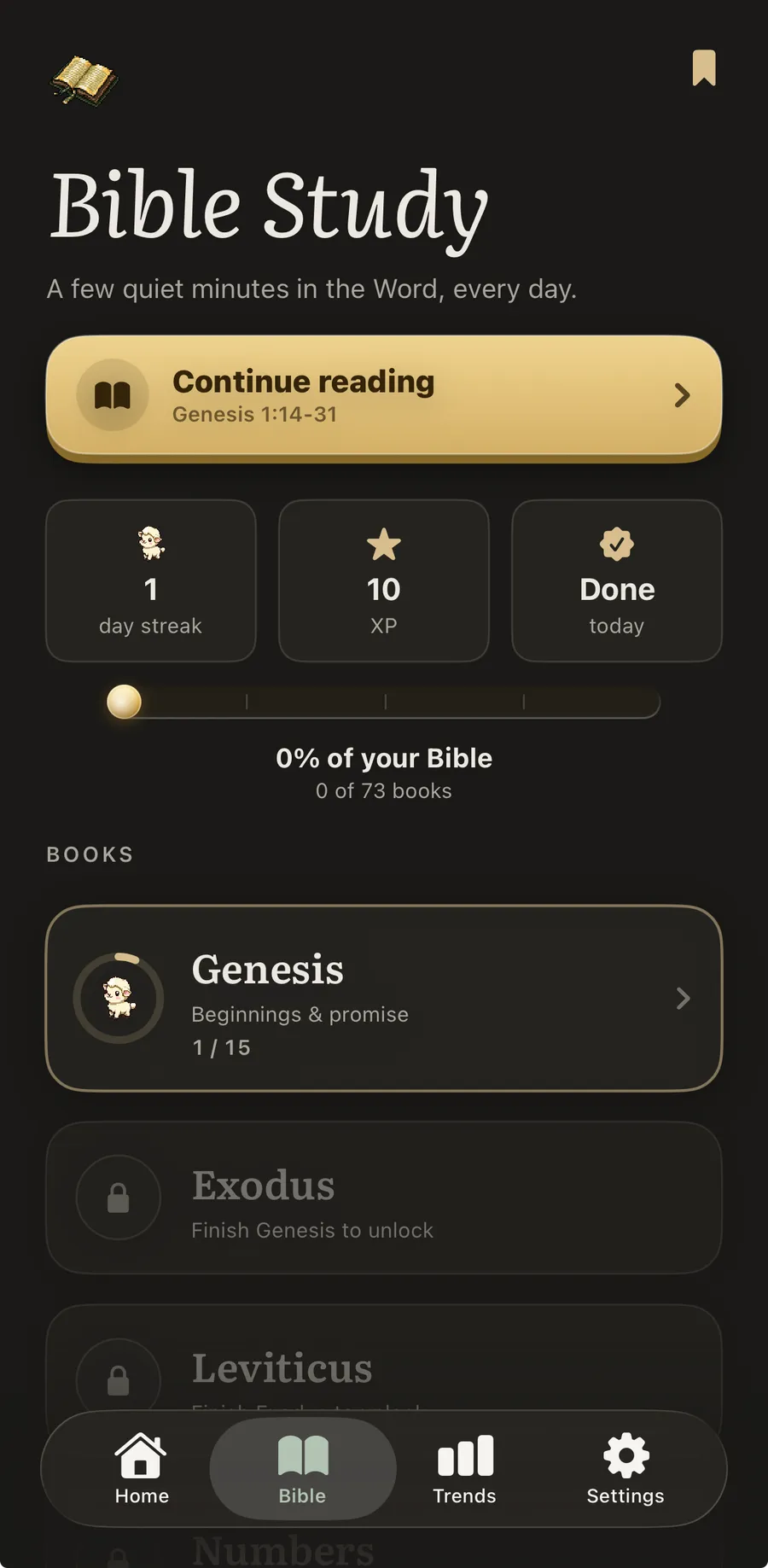
If the part that beats you is the backlog rather than the reading, the fix is a plan that puts one portion in front of you and never shows you the arrears. That is the whole design of BlessUp: the day’s reading is already chosen when you wake up, it runs about nine minutes, and reading it is what opens the apps you shielded. Day one is Genesis 1 to 3, and there is no catching up to do, ever. See how the day’s reading works.
What to do about the days you miss
You will miss days. A plan that assumes otherwise is not a plan, it is a wish. The useful question is what happens on the morning after.
The most careful research on this is still Phillippa Lally and colleagues, who followed 96 volunteers adopting a daily behaviour and rating how automatic it felt over twelve weeks. Two findings matter here. Reaching 95 percent of an individual’s automaticity ceiling took anywhere from 18 to 254 days, so the popular “66 days” is a median hiding an enormous range. And in the authors’ own words, missing one opportunity to perform the behaviour did not materially affect the habit formation process.
That study was about drinking water and doing sit-ups, not Scripture, and it cannot tell you anything about your soul. What it does tell you is that a single gap is not structurally significant, which is the opposite of what a plan with a visible backlog implies.
So the practical rule is short. Do not catch up. Read today’s portion today, leave the gap where it fell, and keep going. If it has been a fortnight rather than a night, the same rule holds — there is more on what to do when you miss a day, and on why streaks that punish a gap make people quit.
You do not have to start in January
The American Bible Society’s State of the Bible 2026, fielded by NORC at the University of Chicago with 2,649 American adults interviewed between January 8 and 27, 2026, found that 17 percent of respondents have read the entire Bible, a third have read all or most of it, and half have read at least half.
Those are not small numbers, and almost none of that reading was done by a cohort that started on January 1 and never missed. It was done in ordinary weeks, in unremarkable months, by people who began when they began. February is a perfectly good month to start. So is a Tuesday in October, which is roughly when next year’s plans start appearing anyway.
If your church begins January with a fast, the Daniel Fast reading plan reads Daniel in 21 days, and a year plan can pick up the day after.
The passage people reach for in this exact spot is in Lamentations, written by someone with far more to grieve than a broken reading plan: “Because of the Lord’s great love we are not consumed, for his compassions never fail. They are new every morning; great is your faithfulness” (Lamentations 3:22–23, NIV). New every morning is a description of mercy, and it is also a fair description of how a reading plan is meant to work. Today’s portion is today’s. Yesterday’s is not owed.
If you are still deciding what to read rather than when, where to start reading the Bible is the more useful question, and our frequently asked questions cover the practical side of setting a daily reading up.
Frequently asked questions
When is the best time to start a Bible-in-a-year plan?
Whenever you will actually keep it. January 1 has the most company and the highest drop-off: Bible Gateway's figures showed plan traffic falling 30 percent within a week of January 1. A plan started in February or June at a pace you can hold on a bad day will finish ahead of a January plan set at a pace you cannot.
How long does it take to read the Bible in a year?
About nine minutes a day for the Protestant canon, which is 724,811 words spread across 365 days at a normal reading pace of around 220 words per minute. The Catholic canon comes to about 10.3 minutes a day and the Orthodox canon to about 10.9.
Why do so many Bible reading plans fail in February?
Two things arrive at once. A straight-through plan reaches Leviticus about four weeks in, which is a priestly manual of sacrifices and purity law rather than narrative. At the same time the first missed days have built into a visible backlog, so the plan starts reading as a debt instead of a gift.
What should I do if I am a week behind my reading plan?
Do not try to catch up. Read today's portion today and leave the gap where it fell. In the habit-formation research, missing a single opportunity did not materially affect the process; it is the accumulated backlog, not the missed day, that ends most plans.
Is it better to read the Bible chronologically or straight through?
Neither is more faithful. Straight through gives you the shape of the book as it was assembled, and puts Leviticus in front of you early. Chronological gives you the sequence of events and folds Job into Genesis. If you have abandoned a straight-through plan before, a plan pairing one Old Testament and one New Testament reading each day tends to hold better.
Every morning, your reading is already waiting. You will never wonder where to start.
No guilt. Ever. Grace is built in. Funded by readers, never by ads.