How to Write a Rule of Life
By Dom · · 13 min read
Someone at church mentioned a rule of life, and it sounded like the thing you have been missing: a shape for the week, decided once, instead of deciding every morning whether today is a day you pray. Then you looked up a template. Half of them read like a monastery timetable and the other half like a productivity planner with verses in the margins.
A rule of life is older and simpler than either. It is a written pattern for how you intend to live, kept where you can see it. Here is how to write a rule of life that is still in use in March, including the line almost every modern rule gets wrong.
Key takeaways
- A rule of life is a trellis, not a cage. It is a written pattern for your week, not a performance standard and not a way to earn anything.
- It is old. The practice traces to the fourth-century monastic movement, and Benedict's sixth-century Rule has shaped Eastern and Western Christians for roughly 1,500 years.
- Tie every line to a cue. Habits are actions triggered by context, so “after breakfast” holds where “more often” does not.
- Write the phone line first. It is the line most modern rules fail on, and the one most worth handing to a setting rather than carrying yourself.
- Review at two months, not two weeks. Of the studies that have timed habit formation, medians landed near 59 and 66 days.
What a rule of life is (a trellis, not a cage)
A rule of life is a short written document describing the practices you intend to keep and roughly when. That is all. It is not a schedule, not a vow, and not a scorecard.
The trellis image is the one that gets used most, and it is worth keeping, because a trellis does not make a plant grow. It gives the growth something to climb, so the thing goes up instead of sideways. Your rule does not produce a spiritual life. It arranges one so that the ordinary demands of a week do not quietly crowd it out.
The distinction that matters most is the one Renovaré makes plainly: a regula vitae is “neither an attempt to prove ourselves to God, nor to impose anything on other people”. That sentence is worth copying at the top of your own page. A rule is a response to grace rather than a way of earning it, and the moment it starts functioning as a measuring stick you are holding it the wrong way round.
It also differs from a resolution in a specific, practical way. A resolution names an outcome and leaves the method blank — read more, pray more, waste less time. A rule names a practice and a place in the week. “Pray more” is a wish. “A psalm after breakfast, before I open anything else” is a rule.
Where it comes from: Benedict to Renovaré
This is not a new idea with an old-sounding name. The Gospel Coalition traces the Rule back to the early monastic movement of the fourth century, with the best-known version written by Benedict in the sixth. TGC describes the Rule of Saint Benedict as having influenced Eastern and Western Christians for roughly 1,500 years; it is worth noting that Eastern monasticism developed its own rules from the same fourth-century movement, looking to Basil the Great rather than to Benedict. Many Reformers and later evangelicals kept similar patterns without using the word.
The modern recovery of it is broad. Writing for Renovaré, Chris Webb builds a rule on the six streams from Richard Foster's Streams of Living Water — contemplative, holiness, charismatic, social justice, evangelical and incarnational — and shows his own rule under those headings, with practices like praying the daily offices, fasting one day a week and reading Scripture daily. Those are his, not a template to copy. The practice is also having a wider moment through Practicing the Way and John Mark Comer's work, which is how many people have encountered it recently. You do not need any particular one of these to write a rule, and this post does not assume one.
Traditions differ on what belongs in a rule, and that is genuinely their business rather than ours. If you are in a church with a view on it, ask your pastor before you ask the internet.

Write it in four steps
Set aside an hour. Use paper, or one page in a notes app you will actually reopen.
- Pick your areas. Four to six, no more. A workable set for most people is God, body, people, work and the phone. You can use the six streams instead if that fits your tradition better. The number matters more than the labels — a rule with eleven areas is a wish list.
- Write one or two practices per area, as positive present-tense sentences. Not “stop skipping church” but “we worship together on Sunday.” Positive because a rule you read every week should describe a life you want, and present tense because you are naming a pattern rather than promising an improvement.
- Attach each practice to a cue. This is the step almost every template leaves out, and it is the one that decides whether the rule survives. More on why below.
- Add a review date two months out. Write the actual date on the page, not a vague intention to revisit it.
Then put it somewhere you will see it weekly. A rule in a drawer is a nice afternoon you spent once.
The line most rules fail on: the phone
Nearly every modern rule has a line about the phone, and it is nearly always the first line to go.
The reason is structural rather than moral. Every other line in your rule is supported by something outside you: Sunday worship has a congregation and a start time, a weekly fast has a day, a walk has daylight. The phone line has none of that. It asks you to decide, alone, in the moment you least want to, several times a day. Written the usual way — “I do not use my phone first thing” — it is a resolution that has wandered into a rule and it will behave like one.
So write it differently. Give it a cue like every other line, make it specific enough to be checkable, and where you can, let something other than willpower hold it:
- Not “I will use my phone less” but “the feed opens after the day's chapter, not before.”
- Not “no phone at night” but “downtime starts at nine, set once in Settings.”
- Not “I am more present with the children” but “the phone is in my bag between five and seven.”
Each second version names a moment or a setting instead of an intention, which is what makes it checkable a month later.
And be careful which mechanism you trust, because not all of them are equal. We have written about why charging the phone in another room keeps failing: it is a rule you re-decide every single night, and re-decided rules drift, usually within a week. That is the distinction worth carrying into your own page. A line held by a setting, a fixed hour or another person will still be there in March; a line held only by your resolve at nine in the evening is the one to write most carefully, or to hand to something else. The longer version of that argument is screen time as a spiritual problem.
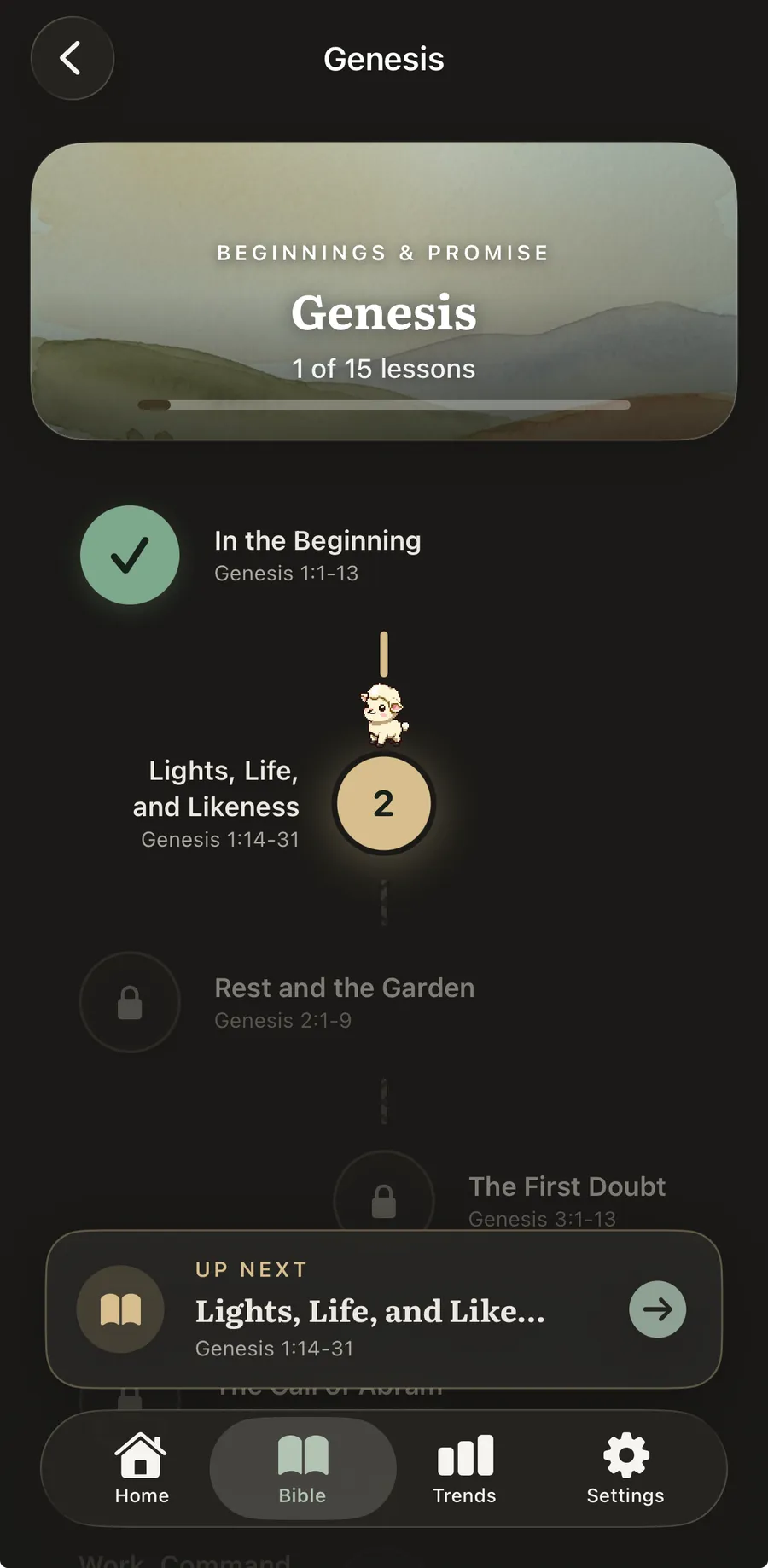
If the phone line is the one you expect to break, it is worth letting the phone keep it rather than carrying it yourself every morning. BlessUp shields the apps you choose until the day's chapter is read — about nine minutes on a year-long plan — and re-locks them at a reset hour you set around your own bedtime. When a day goes wrong, a grace day covers it and nothing resets, which is the part a rule needs most in month two. It is free to download on the App Store.
A rule of life example you can use as a template
Here is a complete rule of life example, written for an invented but ordinary case: a working parent with two school-age children, who wants time in Scripture and keeps losing the evening to the phone. Five areas, one or two practices each, every line tied to a cue. Copy the shape as a template and replace the contents with your own.
| Area | The practice, as written | The cue |
|---|---|---|
| God | I read the day's chapter before I read anything else. | Before the first cup of coffee |
| God | We pray together at the table on Sunday. | Sunday lunch |
| Body | I walk for twenty minutes without headphones. | After the school drop-off |
| People | I call one person I have been meaning to call. | Thursday, on the walk |
| Work | I keep the first hour for the hardest thing. | On sitting down at the desk |
| The phone | The feed opens after the day's chapter, not before. | The first time I unlock the phone |
| The phone | Downtime starts at nine. I set it once. | Nine o'clock, by the phone's own clock |
| Review | I read this page again and change one line. | The date, written here: two months from today |
Notice how short it is. Eight lines is a real rule; it fits on an index card and you can hold the whole thing in your head. Notice too that nothing in it is heroic. A rule made of impressive practices is a rule written for the person you would like to be rather than the one who has to keep it on a Tuesday in February.
Keeping it: cues, review, and grace
Three things decide whether the page survives contact with your actual life.
Cues. In psychology, habits are defined as actions triggered automatically by contextual cues associated with performing them — Gardner, Lally and Wardle give the examples of washing your hands after using the toilet, or putting on a seatbelt after getting into the car. Repeat an action in a consistent context and it eventually fires on the context alone. That is why every line of the example rule names a moment in the day rather than a frequency. “After the kettle goes on” is a cue. “Most mornings” is not.
Review. Two months, not two weeks. A systematic review of 20 studies covering 2,601 adults found that, among the four studies that timed habit formation, the medians landed at 59 and 66 days, with individual times ranging from 4 to 335 days. Those were health behaviours like exercise, diet and flossing rather than devotional practice, so treat it as a rough shape. The shape still tells you that judging a rule in week two is judging it far too early — how long a habit takes goes into this properly.
Grace. This is the one that keeps people from quitting. Gardner, Lally and Wardle report that missing the occasional opportunity to perform a behaviour did not seriously impair habit formation, and that automaticity gains resumed after a single missed performance. A broken day is not a broken rule. Build that in explicitly: write on the page what happens when you miss, so the answer is decided before you need it. We have written about when you miss a day, and about why grace days beat streaks, which is the same argument applied to consistency.
Underneath all of it is a prayer rather than a productivity goal: “Teach us to number our days, that we may gain a heart of wisdom” (Psalm 90:12, NIV). Numbering your days is what a rule does on paper. The heart of wisdom is not something the page can give you, and it is worth keeping those two apart in your mind as you write. If you want to know where this advice is coming from, here is who we are.
Frequently asked questions
What is a rule of life?
A short written pattern for how you intend to live: a few areas of life, a few practices in each, and roughly when they happen. The tradition calls it a regula vitae, and the image most often used is a trellis rather than a cage - it does not make anything grow, it gives growth something to climb. Renovare puts the key limit well: a rule is neither an attempt to prove ourselves to God nor to impose anything on other people.
How is a rule of life different from New Year's resolutions?
A resolution names an outcome and leaves the method blank - read more, pray more, waste less time. A rule names a practice and where it sits in the week, which is why it survives longer. The other difference is posture: a resolution is usually about becoming someone better by your own effort, while a rule is meant as a response to grace rather than a way of earning it. Practically, the test is whether each line has a moment attached to it.
What should be included in a rule of life?
Four to six areas, and one or two practices in each, written as positive present-tense sentences. A workable set is God, body, people, work and the phone; Renovare's version instead uses the six streams from Richard Foster's Streams of Living Water. Include one line about the phone, because it is the line most modern rules fail on, and include a review date. Keep the whole thing short enough to fit on an index card.
How often should you review your rule of life?
About every two months at first, with the date written on the page. A systematic review of 20 studies covering 2,601 adults found that among the four studies that timed habit formation, medians landed at 59 and 66 days, with individual times ranging from 4 to 335. Those were health behaviours rather than devotional ones, so it is a rough guide, but it means a rule judged in week two is being judged far too early. Once the practices are settled, twice a year is plenty.
Is a rule of life biblical?
There is no passage that prescribes writing one, so it is a practice the church developed rather than a command Scripture gives. What Scripture does carry is the instinct behind it - Psalm 90:12 asks God to teach us to number our days, that we may gain a heart of wisdom. Christians across traditions have kept rules for roughly 1,500 years, and traditions differ on what belongs in them. For whether and how it fits your own church, your pastor is the right person to ask.
Small daily readings, cover to cover. That is the whole plan.
No guilt. Ever. Grace is built in. Funded by readers, never by ads.