How to Pray the Rosary
By Dom · · 12 min read
The beads were your grandmother’s, or they came in a small pouch at your Confirmation, and they have been in a drawer since. You remember the Our Father and most of the Hail Mary. What you do not remember is the order, which mysteries go with which day, or what you are meant to be thinking about for ten Hail Marys in a row.
This guide lays it out bead by bead. It also does one thing most guides leave out: it sends you to the page of the Bible each mystery comes from, with how long that passage takes to read.
Key takeaways
- Five decades in order: the Apostles’ Creed, one Our Father, three Hail Marys and a Glory Be, then five sets of one Our Father, ten Hail Marys and a Glory Be, and the Hail, Holy Queen to close.
- The days: Joyful on Monday and Saturday, Sorrowful on Tuesday and Friday, Glorious on Wednesday and Sunday, Luminous on Thursday.
- Eighteen of the twenty mysteries are scenes narrated in the Gospels or Acts. Most take about a minute to read, and all twenty passages together take about 17 minutes.
- To meditate, read the scene first. John Paul II recommended following the announcement of each mystery with a Bible passage and a short silence.
- One decade is a real prayer. One Our Father, ten Hail Marys and a Glory Be on a single mystery takes a few minutes.
What the Rosary is, in one paragraph
The Rosary is a Catholic prayer said on a loop of beads. You repeat a small number of familiar prayers while you hold one event from the life of Jesus in your mind. Those events are called mysteries, and there are twenty of them in four sets of five. The US bishops call it a Scripture-based prayer, and say its repetition is meant to lead you into restful, contemplative prayer on each mystery. Pope John Paul II, in his 2002 letter Rosarium Virginis Mariae, wrote that the Rosary, though clearly Marian in character, is at heart a prayer centred on Christ, and that it holds the depth of the whole Gospel message, “of which it can be said to be a compendium.”
It is also widely prayed. In a Pew Research Center survey of US Catholics published in June 2025, 37% of Hispanic Catholics and 22% of White Catholics said they pray the rosary at least monthly. If you are coming back to it, you are joining a great many people.
The prayers on the beads, in order
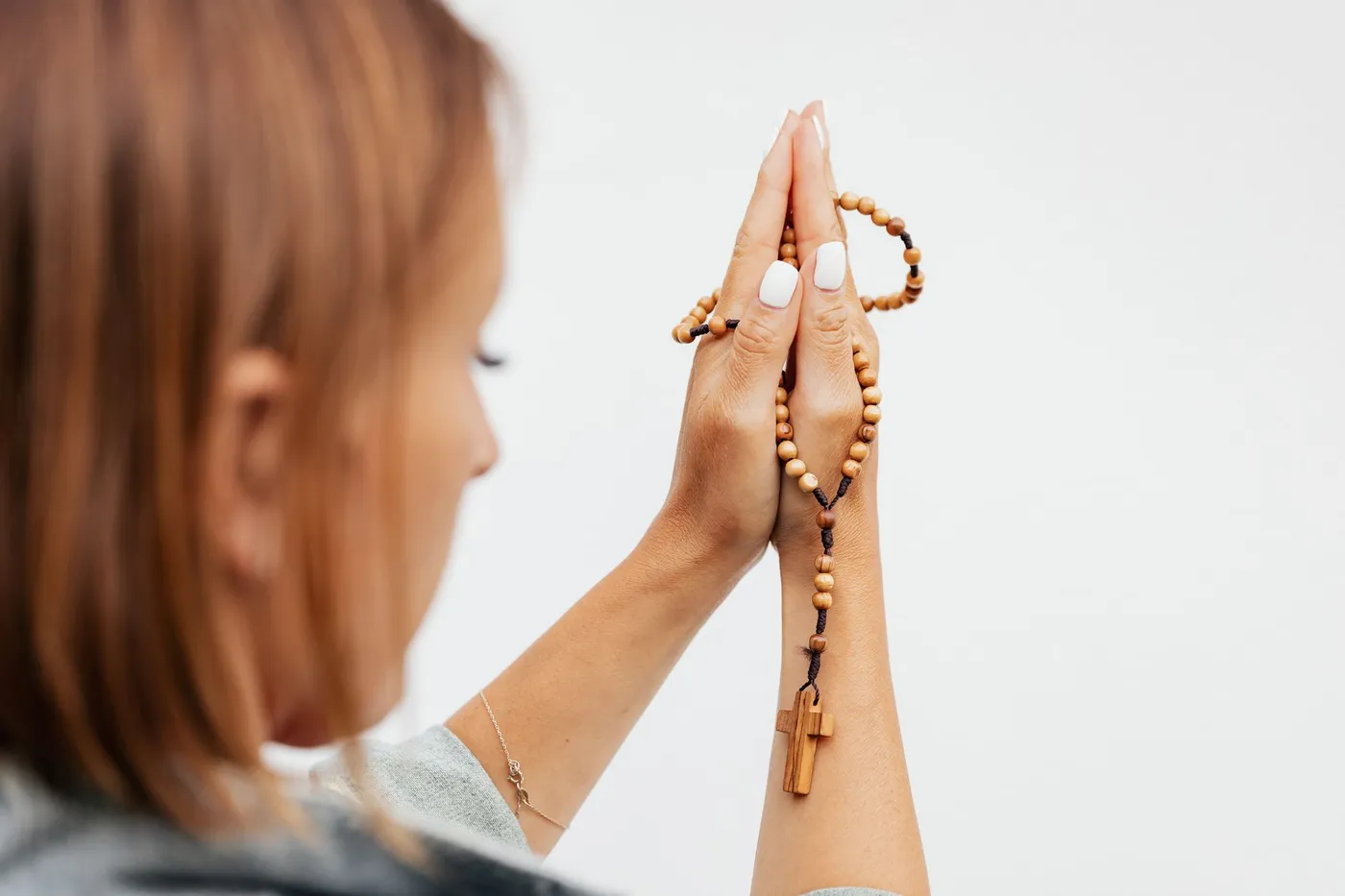
A rosary has a crucifix, a short tail of five beads, and a loop of five groups of ten beads, called decades, with a single bead between each group. This is the order the US bishops give:
- Make the Sign of the Cross.
- Holding the crucifix, say the Apostles’ Creed.
- On the first bead, say an Our Father.
- On each of the next three beads, say a Hail Mary.
- Say the Glory Be.
- For each of the five decades: announce the mystery, then say an Our Father on the single bead. On each of the ten beads say a Hail Mary while you think about the mystery. Finish the decade with a Glory Be. Some people add the short Fatima prayer here (“O my Jesus, forgive us our sins…”).
- After the fifth decade, say the Hail, Holy Queen and the closing prayer.
- End with the Sign of the Cross.
Counted up, that is one Creed, six Our Fathers, fifty-three Hail Marys and six Glory Bes. The USCCB guide links the full text of each prayer if any of them have slipped.
The Hail Mary itself begins in Scripture. Its first line is the angel Gabriel’s greeting, “Hail, favored one! The Lord is with you,” and its second is Elizabeth’s, “Most blessed are you among women, and blessed is the fruit of your womb” (Luke 1:28 and 1:42, NABRE). The US bishops note that the second half of the prayer was officially added by St. Pius V.
The four sets of mysteries and their days
You pray one set of five mysteries at a sitting. The US bishops give this as the traditional pattern:
- Joyful Mysteries (the birth and childhood of Jesus): Mondays and Saturdays, and Sundays in Advent.
- Sorrowful Mysteries (His Passion and death): Tuesdays and Fridays, and Sundays in Lent.
- Glorious Mysteries (the Resurrection and what followed): Wednesdays, and Sundays outside Advent and Lent.
- Luminous Mysteries (His public ministry): Thursdays.
The Luminous Mysteries are the newest. John Paul II proposed them in 2002 as “mysteries of light,” so that the Rosary would also cover the years between Jesus’ childhood and His Passion. In the same letter he suggested moving the second Joyful day to Saturday so that Thursday was free for them.
The days are a custom, not a rule. If it is Tuesday and you want to pray the Nativity, pray the Nativity.
The twenty mysteries and the chapters they come from
Here is the part that makes the Rosary easier. Almost every mystery is a short scene you can read. If you have read it, even once, you have something to picture while your fingers move.
| Mystery | Passage (NABRE) | About | Reading time |
|---|---|---|---|
| Joyful (Monday, Saturday) | |||
| The Annunciation | Luke 1:26-38 | 270 words | 1.2 min |
| The Visitation | Luke 1:39-56 | 270 words | 1.2 min |
| The Nativity | Luke 2:1-20 | 400 words | 1.8 min |
| The Presentation in the Temple | Luke 2:22-38 | 350 words | 1.6 min |
| The Finding in the Temple | Luke 2:41-52 | 220 words | 1.0 min |
| Luminous (Thursday) | |||
| The Baptism in the Jordan | Matthew 3:13-17 | 110 words | 0.5 min |
| The Wedding Feast at Cana | John 2:1-11 | 210 words | 1.0 min |
| The Proclamation of the Kingdom | Mark 1:14-15 | 40 words | 0.2 min |
| The Transfiguration | Matthew 17:1-8 | 160 words | 0.7 min |
| The Institution of the Eucharist | Matthew 26:26-29 | 100 words | 0.4 min |
| Sorrowful (Tuesday, Friday) | |||
| The Agony in the Garden | Luke 22:39-46 | 140 words | 0.6 min |
| The Scourging at the Pillar | John 19:1 | One verse | A few seconds |
| The Crowning with Thorns | Matthew 27:27-31 | 100 words | 0.5 min |
| The Carrying of the Cross | Luke 23:26-32 | 150 words | 0.7 min |
| The Crucifixion and Death | Luke 23:33-46 | 270 words | 1.2 min |
| Glorious (Wednesday, Sunday) | |||
| The Resurrection | Luke 24:1-12 | 210 words | 1.0 min |
| The Ascension | Acts 1:6-11 | 160 words | 0.7 min |
| The Descent of the Holy Spirit | Acts 2:1-13 | 230 words | 1.0 min |
| The Assumption | Luke 1:46-55* | 130 words | 0.6 min |
| The Coronation of Mary | Revelation 12:1-6* | 160 words | 0.7 min |
| All twenty | About 3,700 words | About 17 min | |
*A plain note on the last two. Eighteen of the mysteries are events the Gospels or Acts narrate directly. The Assumption and the Coronation of Mary are not narrated as events in Scripture; they come from Catholic tradition. The US bishops’ guide pairs them with lines from Mary’s own song in Luke 1 and from Revelation 12, so those are the passages given here.
Notice how short these are. A whole set of five takes between three and seven minutes to read. The Catholic Bible also includes books that Protestant editions do not; if you are unsure which Bible you have, see how Protestant, Catholic and Orthodox Bibles differ. Every passage above is in all of them.
How to actually meditate during ten Hail Marys
This is the question people are shy to ask. Are you supposed to think about the words of the Hail Mary, or about the mystery? The answer in Catholic teaching is the mystery. The Hail Marys are the steady background, and the scene is what you look at.
John Paul II gave practical advice on this in Rosarium Virginis Mariae, and it comes down to three small habits.
- Read the passage first. He wrote that it is helpful to follow the announcement of the mystery with a related Biblical passage, “long or short, depending on the circumstances.” This is where the table earns its place. Before the first Sorrowful decade, read the eight verses of the Agony in the Garden. Now you have a place, a night, and a sentence to hold: “Father, if you are willing, take this cup away from me; still, not my will but yours be done” (Luke 22:42, NABRE).
- Pause. He recommends a short silence after the reading, before the vocal prayers begin, to let the scene settle.
- Lean on the name of Jesus. He calls the name of Jesus the “centre of gravity” of the Hail Mary, the hinge between its two halves. When your mind drifts, that word in each Hail Mary is the place to come back to.
Your mind will wander anyway. That happens to everyone who prays, with beads or without, and it is not a sign you are doing it wrong. Our guide on how to focus when you pray covers what helps, and the short version is the same here: notice, and return to the scene.
The slow rhythm helps too, and there is a small study on it. In 2001, researchers in Italy reported in the BMJ that when 23 healthy adults recited the Ave Maria in Latin, their breathing slowed to almost exactly six breaths a minute, from about fourteen at rest. That is a physical observation from a small group, not a spiritual claim and not medical advice. But it matches what people who pray the Rosary often say: the pace itself is calming.
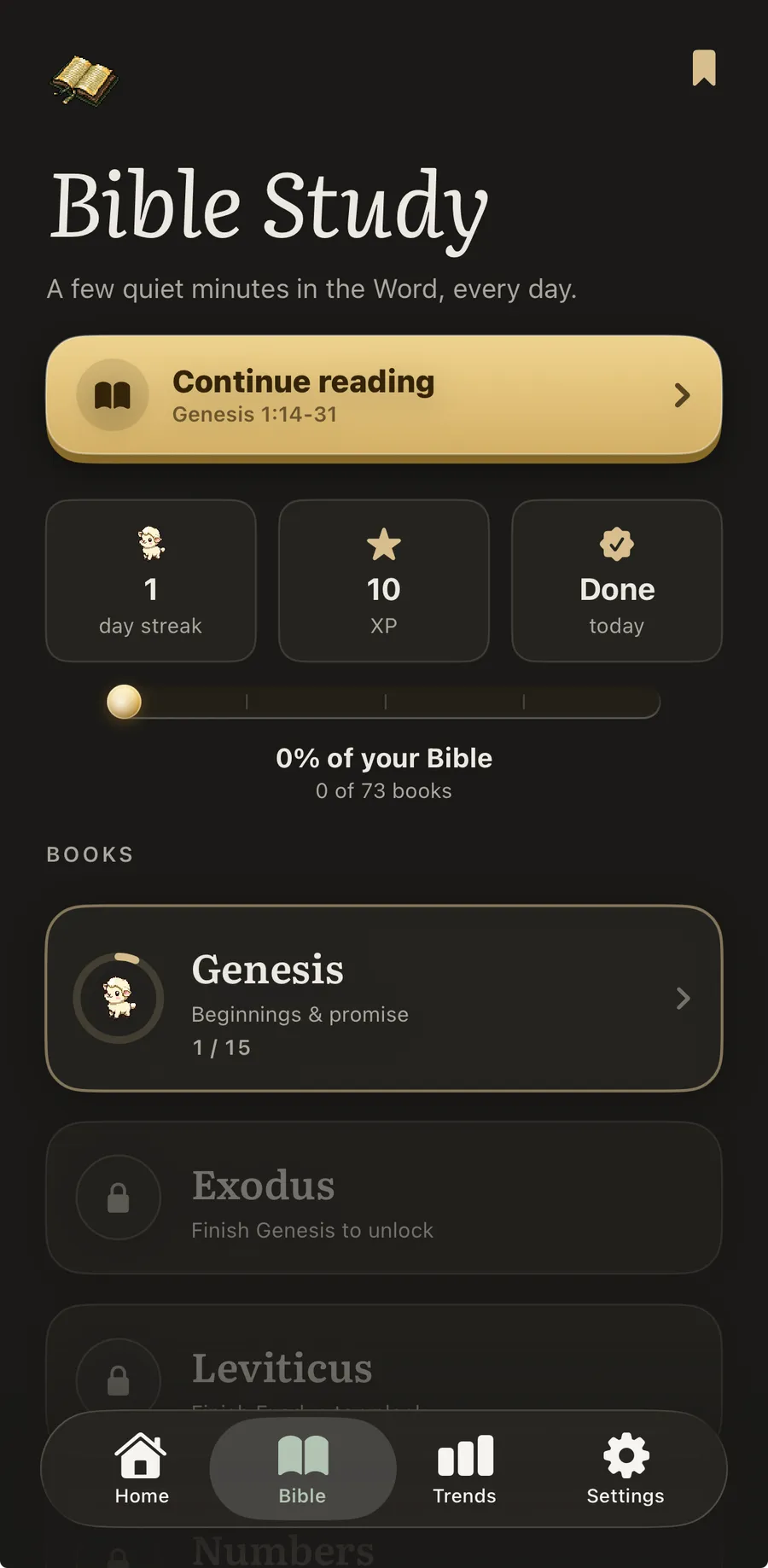
Knowing which scene to read is most of what makes a decade easier, and it is the same with the Bible as a whole: the hard part is deciding where to open it. BlessUp takes that decision away. Each morning the day’s reading is already waiting, in the NABRE if you tell the app you are Catholic, on a plan that covers the Catholic canon in a year at about 10.3 minutes a day. Read the chapter and the apps you have chosen to shield open. See what day one looks like
How long it takes, and the one-decade version
Five decades usually takes somewhere around fifteen to twenty minutes. That is our estimate, and here is the arithmetic behind it. In the BMJ study each Hail Mary, said in Latin and split between a priest and a congregation, fitted within one slow breath, about six a minute. At that pace the fifty Hail Marys of the five decades take a little over eight minutes. The Creed, the Our Fathers, the Glory Bes, announcing each mystery and the closing prayer make up the rest. Reading the five passages first adds three to seven minutes. Praying alone in English, your pace will be your own.
If that is more than you have, pray one decade. Pick one mystery. Read its passage, which takes about a minute. Say one Our Father, ten Hail Marys and one Glory Be. That is a few minutes, and it is a complete prayer, not a lesser one. Many people build back up from a single decade a day.
A small daily prayer you keep is worth more than a long one you dread. That is the whole idea behind praying consistently: choose a size you can manage on a hard day. And when a day gets away from you, a missed day is not a failure. Pick the beads up tomorrow.
The US bishops note that the Rosary can be said privately or with a group, and many parishes pray it together before or after Mass. If you would like to pray it with others, our church finder lists churches in 54 US cities; a parish bulletin or website will usually say when.
Frequently asked questions
How long does it take to pray the Rosary?
Five decades usually takes around fifteen to twenty minutes at an unhurried pace, by our estimate; it depends on how quickly you pray and whether you read a Scripture passage before each decade. A single decade, with one Our Father, ten Hail Marys and a Glory Be, takes a few minutes.
Which mysteries do you pray on which day?
The US bishops give the traditional pattern as Joyful Mysteries on Mondays and Saturdays, Sorrowful on Tuesdays and Fridays, Glorious on Wednesdays and Sundays, and Luminous on Thursdays. On the Sundays of Advent the Joyful Mysteries are prayed, and on the Sundays of Lent the Sorrowful.
Can you pray the Rosary without beads?
Yes. John Paul II described the beads as the traditional aid for the Rosary and, at the simplest level, a way of counting the Hail Marys. Ten fingers count a decade just as well. The prayers and the mystery you are thinking about are the Rosary; the beads help you keep your place.
Can Protestants pray the Rosary?
The Rosary is a Catholic devotion, and nothing stops any Christian from praying it. Its Our Father and the first half of the Hail Mary are taken from the Gospels, and most of its mysteries are Gospel scenes. Protestant traditions differ on asking Mary to pray for us, which the second half of the Hail Mary does, so it is worth talking with your own pastor.
What do you think about while praying the Rosary?
The mystery for that decade, not the individual words. John Paul II suggested reading a related Bible passage after announcing the mystery, pausing briefly in silence, and then letting the scene stay in your mind while you say the ten Hail Marys. When your mind wanders, return to the scene.
Read the scene, then pray the decade.
No guilt. Ever. Grace is built in. Funded by readers, never by ads.