How to Make Time for God
By Dom · · 11 min read
It is 9:40 at night. The kids are down, the dishes are mostly done, and you finally sit. The Bible is on the shelf across the room. Your phone is already in your hand. You meant to get to the Bible today, and yesterday, and you have been told the answer is to get up earlier. You tried that. It lasted about a week.
The trouble with most advice on how to make time for God is that it never says how much time. So the ask feels endless, and an endless ask is easy to put off. This post starts with the number, then looks at where those minutes could honestly come from.
Key takeaways
- About nine minutes a day reads the Protestant Bible cover to cover in a year. The Catholic and Orthodox canons take about 10.3 and 10.9 minutes.
- You rarely find nine spare minutes. You trade them, and the easiest place to trade from is usually the phone.
- Pick a slot for how it holds on a bad day, not how it looks on a good one. A slot tied to something you already do beats a new alarm.
- Judge a new slot at about two months, not two weeks. In the habit studies that timed it, median times ran 59 to 66 days.
- A missed day does not undo the habit. Research on habit formation found an occasional miss did not seriously set it back.
How much time are we actually talking about
Most pages on making time for God stop at "make it a priority." That leaves the size of the ask blank, and a blank ask always feels bigger than it is. So here is a real figure.
Reading the Protestant Bible in a year takes about nine minutes a day. That is not a rounded-down marketing number. It comes from the real word count of the canon, spread across 365 days, at a normal reading pace of 220 words a minute. The Catholic canon is longer and takes about 10.3 minutes a day. The Orthodox canon takes about 10.9. The full working, book by book, is in how long it takes to read the Bible in a year.
Nine minutes is not the only way to spend time with God. Prayer, worship and quiet all count, and some days you will want more. But it is a useful floor. It is small enough to test against your actual day, and big enough to carry you from Genesis to Revelation by next autumn.
If you are not reading much right now, you are in large company. Pew Research Center's Religious Landscape Study, a survey of US adults in 2023 and 2024, found that 22% read scripture outside religious services at least once a week, and 61% seldom or never do. That is not a verdict on anyone. It is a picture of how hard it is for most people to fit reading into a modern day.
Where the time currently goes
Before you can move nine minutes, it helps to know where they are sitting now. Guesses are not much use here. Most of us are wrong about our own habits in both directions.
Your phone already keeps the record. On an iPhone, Settings then Screen Time shows your daily average, your most-used apps and how many times you picked the phone up. Pew Research Center's 2025 survey of 5,022 US adults found that 91% own a smartphone, so for nearly everyone reading this, that record exists. We walk through reading it in how much time you actually spend on your phone.
You are not looking for a number to feel bad about. You are looking for one ordinary nine-minute stretch that already happens every day. For most people it is there, often more than once.
You do not find time, you trade it
"Find time" suggests there is a hidden gap in your day, waiting to be discovered. For a parent, a shift worker or anyone caring for someone, there usually is not. The day is full. Adding a new block on top of a full day is why the early alarm lasted a week.
Trading is different. You take nine minutes that are already being spent on something, and spend them on this instead. Nothing new is added. Something small is swapped.
The phone is the honest place to trade from, for two reasons. First, it is where most people genuinely have loose minutes. Second, the minutes on it are the easiest to give up, because they were rarely chosen in the first place. Nobody plans the second scroll of the morning.
The table below turns nine minutes into the currencies you already hold, and rates each one the way it matters: on a bad day.
| Where the nine minutes come from | How it holds on a bad day | What tends to take it back |
|---|---|---|
| The first scroll after the alarm | Strong. It happens every day, tired or not. | Opening the phone "for a second" first |
| The gap between waking and getting up | Strong, if the Bible or reading is within reach of the bed | Snoozing, or a child up early |
| A third of a commute, as a passenger | Medium. Gone on days you drive or work from home. | Crowded trains, calls, a change of route |
| Half a coffee or lunch break | Medium. Breaks get eaten when work runs over. | Colleagues, errands, a late meeting |
| The last scroll before sleep | Weak. It is the most tired you will be all day. | Falling asleep, or scrolling past the point |
Choosing a slot that survives a bad day
Most people choose a time for how it looks on a good day. Six in the morning, coffee made, house quiet. Then the first bad week arrives, with a sick child or a late shift, and the ideal slot is the first thing to go.
Choose the other way round. Picture your worst ordinary day from the last month, and ask which slot would still have happened. That is your slot, even if it is less lovely. A slot that holds on a bad day will hold on every day.
For many people that turns out to be the moment the phone first comes off the charger, because that moment happens every day without exception. If morning is not possible for you at all, that is fine. We weigh the options in the best time of day to read the Bible.
It also helps to decide what you will read before the slot arrives. Minutes spent choosing are minutes not spent reading. If your slot is short, what to read when you only have ten minutes has four options that fit.
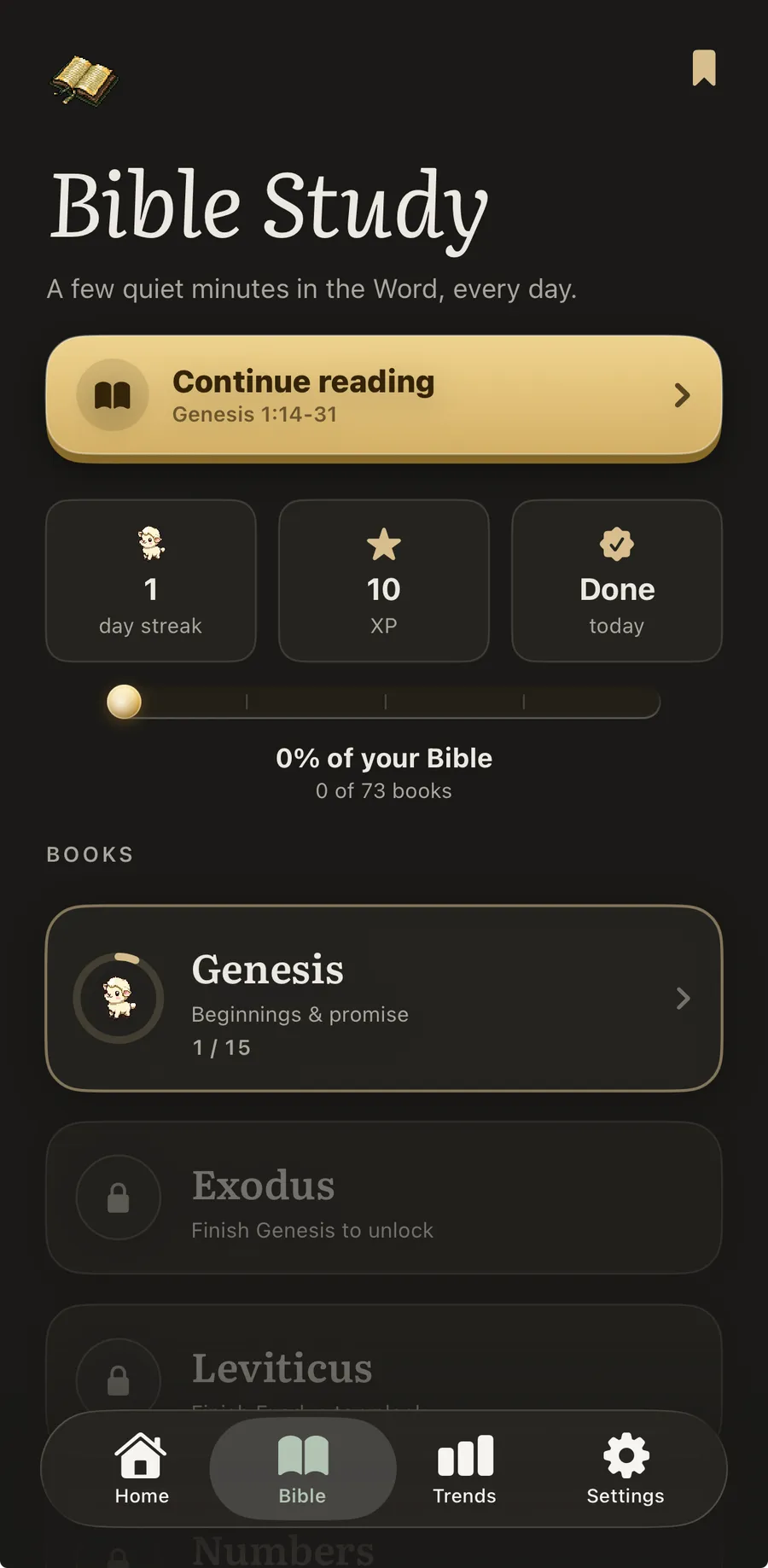
You have seen the number: 1,986 words a day on the Protestant plan, about nine minutes, a little more for the Catholic and Orthodox canons. BlessUp does that sum for your tradition and has the day's portion waiting, so none of the nine minutes goes to deciding what to read. It shields the apps you pick until the chapter is read, which turns the first scroll into the slot, and a missed day is covered by a grace day. See what nine minutes a day looks like
Attach it to something you already do
A time on the clock is a weak trigger. A moment you already live through is a strong one.
This is not only folk wisdom. In a review of habit research in the British Journal of General Practice, Benjamin Gardner, Phillippa Lally and Jane Wardle describe habits as actions set off automatically by a cue in the setting, like washing your hands after using the toilet, or putting on a seatbelt after getting into the car. Repeat the action after the same cue, and the cue starts to do the remembering for you.
So instead of "I will read at 6:30," try one of these:
- After I pour my first coffee, I read the day's chapter before I sit down with anything else.
- When I take my phone off the charger, the Bible app is the first thing I open.
- When I get on the train, I read before I check messages.
- After the kids are in the car, I read in the parking lot before I drive to work.
Pick one cue, not four. The best cue is one that already happens every single day, in the same place.

What to do with the week it falls apart
It will fall apart some weeks. Children get sick. Travel moves every cue you had. This is not a sign that you were never serious. It is ordinary life.
Two findings help here. First, habits take longer than most advice admits. A 2024 systematic review of 20 studies with 2,601 adults found that of the four studies that timed habit formation, median times ran from 59 to 66 days, with individuals ranging from 4 to 335 days. Those studies were about health habits like exercise and eating, not prayer or Scripture. Still, the lesson carries: judge a new slot at two months, not two weeks.
Second, a miss is not a reset. Gardner, Lally and Wardle report that missing the occasional chance to do the behavior did not seriously impair the habit. The day after a miss, you do the next reading. You do not go back and make up the gap, and you do not start the plan over. We explain why this matters in how grace days keep a reading habit alive.
There is an old prayer for this, and it is not a scheduling trick. In Psalm 90:12 Moses asks, "Teach us to number our days, that we may gain a heart of wisdom" (NIV). The psalm is about how short a life is, and it asks God for the wisdom to see the days as they are. Nine minutes will not solve a full life. But asking to see your day honestly, and then giving a small part of it back, is a prayer you can pray on the worst day of the week.
If you would like help setting up a rhythm that fits your family or your work, your pastor is a good person to ask. We build tools; they know you. Common questions about how the app handles all this are on our FAQ page, and more posts on building a daily practice are collected under spiritual discipline.
Frequently asked questions
How much time should I spend with God each day?
There is no required amount, and Scripture does not set one. A useful floor is about nine minutes a day, which is what it takes to read the Protestant Bible in a year at a normal reading pace. The Catholic and Orthodox canons take about 10 to 11 minutes. Prayer and quiet can sit on top of that whenever you have more.
How do I make time for God when I have no time?
Trade time rather than trying to find it. Look at your phone's Screen Time report for one ordinary nine-minute stretch that already happens every day, such as the first scroll after the alarm, and spend it on reading instead. Tie it to a cue you already live through, like pouring your first coffee.
Is it okay to spend only a few minutes with God?
Yes. A few minutes kept every day is worth more than an hour that happens once a month. Habit research suggests consistency matters more than length for making a practice stick, and a short slot is much more likely to survive a hard week.
What is the best time of day to read the Bible?
The best time is the one that still happens on your worst ordinary day. For many people that is the first time they pick up their phone in the morning, because it happens every day without exception. If mornings are impossible, a lunch break or commute works too.
How long does it take to read the Bible in a year?
About nine minutes a day for the Protestant Bible, based on its real word count spread across 365 days at 220 words a minute. The Catholic canon takes about 10.3 minutes a day and the Orthodox canon about 10.9.
Genesis to Revelation, about nine minutes at a time. Start tomorrow morning.
No guilt. Ever. Grace is built in. Funded by readers, never by ads.