Which Bible Translation Should You Read?
By Dom · · 8 min read
You are standing in front of a shelf, or a dropdown menu, and there are nine of them. NIV, ESV, NASB, NLT, KJV, CSB, NRSV, NKJV, The Message. They are all the Bible. They are visibly not the same words.
The good news is that the choice is much lower stakes than the shelf makes it look. The better news is that there is one question underneath it that actually decides the answer, and it is not which translation is most accurate.
Key takeaways
- Every mainstream English Bible is accurate. They differ on whether to preserve the original wording or the original meaning when both are impossible.
- NASB and ESV sit at the word-for-word end; NLT at the thought-for-thought end. NIV and CSB sit in the middle, which is why they are the usual first Bible.
- The Message is a paraphrase, not a translation. Good alongside another version, wrong as your only one.
- Your tradition narrows the field first: NABRE for US Catholic readers, NKJV for Orthodox study Bibles, a wide field for Protestants.
- Among American Bible readers, 55% preferred the KJV and 19% the NIV in the Bible in American Life study — the opposite of the sales figures.
There is one real question, and it is not accuracy
Every mainstream English Bible is translated by committees of scholars working from the same Hebrew, Aramaic and Greek manuscripts. None of them is inaccurate. What differs is what each committee decided to preserve when preserving everything was impossible.
Hebrew and Greek do not map onto English one word at a time. A translator constantly chooses between keeping the original sentence structure and keeping the original meaning obvious. Lean one way and you get a version that reads a little strangely but shows you the seams. Lean the other and you get a version that reads beautifully and has quietly made some interpretive decisions on your behalf.
That spectrum has names. Formal equivalence means word-for-word. Dynamic or functional equivalence means thought-for-thought. Almost every English Bible sits somewhere between the two poles rather than at one of them.
The spectrum, with real examples
| Translation | Philosophy | Best for |
|---|---|---|
| NASB | The most word-for-word translation widely available | Close study, tracing a repeated word |
| ESV | Formal equivalence | Study and preaching; widely used in Reformed churches |
| KJV / NKJV | Word-for-word, 1611 and its modernised revision | Memorisation, familiar cadence, public reading |
| NRSV | Blend of meaning-based and form-based | Academic work; common in mainline and ecumenical settings |
| NABRE | Revised toward formal translation | Catholic readers; the US lectionary translation |
| NIV | Blend of form-based and meaning-based | General reading, church use, a first Bible |
| CSB | Balance of word-for-word and thought-for-thought | Daily reading; written to a seventh-grade level |
| NLT | Meaning-based | Reading long stretches; anyone stalled by formal English |
| The Message | A paraphrase, not a translation | Alongside another version, never as your only one |
The last row matters. The American Bible Society is explicit that The Message is a paraphrase attempting to capture the tone, rhythm and idiom of the original rather than a direct translation. It can be wonderful. It should not be the version you check a disputed verse against.
What people actually read, which is not what sells
There is a persistent gap between the two. The Bible in American Life study, run by the Center for the Study of Religion and American Culture at Indiana University–Purdue University Indianapolis and reported by Lifeway Research in 2014, found that among American Bible readers 55% preferred the King James Version and 19% the NIV — while booksellers had long assumed the NIV was dominant because it outsold everything.
The same study found a difference in how the two get used: 70% of NIV readers read weekly, against 54% of KJV readers. Read one way that is a comment on language; read another it is a comment on what a Bible is for. A version you revere and a version you read are allowed to be different books on the same shelf.

Your tradition narrows the field before you do
This is the part general comparison articles usually skip, and for many readers it settles the question.
- Catholic readers need a translation that includes the deuterocanonical books and carries an imprimatur. In the United States that is normally the NABRE, which is what you hear read at Mass. The NRSV Catholic Edition and the Jerusalem Bible are also standard.
- Orthodox readers generally use the NKJV as the base text for English-language study Bibles, with the Septuagint standing behind the Old Testament rather than the Hebrew Masoretic text.
- Protestant readers have the widest field: NIV, ESV, CSB, NLT, NKJV and NASB are all in common use, often varying congregation by congregation.
None of this is a ranking. The canon itself differs between traditions, which is a larger question than wording — what is actually different between the Protestant, Catholic and Orthodox Bibles works through which books each includes and why.
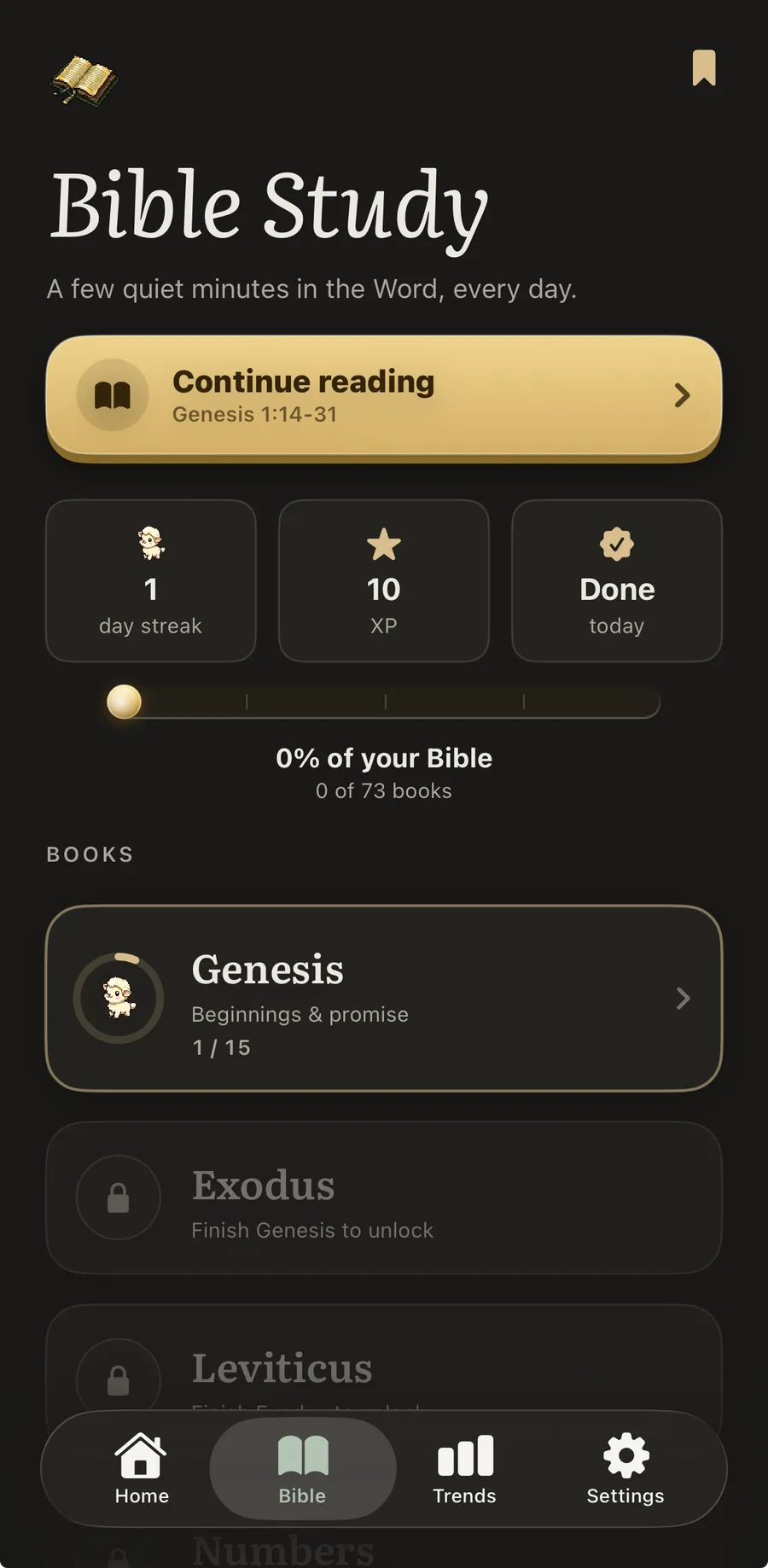
The version you never open is not more accurate than the one you read. If picking has become the thing standing between you and the reading, take that decision off the table: BlessUp ships five translations, pre-selects one to match your tradition, and shields the apps you choose until the day’s portion is read. About nine minutes, in whichever English you find easiest to follow. See the translations it carries.
So which one
Four honest recommendations, by what you are actually trying to do.
- A first Bible, or a return after years away: NIV or CSB. Both sit in the middle of the spectrum, both read cleanly aloud, and neither will strand you in a sentence you have to reread three times.
- Reading long stretches, or reading with children: NLT. If a cover-to-cover plan has stalled in Leviticus twice, the friction may genuinely be the prose.
- Study, or tracing a word through a book: ESV or NASB. Word-for-word translation is what makes a repeated Hebrew term visible in English.
- Memorisation and public reading: KJV or NKJV. The rhythm is doing real work, and most of the verses you already half-know are in this cadence.
Reading one verse in several translations is also the first step of verse-mapping, one of the Bible study methods we compare side by side.
The strongest setup is two: one you read and one you check against, one from each end of the spectrum. Comparing the same passage in both is the fastest way to see where a translator made a choice. If you are still deciding what to read rather than which version to read it in, where to start reading the Bible is the more useful question, and a beginner’s reading plan covers the pace.
What the translation does not change
What a translation can flatten, though, is a distinction the original keeps. the two Greek words behind “patience” is a clear case: English prints one word where the New Testament uses two, and they do not mean the same thing.
The reading itself. The American Bible Society’s State of the Bible 2026 — 2,649 interviews with US adults fielded 8–27 January 2026 by NORC at the University of Chicago — found a quarter of Americans are active Bible users, and that the group open and curious about Scripture has grown by nine million people in two years. Nobody in that group is held back by their translation.
We are app builders rather than pastors, so for anything doctrinal here the right question goes to your own pastor or parish, who will also tell you which version your congregation reads. On the practical question, 2 Timothy 3:16 calls all Scripture God-breathed and useful (NIV), and it makes no mention of a preferred edition. Pick the one you will open tomorrow, and the BlessUp FAQ covers switching later without losing what you have read.
Frequently asked questions
Which Bible translation is the most accurate?
All mainstream English translations are accurate; they are made by committees of scholars from the same Hebrew, Aramaic and Greek manuscripts. The NASB is generally described as the most word-for-word, which makes it useful for close study, but word-for-word is not the same as more accurate. A thought-for-thought translation can convey a sentence's meaning more faithfully in English than a literal rendering does.
What is the difference between word-for-word and thought-for-thought translation?
Word-for-word, or formal equivalence, keeps the original sentence structure and word choices as closely as English allows. Thought-for-thought, or dynamic and functional equivalence, asks how the original meaning would be expressed naturally today. Formal versions show you more of the seams; functional versions read more easily and make more interpretive decisions for you.
Which Bible translation should a beginner read?
The NIV or the CSB. Both sit in the middle of the translation spectrum, both read cleanly aloud, and neither uses sentence structures that need rereading. If a reading plan has stalled twice on the prose itself, the NLT is easier again. Catholic readers starting out should use the NABRE, which is the translation read at Mass in the United States.
Which translation do Catholic and Orthodox readers use?
In the United States, Catholic readers normally use the NABRE, the translation used in the lectionary; the NRSV Catholic Edition and the Jerusalem Bible are also standard. English-language Orthodox study Bibles generally use the NKJV as their base text, with the Septuagint behind the Old Testament rather than the Hebrew Masoretic text.
Should I read more than one Bible translation?
Two is a strong setup: one you read regularly and one from the other end of the spectrum to check against. Comparing the same passage in a word-for-word and a thought-for-thought version is the quickest way to see where a translator made a choice. It is not necessary, and one version you actually open beats two you own.
Your tradition, your canon, your translation. BlessUp is free to download.
No guilt. Ever. Grace is built in. Funded by readers, never by ads.