Bible Verses About Loneliness
By Dom · · 12 min read
You can be lonely in a full house, and you can be lonely in a church on a Sunday with people you like. Which is why the usual page of verses — twelve promises that you are never truly alone — often reads like an argument with something you did not say.
Scripture handles this better than its highlight reel does. It names loneliness before answering it, takes the body seriously first, and its answer is more often a person than a feeling. Here are twelve passages, what each is for, and when each lands badly.
Key takeaways
- The first thing God calls “not good” in the Bible is a person being alone (Genesis 2:18) — before anything in the story has gone wrong. Loneliness is not a symptom of weak faith.
- Psalm 25:16 asks directly: “Turn to me and be gracious to me, for I am lonely and afflicted.” Scripture gives the condition words before it gives it answers.
- When Elijah said “I am the only one left,” God’s first response was food and sleep, twice. The correction came fourth, not first (1 Kings 19).
- Scripture’s usual remedy is other people: “God sets the lonely in families” (Psalm 68:6). Jesus asked three friends to stay awake with Him.
- The U.S. Surgeon General’s advisory reports social isolation raises the risk of premature death by 29%. This is a health matter as well as a spiritual one.
Loneliness is not a sin, and Scripture says so on page two
The first thing God calls “not good” in the Bible is not a wrong act. It is a person being by himself.
Genesis 2:18: “It is not good for the man to be alone. I will make a helper suitable for him” (NIV). That sentence comes before anything has gone wrong in the story — before disobedience, before shame, before anyone is hiding from anyone. Loneliness is diagnosed as a problem in a world where nothing else is yet.
That matters, because the quiet fear underneath a lot of Christian loneliness is that it is a symptom — that someone who really trusted God would not feel this. Genesis answers plainly: the not-goodness of being alone is God’s own assessment, about a man in a garden on perfectly good terms with Him.

The verse most lists leave out
Pages of loneliness verses tend to open with a promise. The Psalms open with a request.
Psalm 25:16–17: “Turn to me and be gracious to me, for I am lonely and afflicted. Relieve the troubles of my heart and free me from my anguish” (NIV). No reframing. No reminder that he is technically never alone. He names the condition and asks for it to change.
Psalm 142:4 goes further: “Look and see, there is no one at my right hand; no one is concerned for me. I have no refuge; no one cares for my life.” Almost certainly an overstatement. Also in the Bible, unedited, with no footnote correcting it. Scripture gives loneliness its own vocabulary before it gives it any answers, a courtesy most verse lists skip.
What God actually did for the loneliest man in the Old Testament
Elijah has just won. Carmel is over, the drought has broken, and he is running for his life. A day into the desert he sits under a broom bush and asks to die.
1 Kings 19:4: “I have had enough, Lord. Take my life; I am no better than my ancestors” (NIV). Later, twice, he says the line that names what he thinks his situation is: “I am the only one left” (1 Kings 19:10).
Read what happens next slowly. The order is the whole point.
- First he is allowed to sleep. An angel wakes him, tells him to eat, and he lies back down. Nobody explains anything.
- Then he is fed again. “Get up and eat, for the journey is too much for you” (1 Kings 19:5–7). Bread and water, twice, before a single word of counsel.
- Then he is asked what he is doing there, and allowed to give his whole speech — then allowed to give it again after the wind, the earthquake and the fire.
- Only last is he corrected, and the correction is factual: “Yet I reserve seven thousand in Israel” (1 Kings 19:18). He was wrong about being the only one. He was not told off for feeling it.
If you are trying to help someone lonely, that sequence beats any verse list: body first, presence second, information last. And if you are the lonely one, notice the correction came fourth. “You’re not really alone” is true — and it is what God said after the food, the sleep and the listening.
Twelve passages, and what each one is actually for
Verses are not interchangeable. What steadies someone in month six of an isolating season can be the wrong thing to hand them in week one — the same problem we hit writing about the passages people reach for in anxiety. The verse is rarely wrong; the timing usually is.
| Passage | What it does | When it lands |
|---|---|---|
| Genesis 2:18 | Names being alone as “not good” | When you suspect the feeling is a personal failing |
| Psalm 25:16–17 | Gives you words to ask with | When you cannot describe it to anyone |
| Psalm 142:1–4 | Permits the overstatement | At the worst of it, when nothing feels proportionate |
| Psalm 68:5–6 | Says God’s remedy is a household | When you are deciding whether to go somewhere |
| 1 Kings 19:4–18 | Shows the order of care: food, rest, listening, truth | When you are exhausted, not just alone |
| Deuteronomy 31:6 | Promises God’s presence, not company | Before something you have to do by yourself |
| Hebrews 13:5 | “Never will I leave you” | Steady ground, most days — too early on the hardest ones |
| Isaiah 41:10 | Addresses fear underneath the isolation | When alone has started to mean unsafe |
| John 14:18 | “I will not leave you as orphans” | When the loneliness is grief-shaped |
| Mark 14:32–42 | Shows Jesus asking friends to stay | When asking for company feels like weakness |
| Romans 8:38–39 | Sets the outer limit: nothing separates | Late, as ballast rather than first aid |
| Ecclesiastes 4:9–12 | Argues plainly that two is better than one | When you are talking yourself out of reaching out |
Jesus was lonely, and He asked for company
In Gethsemane He takes three friends further in than the rest and asks them to stay awake. They fall asleep. He comes back and says, “Simon, are you asleep? Couldn’t you keep watch for one hour?” (Mark 14:37, NIV).
A small scene doing something large. The Son of God, the night before the crucifixion, with unbroken access to the Father, wanted people in the room — asked out loud, and said so when it did not happen. Wanting human company is not a lower-grade need a mature faith outgrows. If closeness with God were sufficient alone, Gethsemane would read very differently.
Why “you are never alone” is true and still not enough
Both sit in the same book, and neither cancels the other. Hebrews 13:5 quotes God directly: “Never will I leave you; never will I forsake you” (NIV). Deuteronomy 31:6 says it earlier and almost identically. These are real promises, not consolation prizes. But read closely, they promise presence. They do not promise that the ache lifts, and they do not promise people.
Handing that verse over as though it settles the matter answers a theological question the lonely person may not have been asking. Genesis 2:18 is still true on the same page. It is the same tension as praying when you don’t feel it: the promise holds whether or not the feeling arrives, and pretending the feeling does not matter helps nobody.
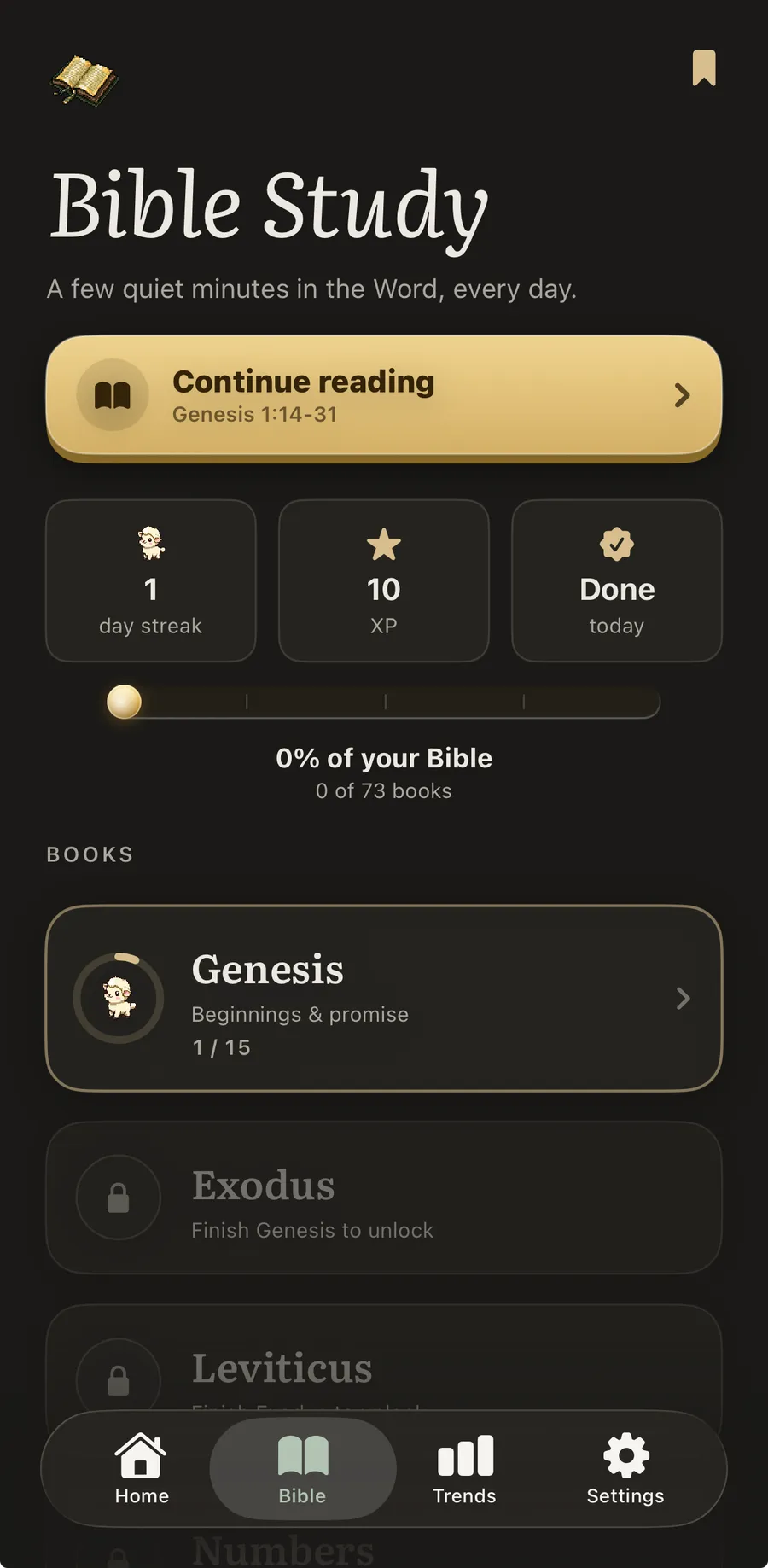
None of this is fixed by an app, and it would be dishonest to suggest otherwise. What a phone can do is smaller and still worth something: keep one thing steady on the days you do not want to do anything at all. BlessUp holds your place in a reading plan and asks two questions about how you are before it hands you anything, so a hard fortnight does not end with you back at Genesis 1 feeling further behind. Connection grows the way anything grows — a little, daily, with grace. BlessUp is on the App Store.
Scripture’s usual answer to loneliness is people
Psalm 68:5–6 is the clearest statement of it: “A father to the fatherless, a defender of widows, is God in his holy dwelling. God sets the lonely in families” (NIV). Not comforts the lonely. Sets them somewhere, with other people in it.
That is an uncomfortable finding for an article, since reading one is the opposite of it. But it is what the text keeps doing. God’s answer to Adam is another person. His answer to Elijah is seven thousand of them. His answer to the fatherless is a household.
The research points the same way, with the usual caution that none of it proves cause. The U.S. Surgeon General’s social connection advisory reports that social isolation raises the risk of premature death by 29%, and that adults who often feel lonely are more than twice as likely to develop depression. A Pew Research Center analysis of World Values Survey data across 26 countries found 36% of actively religious American adults describe themselves as very happy, against 25% of inactive and unaffiliated adults — while stating outright that the numbers “do not prove that going to religious services is directly responsible for improving people’s lives.” American Bible Society research, from 2,506 interviews with NORC at the University of Chicago, reports Scripture-engaged adults are 50% less likely than Bible-disengaged adults to report high loneliness. Read that as an association running both ways: people who are less lonely also have more capacity to read.
One honest caveat, from the other side. A 2004 Gallup survey of 1,002 U.S. church members found only 39% said their best friend attended the same church. Being in a building with people is not the same as being known by them, and a year of attendance can pass without either. If you are starting from nothing, how to find a church in a new city covers the search, and our church finder lists congregations across 54 US cities.
A short practice for a lonely week
Three things, in order, none of which require feeling better first.
- Pray Psalm 25:16 as written. Out loud, in the first person, without softening it. It is already a complaint; you do not need to add a disclaimer.
- Do the Elijah order on yourself. Eat something. Sleep. Only then decide what your situation means. Conclusions reached at 1 a.m. on an empty stomach are not data.
- Send one message. Not a plan, not a confession — one message to one person, arranging one specific thing. Ecclesiastes 4:9 is a recommendation, not a sentiment.
And if a bad week has already broken a routine you cared about, what to do when you miss a day covers that. The short version: you do not owe anyone a catch-up.
One boundary worth naming. Loneliness and depression overlap without being the same thing, and a verse list is not treatment for either. If this has been heavy for weeks, or if you are having thoughts of harming yourself, talk to a doctor, or call or text 988 in the US for the Suicide and Crisis Lifeline. Scripture and a clinician are not competing options.
Frequently asked questions
What does the Bible say about loneliness?
It names it as a real condition rather than a failure. Genesis 2:18 has God calling it "not good" for a person to be alone, before anything in the story has gone wrong. Psalm 25:16 and Psalm 142:4 give the feeling direct language. Scripture’s usual remedy is other people: Psalm 68:6 says God "sets the lonely in families."
Is it a sin to feel lonely?
No. Genesis 2:18 records God calling it not good for the man to be alone, in a setting where nothing else was wrong. In Gethsemane, Jesus asked three friends to stay awake with Him. Wanting human company is not a weakness a mature faith outgrows.
Which psalm is about loneliness?
Psalm 25 is the most direct: verse 16 reads "Turn to me and be gracious to me, for I am lonely and afflicted." Psalm 142:4 is the bleakest, with "no one is concerned for me... no one cares for my life." Psalm 68:5–6 is the one that answers, describing God as a father to the fatherless who sets the lonely in families.
Does the Bible promise God will take the loneliness away?
It promises presence, which is not quite the same thing. Hebrews 13:5 and Deuteronomy 31:6 both record God saying He will never leave or forsake His people. Neither promises that the ache lifts, or that company arrives. That is why "you are never alone" is a real comfort and rarely a complete one.
Can reading the Bible help with loneliness?
The association is there, though it does not establish cause. American Bible Society research, from 2,506 interviews with NORC at the University of Chicago, reports that Scripture-engaged adults are 50% less likely than Bible-disengaged adults to report high loneliness. That likely runs both ways. Reading is not a substitute for people or for medical care.
Small daily readings, cover to cover. That is the whole plan.
No guilt. Ever. Grace is built in. Funded by readers, never by ads.